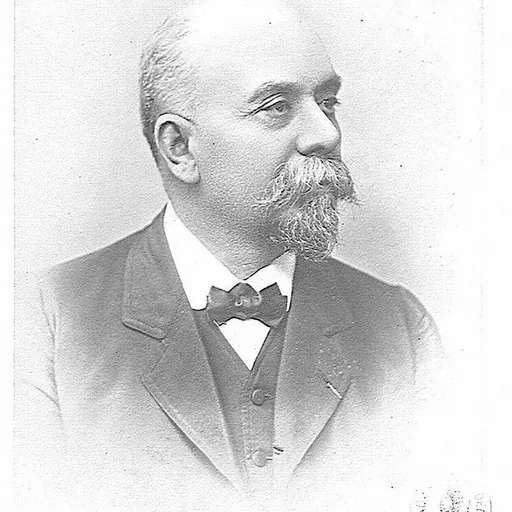
Emmanuel Régis
French neurologist, professor of psychiatry at Bordeaux University
About Emmanuel Régis
Lived 1855 – 1918 (aged 63). Emmanuel Régis was a French neurologist, university teacher, physician and psychiatrist.
Emmanuel Régis (1855–1918) was a French neuropsychiatrist and professor at the Faculty of Medicine in Bordeaux, where he was the first holder of the clinical chair of mental diseases. He was one of the French pioneers of forensic and military psychiatry, and his Précis de Psychiatrie (Manual of Psychiatry) was published internationally.
Biography Emmanuel Jean Baptiste Joseph Régis, aka Emmanuel Régis, was born on 29 April 1855 in Auterive (Haute-Garonne) and died in Bordeaux (Gironde) on 21 June 1918. He was the son of Louis Régis, a doctor of medicine, and Marie Joséphine Gabrielle Apollonie Fornier de Lachaux. His elder brother was an artillery colonel and military writer, and his younger brother was a graduate of the École Normale Supérieure and a mathematician. He married Raymonde Henriette Marie Fournié (1856–1940) in Pamiers (Ariège).
Medical training Emmanuel Régis prepared for his baccalaureate in Paris at a religious school run by the Priests of Saint Anthony on Rue Saint Antoine, where his uncle, the prelate Canon Régis, had also been educated. He studied medicine at the University of Toulouse, where he graduated with honours from the School of Medicine. He continued his medical training in Paris as a hospital intern. His calling to psychiatry may be attributed to a cousin, Doctor Linas, a former intern at the Charenton asylum in Paris and inspector of the asylums of the Seine. He then served as chef de clinique (assistant professor) from 1881 to 1882 in the same department. Benjamin Ball, the holder of France's first chair in mental diseases, was himself a student of Ernest-Charles Lasègue (1816–1883) and Jacques Joseph Moreau de Tours (1804–1884), who was known for his treatise On Hashish and Mental Alienation. Ball had a major influence on Régis, particularly regarding his medical approach to psychiatry, based upon the postulate that biological and hereditary factors play a key role in the etiology of mental illnesses.
During his internship, Régis was named Laureate of the Medical-Psychological Society and received the Esquirol Award (1879) and the Annales Médico-Psychologiques Prize (1880) for a study published in 1878 entitled Dynamics or functional exaltation at the onset of progressive general paresis. In 1880, he defended his medical thesis on La folie à deux ou folie simultanée, A similar episode was to occur later in Bordeaux during the agrégation examination, pitting Régis' student, the neuropsychiatrist Jean Abadie, against the asylum psychiatrist Charles Perrens.
In 1882, Emmanuel Régis accepted a post at the Castel d'Andorte clinic in Le Bouscat, a suburb of Bordeaux. The attendees included healthcare professionals as well as lawyers, magistrates and philosophers. Régis also gave lectures in the faculties of law and arts, and foreign faculties sent specialists to him for training. Angelo Hesnard (1886–1969), a student of Régis, noted in his eulogy to him that "Régis’s academic work bestowed great honour on the University of Bordeaux". Comprising two rooms of six beds each (one for women and one for men), the ward was designed to hospitalise in dignified conditions the so-called "delusional patients at general hospitals" (délirants des hôpitaux). These patients presenting with acute and transient psychotic disorders could not be admitted to medical wards, where they "disturbed the peace of the wards". The creation of dedicated beds in the general hospital prevented them from being sent to an asylum, which Régis regarded as a “disgraceful measure”, and enabled medical students to be trained in appropriate conditions. Régis denounced the abusive isolation of the lunatics in asylums where they had no contact with the outside world, a policy that deprived “these patients of the nourishment they lack most, namely the emotional, moral and social bond with others, in other words, human intersubjectivity”. They opened wards dedicated to soldiers presenting with psychiatric disorders at the Bordeaux asylum in August 1914. This was to be Régis final post. Deeply affected by the death in action on 20 October 1917 of his son Jean, an aviation sergeant, he died on 20 June 1918, a few months before the end of the war. He served as president of the Bordeaux Society of Medicine and Surgery (1909) and was a member of several international societies of neurology and psychiatry (United Kingdom, Moscow and the United States). He was also actively involved in organising numerous congresses, serving as secretary-general of the 3rd National Congress of Public Assistance and Private Charity (1903) and president of the 12th Congress of Psychiatrists and Neurologists of France and French-speaking Countries (Grenoble, 1902). This work was translated into several languages and its second edition was honoured by the French Academy of Medicine. The manual served as the standard academic textbook on French psychiatry for decades.
From the time of his internship in the 1870s, Régis posited the then-controversial hypothesis that syphilis was the probable cause of general paresis. To corroborate this hypothesis, he published statistical analyses of series of patients hospitalised at the private psychiatric clinic Castel d’Andorte and Saint-André Hospital, showing that syphilitic infection was found in 85% of cases of general paresis.
The "autointoxication" model of psychosis
The study of delirium (confusion mentale) was to the fore in Régis' work. He helped to clarify the clinical picture of this syndrome, which was identified by Philippe Chaslin (1857–1923), by coining the term "onirism". In line with the work of Jacques Joseph Moreau de Tours and Benjamin Ball, the hypothesis of "auto-intoxication" is central to his aetiopathogenic model of psychiatric disorders. According to this model, psychotic disorders are induced by toxic factors of internal origin (“poisoning of the body by internal humours”) or external origin (infections), leading to the onset of “more or less acute episodes of delirium”.
The Précis de psychiatrie provides a detailed account of the research aimed at identifying these toxic substances by exploring “the composition, in the mentally ill, of various humours, secretions and excretions of the body: blood, gastric juice, saliva”. Régis underlined the fuzziness regarding the boundaries between the two diagnostic entities: “The difficulties in distinguishing between dementia praecox and periodic psychosis stem from the excessive scope attributed by some to dementia praecox, and by others to depressive madness [...]. The boundaries of each of these two psychoses are very poorly defined, and many cases are classified indiscriminately as one or the other depending on the author, or even by the same author at different times.” As early as 1897, he devised a plan for a municipal service offering free consultations for “abnormal children” in Bordeaux's state schools, which was officially established in 1900. The organisation in Bordeaux in June 1903 of the third National Congress of Public Assistance and Private Charity played a significant role in the project's subsequent development. Régis succeeded in convincing the school authorities that public state schools should take responsibility for the education of these children, which until then had been provided by private institutions. Régis established what he termed the “Work for Abnormal Children” (oeuvre de l'enfance anormale). This project was aimed at educating the “abnormal children” of the city of Bordeaux by creating classes within state schools tailored to their level of disability. More than 1,500 “abnormal children” were registered from 1906 onwards, following assessment by members of the medical-educational commission set up in for this purpose. The first two classes for boys opened in 1907, and the first class for girls in 1908. Following Régis' death, the project continued under the guidance of Jean Abadie. The guiding principle in his work was that the insanity of criminals should not overlooked, in order to prevent the “transformation of the lunatic into a defendant”. His studies of cases of regicide aimed to demonstrate that crimes committed could be attributed to pathological states during which the individual had no control over their actions—states requiring medical care rather than criminal punishment. A chapter on military psychiatry was included in the 3rd edition of the Précis de psychiatrie in 1906. The specialty of military neuropsychiatry was established around 1910 by the Ministry of the Navy thanks to the efforts of Régis and his students. In April, May and June 1913, Régis and Hesnard published three major articles in the psychiatric journal L'Encéphale on “The doctrine of Freud and his school: a general bibliographical and critical review”.
Hesnard and Régis were both laudatory and critical of Freudian theories. Régis' contribution to French psychoanalysis was also praised by his contemporaries, such as Professor (1862–1921), who wrote in 1913: “Having demonstrated the systematic excesses and methodological flaws of this doctrine, you have, as a fruitful critic and generous commentator, highlighted the interest and psychological significance of a theory which, thanks to you, will henceforth be preserved in France from the irony of sceptics and the disdain of the ignorant.”
Other works Régis was the author of numerous other works on the clinical characteristics of psychiatric disorders, including hysteria, neurasthenia, obsessions and impulses, delusional and hallucinatory themes, psychotrauma, psychiatric disorders secondary to other medical conditions, alcoholism, etc. He was also interested in the clinical descriptions of psychiatric disorders in Shakespeare's works and in Sarah Bernhardt's interpretation of the character of Hamlet, as well as in the psychopathology of Jean-Jacques Rousseau and Molière.
Tribute
In 1956, a special issue of the journal L'information Psychiatrique was dedicated to Emmanuel Régis. The issue included a comprehensive list of his works, as well as tributes from his student Angelo Hesnard and the psychiatrists Henri Ey and Paul Guiraud. Street (rue) Régis in Bordeaux
Don’t just read it —
keep it.
Full-length biographies made to live with: read them, listen on the way to work, watch them tonight.
- E-book
- Audio
- Video
Instant download · yours to keep · every purchase keeps this site free
Important facts
People in Emmanuel Régis's life
Named in this biography and alive at the same time




Related people
Same field, nearest in time

Contemporaries
People whose lives overlapped Emmanuel Régis's


Frequently asked questions
Who was Emmanuel Régis?
French neurologist, professor of psychiatry at Bordeaux University (1855-1918)
When was Emmanuel Régis born?
Emmanuel Régis was born on 29 April 1855 in Auterive.
When did Emmanuel Régis die?
Emmanuel Régis died on 21 June 1918 in Bordeaux.
What was Emmanuel Régis's occupation?
Emmanuel Régis was a neurologist, university teacher, physician and psychiatrist.
What nationality was Emmanuel Régis?
Emmanuel Régis was French.
Sources & further reading
Cite this page
APA: Biography.guide. (2026). Emmanuel Régis. https://biography.guide/emmanuel-regis/
MLA: "Emmanuel Régis." Biography.guide, https://biography.guide/emmanuel-regis/.
Chicago: "Emmanuel Régis." Biography.guide. https://biography.guide/emmanuel-regis/.
Data last updated: 2026-09-20 · Spot an error? Report a correction.
Page generated 2026-09-27 05:10 UTC