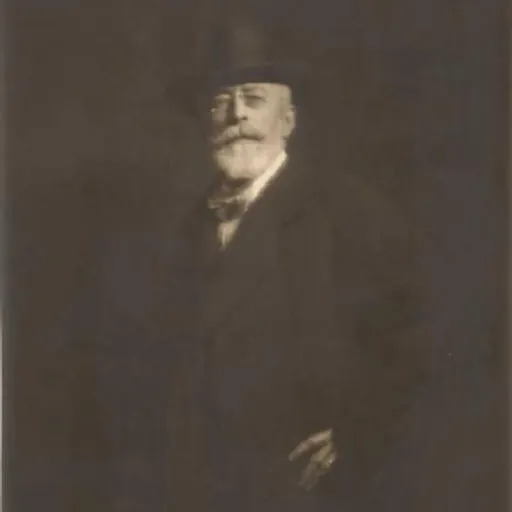
About Emilio Gola
Lived 1851 – 1923 (aged 71–72). Emilio Gola was an Italian painter, watercolorist and pastellist.
Emilio Gola (22 February 1851 – 21 December 1923) was an Italian Impressionist painter.
Biography Born in Milan, then part of the Austrian Empire, into a noble family, Gola was encouraged to develop his interest in art in his adolescence by his father, a dilettante painter. He graduated in industrial engineering from the Polytechnic University of Milan in 1873. He did not enrol at the Brera Academy, but took private lessons from Sebastiano De Albertis. At the same time he became interested in the works of Tranquillo Cremona and Daniele Ranzoni. His wealthy family background enabled him to make a series of visits to France, the Netherlands and England where he encountered the work of foreign artists.
Gola made his artistic début at the Brera Annual Exhibition in 1879 with a Study from Life and Head: Study from Life. His early work was already noted for its strong colour combinations and vigorous brushwork, as in the portrait of Contessa Gola, Mother of the Artist (c. 1882). Gola participated regularly in national exhibitions, but obtained his greatest official recognition at the European level. By the 1880s he was an esteemed portrait who depicted women of the Milanese nobility in their fashionable, worldly dimension but with a vigorously naturalistic approach. His portraits were accompanied by a rich repertoire of views of Milan and the countryside of Brianza in bright colours that were to constitute his stylistic hallmark. Active in the region of Liguria and Venice, he focused in his late period on seascapes distinguished by great formal synthesis and expressive intensity. One of his pupils was Alberto Malaspina.
Work Gola’s oeuvre can be divided principally by subject-matter: landscapes with figures, mostly executed in Brianza, such as Washerwoman (1898; Galleria d'Arte Moderna, Milan) and Landscape: The First Thaw (1892; priv. col.); the Milanese canals (St. Christopher’s Canal, c. 1890; Milan, Nuovo Banco Ambrosiano); seascapes, particularly of Alassio and the Venetian lagoon (Beach at Alassio, 1915–18; Milan, Galleria d'Arte Moderna, Milan); and portraits (Marchesa Emilia Sommi Picenardi, c. 1900, Rome, Galleria Nazionale d'Arte Moderna).
Gola was influenced by the work of the Scapigliati, particularly by their use of juxtaposed or superimposed brushstrokes to attain certain effects of light and colour. However, his subject-matter was different, his colours more brilliant, his brushwork freer, occasionally virtually ignoring form, and at times his figures seem carelessly positioned on the canvas. At his most successful, however, he could produce such splendidly original works as his several interpretations (in oil and watercolour) of the theme Washerwomen at Mondonico (e.g. ex-Chiesa priv. col., Milan).
Selected paintings
Don’t just read it —
keep it.
Full-length biographies made to live with: read them, listen on the way to work, watch them tonight.
- E-book
- Audio
- Video
Instant download · yours to keep · every purchase keeps this site free
Important facts
People in Emilio Gola's life
Named in this biography and alive at the same time




Related people
Same field, nearest in time
Contemporaries
People whose lives overlapped Emilio Gola's



Frequently asked questions
Who was Emilio Gola?
Italian painter (1851-1923)
When was Emilio Gola born?
Emilio Gola was born in 1851 in Milan.
When did Emilio Gola die?
Emilio Gola died in 1923 in Milan.
What was Emilio Gola's occupation?
Emilio Gola was a painter, watercolorist and pastellist.
What nationality was Emilio Gola?
Emilio Gola was Italian.
Sources & further reading
Cite this page
APA: Biography.guide. (2026). Emilio Gola. https://biography.guide/emilio-gola/
MLA: "Emilio Gola." Biography.guide, https://biography.guide/emilio-gola/.
Chicago: "Emilio Gola." Biography.guide. https://biography.guide/emilio-gola/.
Data last updated: 2026-09-20 · Spot an error? Report a correction.
Page generated 2026-09-27 05:10 UTC