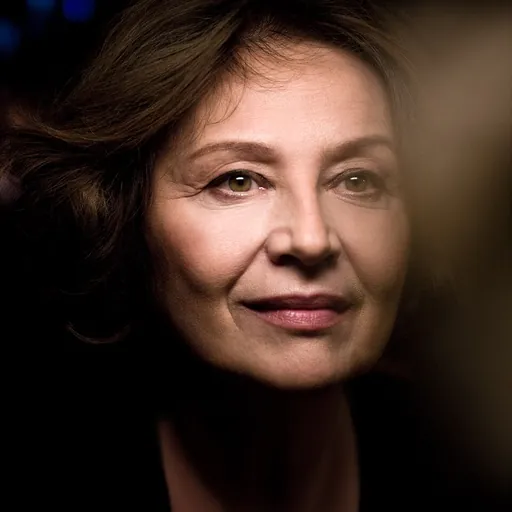
About Emília Vášáryová
Born 1942. Emília Vášáryová is a Czech and Slovak actor, stage actor and film actor.
Emília Vášáryová, Doctor Artis Dramaticae (hon.) (; born 18 May 1942) is a Slovak stage and screen actress, whom Variety and other publications refer to as the "First Lady of Slovak Theater". During a career of more than five decades, she has received numerous awards including Meritorious Artist, the Alfréd Radok Award (1996), the Czech Lion Award, the Golden Goblet Award (2008), and a 2010 ELSA award from the Czech Film and Television Academy (2010). Because her younger sister is former diplomat Magdaléna Vášáryová, the daily newspaper iDNES said fans consider her an "Honorary Consul of Czech and Slovak Relations".
Biography Early years
Vášáryová was born in Horná Štubňa, the First Slovak Republic. However, and along with younger sister Magdaléna (who also became a popular actor), she was raised in Banská Štiavnica, where both their parents taught. Her father, Jozef Vášáry was a member of a Hungarian noble family. He taught Slovak literature and grammar at a gymnasium. Her mother, Hermína, taught German.
As a child and young woman, Vášáryová participated in amateur theater and gymnastics. While at JSŠ high school in Štiavnica, she received a cameo role in the Slovak/Hungarian film St. Peter's Umbrella. She had an uncredited role as a servant girl with only one line, "I'm coming, I'm coming!".
1960s She hoped to study languages or art history at university, but she lacked the so-called "confidential files" (issued by Communist Party of Czechoslovakia). Eventually she was able to enroll at the Academy of Performing Arts in Bratislava to study theater.
During college she had supporting roles in two black-and-white films, Marching Is Not Always Fun (1960), and Midnight Mass (1962). The film Young Ages (1962) also marked her television debut. Her big break came when she was cast in the lead (as "Diana") in Vojtěch Jasný's The Cassandra Cat, in which a magic cat reveals the true nature of everyone he sees. It premiered at the 1963 Cannes Film Festival, taking two major awards, the C.S.T. Prize and Special Jury prize. The film also won awards at various international festivals in Spain, Greece, Colombia, and Italy.
In December 1963, A Face at the Window (directed by Peter Solan) opened with her cast alongside leads Ladislav Chudík and Štefan Kvietik, both of whom had a significant impact on her career. The following year Chudík invited her to join the ensemble of the Slovak National Theatre, over the objections of some of the senior actors who thought she was too young and inexperienced for such a prominent national stage. She did bring some experience to this opportunity, however, because she had previously spent one season at the Bratislava main stage New Scene. Thanks to the influence of Magda Husáková-Lokvencová, wife of Czech President Gustáv Husák, she appeared in four productions.
Her debut rule at the national playhouse was as Ophelia in Hamlet. In 1967 she received the Janko Borodáč award on the basis of two roles, Helena in Shakespeare's A Midsummer Night's Dream, and Florelle in Lope de Vega's comedy The Dancing Master. quote=I didn't want to be an actress, and so I'd cry out whole days – that's what Magda [sister] says at least. I don't much recall it yet. — Emília Vášáryová
Her other feature films include St. Elizabeth Square (1965), Master Executioner (1966), Trailer People (1966), The Dragon's Return (1967) and There's No Other Way (1968). During this period, Vášáryová also launched her television career, receiving Most Popular Actress in Brno in 1967, and winning the first edition of the national TV contest Golden Croc in 1968.
1970s Along with acting onstage (in Herodes and Herodias by Pavol Országh Hviezdoslav, Gorky's Vassa Zheleznova and The Last Ones, Palárik's Thanksgiving Adventure, the Sophocles play Antigone and Leo Tolstoy and Erwin Piscator's War and Peace, Vášáryová continued her television career, with roles in The Balade for the Seven Hanged (1968), Parisian Mohicans (1971), Noodledom (1971), The Shepherd Wife (1972), Monna Vanna (1973), and Impatient Heart (1974; in which her sister Magda co-starred). She was cast in several films, including Copper Tower, directed by Martin Hollý Jr. (who had collaborated with Vášáryová in The Balade for the Seven Hanged), which earned a Special Prize at the 21st Film Festival of Proletariats (FFP) in 1970. Martin Ťapák's The Day Which Does Not Die received various domestic awards for best director and best lead male actor for Štefan Kvietik).
The second half of the 70s was a successful period, and she performed strong roles in both film and theater. She played "Zuza" in Who Leaves in the Rain (directed by Martin Hollý Jr), and she received in Prague ZČDU Award for Best Actress at the 13th Festival of Czechoslovak Film (FČSF) in 1975.
Red Wine by Andrej Lettrich, who received the State Prize of Klement Gottwald for his direction, brought her much popularity on screen, and also on television where the drama was presented as a two-episode TV series. Another Lettrich film, The Lawyer, won the Best Film award at the 16th Festival of Czechoslovak Film (FČSF) in České Budějovice in 1978, and brought Vášáryová her second ZČDU Award at the 21st Karlovy Vary International Film Festival, where she also received the ÚV SZŽ Gold Plaque. She was also awarded the honorary title of Meritorious Artist.
1980s quote=Fame? Never. Neither at the times of much success, I would glorify my work. And that's why I don't want to watch my movies. — Emília Vášáryová It had now been almost eight years since her last appearance on the big screen, but she returned to major films, playing the part of "Silvia" in Red Gypsy (1992), directed by Branislav Mišík. Her role in Hazard (1995) was cast by Roman Petrenko (Czech director, not to be confused with the Russian media executive) making his directing debut. She co-starred in this film based on a true story with Marek Vašut. Tomáš Krnáč cast Vášáryová in his short film, The Higher Power (1996), playing the role of a diva diagnosed with a serious illness. In theater, she earned acclaim for her performance as "the Younger Sister" in the Thomas Bernhard play Ritter, Dene, Voss, presented at the Divadlo na Zábradlí Theatre in Prague in 1996. It earned the Best Play of 1996 award.
By the second half of the 'nineties Vášáryová was in her fifties, and successfully revived her legendary screen career. She began to engage more challenging roles. Following The Cage, she left television for almost a decade. She appeared in Martin Šulík's Orbis Pictus, and it was lauded at the International Filmfestival Mannheim-Heidelberg. Vášáryová played the role of mother. She starred in Eva Borušovičová's official debut Blue Heaven (1997), a film that was nominated at several festivals, including at the 32nd Karlovy Vary IFF, and at the independent Cinequest Film Festival held annually in San Jose, California. Return to Paradise Lost by Vojtěch Jasný was a Montréal WFF nominee. Her next picture, Cosy Dens (1999), was a comedy directed by Jan Hřebejk. Vášáryová became that young director's muse and canvas, starring for him throughout in the 2000s. In her stage work, she played the role of Agnes in the Edward Albee play, A Delicate Balance, and she received the Crystal Wing in 1999 as Best Artist in Theater/Film.
2000s
In the year 2000, for her 1999 role as the Old Woman in Ionesco's absurdist tragedy The Chairs, she received the Dosky Award, the Jozef Kroner Award. She also received the Literature Fund award. In 2001, Vášáryová won recognition from a national pool of Czech journalists who rated her as the "Actress of the Century". She acted in over ten stage roles during this period, performing as Maria Callas in Terrence McNally's Master Class, for which she received both the DOSKY and LitFond Awards in 2002. In 2009 she played the main role in Mother Courage and Her Children by Berthold Brecht and Paul Dessau, and in 2011 she was cast as Violet Weston in Tracy Letts' August: Lost in Oklahoma. For the role of Stevie Gray in Edward Albee's The Goat, or Who Is Sylvia? she received yet another DOSKY award in 2004. She also appeared in other local theatres, such as L&S Studio (Three Versions of Life in 2003, or Kingfisher in 2009) and GUnaGU Theater (Turn-away Side of the Moon in 2015). She also starred in stage productions in Prague, mostly working for the Studio DVA theater.
Her television work in the 2000s include a soap opera The Consulting Room at Pink Garden (2007), the series The Old Town's Crime Stories (2010), and a Czech TV movie, Picnic, directed by Hynek Bočan (2014).
Don’t just read it —
keep it.
Full-length biographies made to live with: read them, listen on the way to work, watch them tonight.
- E-book
- Audio
- Video
Instant download · yours to keep · every purchase keeps this site free
Important facts
People in Emília Vášáryová's life
Named in this biography and alive at the same time




Related people
Same field, nearest in time



Contemporaries
People whose lives overlapped Emília Vášáryová's


Frequently asked questions
Who is Emília Vášáryová?
Slovak actress
When was Emília Vášáryová born?
Emília Vášáryová was born on 18 May 1942 in Horná Štubňa.
What is Emília Vášáryová's occupation?
Emília Vášáryová is an actor, stage actor and film actor.
What nationality is Emília Vášáryová?
Emília Vášáryová is Czech and Slovak.
Sources & further reading
Cite this page
APA: Biography.guide. (2026). Emília Vášáryová. https://biography.guide/emilia-vasaryova/
MLA: "Emília Vášáryová." Biography.guide, https://biography.guide/emilia-vasaryova/.
Chicago: "Emília Vášáryová." Biography.guide. https://biography.guide/emilia-vasaryova/.
Data last updated: 2026-09-20 · Spot an error? Report a correction.
Portrait: Wikimedia Commons · author & licence
Page generated 2026-09-27 04:58 UTC