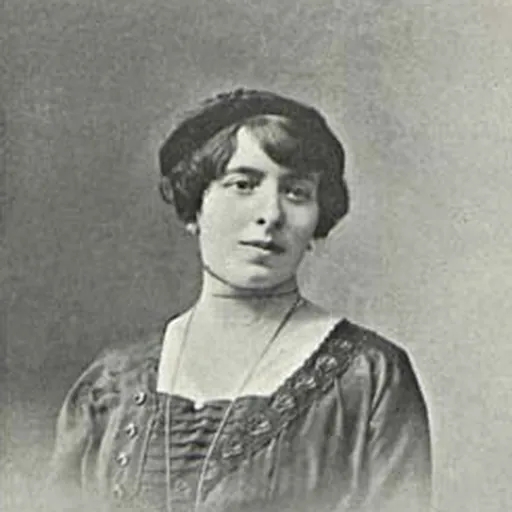
About Emília de Sousa Costa
Lived 1877 – 1959 (aged 81). Emília de Sousa Costa was a Portuguese writer and children's writer.
Emília de Sousa Costa (1877–1959) was a teacher who promoted female education, a writer of novels for both adults and children and a feminist. She is considered a pioneer of children's literature in the Portuguese language and also translated several stories by the Brothers Grimm into Portuguese.
Early life Emília da Piedade Teixeira Lopes de Sousa Costa was born in Lamego in the Viseu district of northern Portugal on 15 December 1877, to Colonel Luís Maria Teixeira Lopes and Maria do Pilar Pinto Cardoso. On 5 October 1904, she married the writer . They had three children, one of whom died at an early age. After marrying, they lived in Coimbra, where her husband completed his degree at the University of Coimbra, before moving to the Portuguese capital of Lisbon, where they were to remain until 1932, later moving to Porto. Emília de Sousa Costa was an early advocate for female education and one of the founders of the Caixa de Auxílio aos Estudantes Pobres do Sexo Feminino (Aid fund for poor female students). In 1911, her husband was involved with the formation of the Refúgio da Tutoria da Infância, which provided for the temporary reception of delinquent or abandoned children. She was a teacher at the Tutoria Central of Lisbon and was a member of the central council of the National Federation of Friends of Children.
Writing Until recently the writing of Sousa Costa has tended to be forgotten, and she has been known primarily for her educational activities. However, there has recently been a re-evaluation of her written work, notably by Maria Regina Tavares da Silva and Carlos Nogueira. Sousa Costa is generally considered to have represented a form of "moderate feminism", unlike the more radical approach of other earlier feminists such as the writer Ana de Castro Osório and the gynaecologist Adelaide Cabete. She wrote several books on feminist issues, namely The Woman at Home (1916), Early Childhood Education (1923), Old Ideas of the Modern Woman (1923), Look at Malice and the Evil of Women (1932) and The Woman Educator. Nogueira points out that in these and many other of her books Sousa Costa expresses a moderate feminism that is patriotic and devout. Her writings celebrate a modern woman who is educated and free but, at the same time, most likely devoted to her roles of wife, mother and educator. Sousa Costa was a feminist through her writings and speeches but not by joining feminist organizations, which she avoided. However, she did not refrain from implicit criticism of the prevailing Estado Novo regime that came to power in 1926.
Sousa Costa was responsible for the publication of a collection of books for children, published as the Biblioteca dos Pequeninos (Children's Library) by the publishing company of the Diário de Notícias newspaper. Her children's books were included in the series, with many being illustrated by Raquel Gameiro. As a translator of the Grimms' Fairy Tales she used the synonym of Maria Valverde. In 1925, she published her only travel diary, entitled Como eu vi o Brasil (As I saw Brazil), based on a trip made to that country in 1923. In 1935, she published a book of stories of a historical character, entitled Lendas de Portugal. The work presents 26 short stories about Portuguese legends. There is a street named after her in São João da Pesqueira in the Viseu district.
Children's books A selection of books for children written by Sousa Costa.
1927 Contos do Joãozinho 1927 O Perú Aviador 1928 História do Menino Jesus 1928 Os Contos do Joãozinho (part 2) 1930 História da Feialinda 1931 Contos dos meus netinhos 1932 Joanito africanista 1933 Quem tiver filhas no Mundo 1933 No Reino do Sol 1933 Tagaté - Ás do Futebol 1934 Triste Vida a da Raposa 1938 Mestre Burro em Calças Pardas 1950 Joanito Africanista
Don’t just read it —
keep it.
Full-length biographies made to live with: read them, listen on the way to work, watch them tonight.
- E-book
- Audio
- Video
Instant download · yours to keep · every purchase keeps this site free
Important facts
People in Emília de Sousa Costa's life
Named in this biography and alive at the same time



Related people
Same field, nearest in time




Contemporaries
People whose lives overlapped Emília de Sousa Costa's



Frequently asked questions
Who was Emília de Sousa Costa?
Portuguese writer (1877-1959)
When was Emília de Sousa Costa born?
Emília de Sousa Costa was born on 15 December 1877 in Lamego.
When did Emília de Sousa Costa die?
Emília de Sousa Costa died on 7 June 1959 in Porto.
What was Emília de Sousa Costa's occupation?
Emília de Sousa Costa was a writer and children's writer.
What nationality was Emília de Sousa Costa?
Emília de Sousa Costa was Portuguese.
Sources & further reading
· Wikipedia: Emília de Sousa Costa
· DBpedia: Emília de Sousa Costa
Cite this page
APA: Biography.guide. (2026). Emília de Sousa Costa. https://biography.guide/emilia-de-sousa-costa/
MLA: "Emília de Sousa Costa." Biography.guide, https://biography.guide/emilia-de-sousa-costa/.
Chicago: "Emília de Sousa Costa." Biography.guide. https://biography.guide/emilia-de-sousa-costa/.
Data last updated: 2026-09-22 · Spot an error? Report a correction.
Portrait: Wikimedia Commons · author & licence
Page generated 2026-09-27 05:00 UTC