
About Emilia Currás
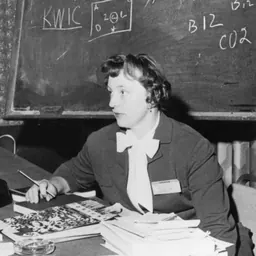
Lived 1927 – 2020 (aged 92). Emilia Currás was a Spanish documentalist, chemist, computer scientist, university teacher and information scientist.
Emilia Teresa Julia Currás Puente (8 October 1927 – 29 March 2020) was a Spanish information scientist and academic. She was also a philosopher and historian of science, as well as a pioneer in the study of the philosophical-scientific bases of Information and documentation.
Biography and career She was born in Madrid on 8 October 1927 from Galician parents Currás and her family lived through the Spanish Civil War in Alberic, Valencia. After the war, the family moved to Tetuan where her mother worked as a teacher. In the middle of the 1940s, they returned to Madrid and Emilia Currás studied at the Lope de Vega secondary school. She graduated from Chemical Sciences at the Complutense University of Madrid and the University of Santiago de Compostela in 1953.
In 1970 she left the private industry sector to join the Faculty of Sciences of the Autonomous University of Madrid and to direct the Scientific Documentation Office within the Department of Applied Chemistry-Physics.
Fields of work Philosophy and history of science Her most notable contribution is the creation of the Theory of Informationism and the Vertical Integration of Science, which appeared in 1981 and was accepted in 1988.
According to Currás, this theory considers information as the axis of our life and as the motor of all neuronal and physical evolution of the human being; that is, the more useful information our brain receives, the greater our neuronal tissue will be, creating the beginning of the path of development of civilization and culture of any people.
Informationism is based on the paradigm of the universality of information, which is independent in itself as a scientific discipline, but which is systemically and vertically related to the other sciences.
Documentation In this field, she was a pioneer in Spain and in many Spanish-speaking countries. She introduced the concept of Documentation Sciences as a nucleus that housed the different disciplines related to the processes of information contained in a document so that it can reach the user quickly, unequivocally and efficiently. She worked on the design and construction of a thesaurus, contributing with the creation of three manuals, where the thesaurus was approached from different perspectives: documentary linguistics, systems theory, ontology, taxonomy, information theory, computer science, etc.
In 1976 she founded the Spanish Society for Scientific Information and Documentation (SEDIC) in 1976, and was its president for twelve years. She was a founding member of Hispano Term and ASEABI. She was also a member of the Council of the International Federation for Documentation (FID) for eight years.
Chemistry She did research on molten antimony tribromide as an ionizing solvent (the subject of her thesis) resulting in the discovery of five new compounds, which were registered in the Index Chemicus database. Her work has been translated into English, Portuguese, Arabic and Czech,
Her publications include: and El rincón de mis pensamientos.
Selected awards Among the numerous awards she received are: Gold Medal of the Prof. Kaula Foundation (1990). Fellow of the Institute for Information Scientists, London (1992). FEDINE Medal of Technological Merit (1997). Honorary President of ISKO-Spain (1998). Gold Badge of the Deutsche Gesellschaft für Information und Wissen (DGI), the German Society of Information Specialists (2002). Woman of the Year 2004 of The American Biographical Institute, being included in its yearbook Great women of the 21st Century. The King's College of Cambridge (UK) included her in the Outstanding Intellectuals of the 21st Century (2004). Honorary Member of the Hispanic Association of Internet Documentalists (AHDI) since 2004. Gold and Brilliant Badge of the Association of Chemists of Madrid (2011). Numerary member of the International Brotherhood of Researchers of Toledo and honorary member of the SEDIC since 2013. Member of the Club of Rome. Knight's Cross awarded by the government of Colombia. She was decorated and honored by the universities of Düsseldorf, Zaragoza, Brasilia, San Marcos de Lima, Autónoma of Madrid, Opavá (Czech Republic), Complutense of Madrid and University of La Manouba (Tunisia).
Don’t just read it —
keep it.
Full-length biographies made to live with: read them, listen on the way to work, watch them tonight.
- E-book
- Audio
- Video
Instant download · yours to keep · every purchase keeps this site free
Important facts
People in Emilia Currás's life
Named in this biography and alive at the same time

Related people
Same field, nearest in time



Contemporaries
People whose lives overlapped Emilia Currás's


Frequently asked questions
Who was Emilia Currás?
Spanish documentalist (1927–2020)
When was Emilia Currás born?
Emilia Currás was born on 8 October 1927 in Madrid.
When did Emilia Currás die?
Emilia Currás died on 29 March 2020 in Madrid.
What was Emilia Currás's occupation?
Emilia Currás was a documentalist, chemist, computer scientist, university teacher and information scientist.
What nationality was Emilia Currás?
Emilia Currás was Spanish.
Sources & further reading
Cite this page
APA: Biography.guide. (2026). Emilia Currás. https://biography.guide/emilia-curras/
MLA: "Emilia Currás." Biography.guide, https://biography.guide/emilia-curras/.
Chicago: "Emilia Currás." Biography.guide. https://biography.guide/emilia-curras/.
Data last updated: 2026-09-22 · Spot an error? Report a correction.
Page generated 2026-09-27 05:13 UTC