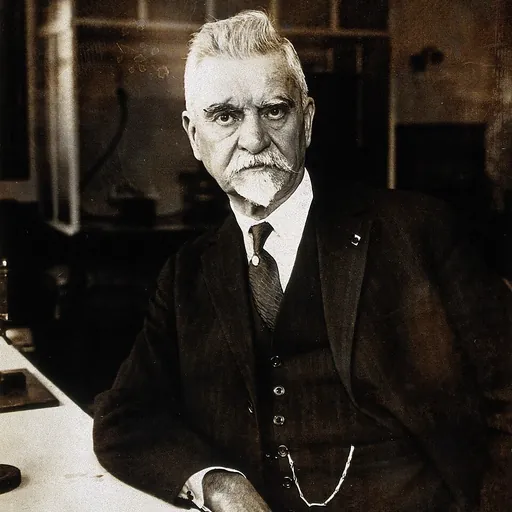
About Émile Marchoux
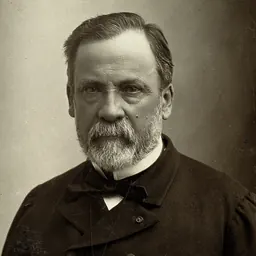
Lived 1862 – 1943 (aged 81). Émile Marchoux was a French physician, botanist and tropical physician.
Émile Marchoux (24 March 1862 – 19 August 1943) was a French physician and biologist born in Saint-Amant-de-Boixe, Charente.
He studied medicine in Paris, defending his doctorate with a dissertation titled Histoire des épidémies de fièvre typhoïde dans les troupes de marine à Lorient (1887). From 1888 to 1900 he served as a naval doctor in Dahomey, afterwards being responsible for vaccination services in Cochin (1890–1893). In 1893 he began taking microbiology classes at the Pasteur Institute in Paris, where he studied the anthrax bacterium in the laboratory of Emile Roux (1853–1933). From 1895 he was based in Saint-Louis, Senegal, where he established a laboratory of microbiology, subsequently dealing with an epidemic involving amoebic dysentery. During his stay in Senegal he published an influential account of malaria that was published in the Annales de l'Institut Pasteur (1897).
From 1901 to 1905, Marchoux worked with Paul-Louis Simond (1858–1947) and Alexandre Salimbeni (1867–1942) in Brazil researching yellow fever. Here the three scientists were successful in eradicating the yellow fever epidemic from Rio de Janeiro. With Salimbeni, he conducted a detailed study of avian spirochaetosis, providing a description on its mode of transmission.
In 1905 he was appointed head of "tropical microbiology" at the Pasteur Institute, and in 1908 he was co-founder of the Société de pathologie exotique with Alphonse Laveran (1845–1922) and Félix Mesnil (1868–1938). In 1922 he was named chairman of the "malaria commission" to the Société de pathologie exotique.
Marchoux is remembered today for providing prophylaxis and humanitarian treatment in his dealings with leprosy and those with the disease. In 1919 he organized under the aegis of the Pavillon colonial de l'Institut Pasteur, a counseling service for tropical diseases, with a special service reserved for people with leprosy. In 1931 with F. Sorel he founded the Institut Central de la Lèpre in Bamako, renamed the Institut Marchoux de Bamako in his honor following his death. In 1923 at Strasbourg he was elected chair of the International Leprosy Congress, afterwards being named president of the International Association of Leprosy.
In 1907 he was co-author of the treatise Hygiène coloniale, which was included in the Traité d'hygiène of Paul Brouardel (1837-1906) and Ernest Mosny (1861–1918). In 1910 he became a member of the Société de biologie, and from 1914 to 1918 was chief medical officer of the Paris Health Department.
Don’t just read it —
keep it.
Full-length biographies made to live with: read them, listen on the way to work, watch them tonight.
- E-book
- Audio
- Video
Instant download · yours to keep · every purchase keeps this site free
Important facts
People in Émile Marchoux's life
Named in this biography and alive at the same time




Related people
Same field, nearest in time


Contemporaries
People whose lives overlapped Émile Marchoux's



Frequently asked questions
Who was Émile Marchoux?
French microbiologist (1862-1943)
When was Émile Marchoux born?
Émile Marchoux was born on 24 March 1862 in Saint-Amant-de-Boixe.
When did Émile Marchoux die?
Émile Marchoux died on 19 August 1943 in Paris.
What was Émile Marchoux's occupation?
Émile Marchoux was a physician, botanist and tropical physician.
What nationality was Émile Marchoux?
Émile Marchoux was French.
Sources & further reading
Cite this page
APA: Biography.guide. (2026). Émile Marchoux. https://biography.guide/emile-marchoux/
MLA: "Émile Marchoux." Biography.guide, https://biography.guide/emile-marchoux/.
Chicago: "Émile Marchoux." Biography.guide. https://biography.guide/emile-marchoux/.
Data last updated: 2026-09-22 · Spot an error? Report a correction.
Portrait: Wikimedia Commons · author & licence
Page generated 2026-09-27 05:03 UTC