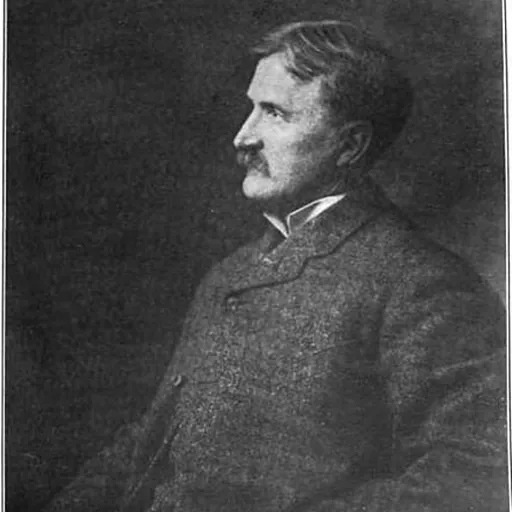
About Emerson Hough
Lived 1857 – 1923 (aged 65–66). Emerson Hough was an American novelist, writer, journalist and jurist.
Emerson Hough (June 28, 1857 – April 30, 1923) was an American writer best known for writing western stories and historical novels. His early works included Singing Mouse Stories and Story of the Cowboy. He was well known for his 1902 historical novel The Mississippi Bubble. Many of his works have been adapted into films and serial films.
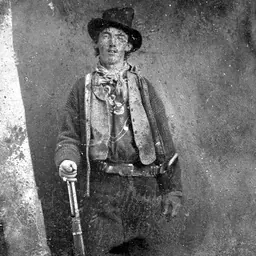
Career Hough was born in Newton, Iowa on June 28, 1857. He was in Newton High School's first graduating class of three in 1875. He graduated from the University of Iowa with a bachelor's degree in philosophy in 1880 and later studied law and was admitted to the bar in 1882. His first article, "Far From The Madding Crowd," was published in Forest and Stream in 1882. He later wrote Story of the Outlaw, A Study of the Western Desperado, which included profiles of Billy the Kid and Pat Garrett. Hough moved to New Mexico after Garrett shot Billy the Kid, and he became a friend of Garrett. He wrote for various newspapers in Des Moines, Iowa, Sandusky, Ohio, Chicago, Illinois, St. Louis, Missouri, and Wichita, Kansas. In 1889 he got a position as western editor of Forest and Stream, editing the "Chicago and the West" column. He was hired by George Bird Grinnell, the owner of Field and Stream, who founded the Audubon Society in 1886 which, along with Theodore Roosevelt's Boone and Crockett Club, was a leader in the conservation movement.
Hough was also a conservationist. One of his projects for Forest and Stream was to survey Yellowstone National Park in midwinter 1893, with a guide and 2 soldiers from the nearby fort of the same name. There were supposed to be more than 500 buffalo there, but their count barely reached 100. Due to Hough's report, eastern newspapers took up the cause against poaching, and in May 1894 the U.S. Congress passed a law making poaching of game in national parks a punishable offense. Later, he and other Saturday Evening Post writers wrote a letter for Stephen Mather and George Horace Latimer to sign, advocating the creation of a national park system. The National Park Service was created in 1916. In addition, he was a co-founder of the Izaak Walton League, an organization of outdoorsmen, in 1922. He wrote the "Out-of-Doors" column for the Saturday Evening Post and these columns later appeared in book form.
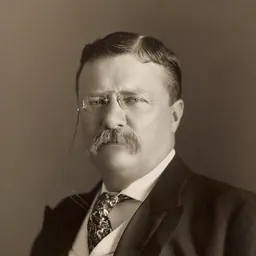
In 1902, Hough began his association with Bobbs-Merrill Company (then Bowen-Merrill), which published his first best-seller, The Mississippi Bubble. Hough began a trilogy on America when he published 54-40 or Fight in 1909, dedicated to Theodore Roosevelt. He dedicated the second volume, Purchase Price, to U.S. Senator Albert Beveridge of Indiana in 1910 and the third, John Rawn, to Woodrow Wilson in 1912. He nevertheless campaigned for Theodore Roosevelt, candidate of the Bull Moose Party, in the 1912 presidential election.
Reviewers noted the political nature of Hough's Western fiction. One reviewer wrote that John Rawn was "not a novel at all; it is an arraignment; it is propaganda" for progressive Republicans or the Democrats. It condemned protective tariffs and presented consistently negative portrait of money-driven characters. The review was positive, praising the novelist's portrait of his main character, but little else. Hough "makes his point, and hammers it hard. He leaves nothing for the reader to guess....He goes at it all with bludgeon and battle-ax....He has, as a fighter, a strong style. His book is well worth reading. But it is not art." Hough responded at length and with good humor, citing widely divergent views of the novel. He explained that a story of "blackguards and traitors" should not lead anyone to the conclusion that he believes such characters typify American society, rather that "imitation of blackguards and traitors is not a fit ambition for Americans."
He took a public position during the election of 1916, adding his name to a letter sent on behalf of the Roosevelt Authors' League pledging support to Theodore Roosevelt because "the international crisis makes your re-election to the Presidency essential to the ultimate welfare of our country." It praised "the splendid fight you are making for Americanism" and had harsh words for the administration of Woodrow Wilson.
His other notable works included Story of the Cowboy, "which received a high recommendation from President Theodore Roosevelt," Way of the West, Singing Mouse Stories, and The Passing of the Frontier. Among his historical novels, The Magnificent Adventure in 1916 was set at the time of the Louisiana Purchase and the Lewis and Clark Expedition and told, said one reviewer, "a good stirring tale."
In 1889 Hough wrote Madre D'Oro, a four-act spectacular drama about the Spanish conquest of the Aztecs. With L. Frank Baum, author of The Wonderful Wizard of Oz, he created two play treatments: The Maid of Athens: A College Phantasy and The King of Gee-Whiz. Neither was ever completed or staged.
He also wrote autobiographical works, such as "Getting a Wrong Start", published anonymously as a serial in the Saturday Evening Post in 1913. It appeared in book form two years later. He then wrote "Emerson Hough Himself-by Himself" for the Post in 1917.
Hough wrote the official account of the activities of the American Protective League (APL), a voluntary organization that attempted to enforce patriotism and stifle dissent during World War I. Called The Web: A Revelation of Patriotism, it told the history of that controversial organization in glowing terms and called for a program of "selective immigration, deportation of un-Americans, and denaturalization of 'disloyal' citizens and anarchists." It said: "We must purify the source of America's population and keep it pure." When the APL organized teams of vigilantes to enforce the military draft, Hough described the places the organization was most needed: "We find that the great states of each coast are practically foreignNew York most of all." During the war he wrote a pamphlet for a similar organization, the American Defense Society, called The Indefinite American Attitude Toward the War and When Shall It End.
Personal life He married Charlotte Chesebro of Chicago in 1897 and made that city his home. During World War I, he served as a captain with the Intelligence Service. He died in Evanston, Illinois, on April 30, 1923, a week after seeing the Chicago premiere of the movie The Covered Wagon, based on his 1922 book. Covered Wagon was his biggest best-selling novel since Mississippi Bubble in 1902. North of 36, another Hough novel, later became a popular silent film as well, "making him one of the first Western authors to enter into the motion picture industry." He is buried in Galesburg, Illinois.
Asked in 1918 to provide some details of his own life, he replied in the context of World War I: "This is no time for autobiography of men of letters. This is the day of biography for men who have been privileged to act in the great scenes of today. It is the time for boys of 23. At least we can bless them and back them the best we know. I will not tell about myself. It is of no consequence." Hough died in Evanston on April 30, 1923.
Later recognition Hough's hometown, Newton, Iowa, has honored him in several ways. A school named for him opened in 1926. Emerson Hough Elementary School was listed on the National Register of Historic Places in 2002. His boyhood home bears a marker provided by the Daughters of the American Revolution. The school grounds include a playground with a western theme called Fort Emerson Hough. The local chapter of the Izaak Walton League also bears his name, as does a street, Emerson Hough Avenue, in Lambs Grove, Iowa, a suburb of Newton.
In March 2010, the school board voted to close Emerson Hough Elementary School. Efforts to prevent its closure included a fund raising and a Facebook page. Although the building was closed to students, it was still in use serving as the school's administration complex, the alternative high school Basics and Beyond, the AEA and the Newton preschool program. Before the start of the 2016 - 2017 school year, board members reconfigured the district's buildings to allow for four K-4 elementary schools and a 5-8 middle school. The move included reopening Emerson Hough Elementary School as a school.
Works
Singing Mouse Stories, 1895 Story of the Cowboy, 1897 Girl at the Halfway House, 1900 The Mississippi Bubble, 1902 Way to the West, 1903 Law of the Land, 1904 Heart's Desire, 1905 King of Gee-Whiz, 1906 Story of the Outlaw, 1906 The Way of a Man, 1907 54-40 or Fight, 1909 The Sowing, 1909 Young Alaskans, 1910 The Purchase Price, 1910 John Rawn, 1912 Lady and the Pirate, 1913 Out of Doors, 1913 Young Alaskans in the Rockies, 1913 Young Alaskans on the Trail, 1914 Getting a Wrong Start (Autobiography), 1915 The Man Next Door, 1916 Magnificent Adventure, 1916 Let Us Go Afield, 1916 The Broken Gate, 1917 The Way Out, 1918 Passing of the Frontier, 1918 Young Alaskans in the Far North, 1918 The Web, 1919 The Sagebrusher, 1919 Maw's Vacation 1921 An Appreciation of Yellowstone National Park, 1922[?] The Covered Wagon, 1922 Young Alaskans on the Missouri, 1922 North of 36, 1923 Mother of Gold, 1924 The Ship of Souls, 1925
Filmography The Broken Coin, directed by Francis Ford (1915, serial, based on a story by Emerson Hough) , directed by Francis Ford (1915, based on a story by Emerson Hough) The Sagebrusher, directed by Edward Sloman (1920, based on the novel The Sagebrusher) The Broken Gate, directed by Paul Scardon (1920, based on the novel The Broken Gate) The Covered Wagon, directed by James Cruze (1923, based on the novel The Covered Wagon) The Man Next Door, directed by Victor Schertzinger (1923, based on the novel The Man Next Door) The Way of a Man, directed by George B. Seitz (1924, serial, based on a story by Emerson Hough) North of 36, directed by Irvin Willat (1924, based on the novel North of 36) The Ship of Souls, directed by Charles Miller (1925, based on the novel The Ship of Souls) One Hour of Love, directed by Robert Florey (1927, based on a story by Emerson Hough) The Broken Gate, directed by James C. McKay (director) (1927, based on the novel The Broken Gate) The Conquering Horde, directed by Edward Sloman (1931, based on the novel North of 36) The Texans, directed by James P. Hogan (1938, based on the novel North of 36)
Don’t just read it —
keep it.
Full-length biographies made to live with: read them, listen on the way to work, watch them tonight.
- E-book
- Audio
- Video
Instant download · yours to keep · every purchase keeps this site free
Important facts
People in Emerson Hough's life
Named in this biography and alive at the same time


Related people
Same field, nearest in time




Contemporaries
People whose lives overlapped Emerson Hough's





Frequently asked questions
Who was Emerson Hough?
American writer
When was Emerson Hough born?
Emerson Hough was born in 1857 in Newton.
When did Emerson Hough die?
Emerson Hough died in 1923 in Evanston.
What was Emerson Hough's occupation?
Emerson Hough was a novelist, writer, journalist and jurist.
What nationality was Emerson Hough?
Emerson Hough was American.
Sources & further reading
Cite this page
APA: Biography.guide. (2026). Emerson Hough. https://biography.guide/emerson-hough/
MLA: "Emerson Hough." Biography.guide, https://biography.guide/emerson-hough/.
Chicago: "Emerson Hough." Biography.guide. https://biography.guide/emerson-hough/.
Data last updated: 2026-09-23 · Spot an error? Report a correction.
Portrait: Wikimedia Commons · author & licence
Page generated 2026-09-27 05:06 UTC