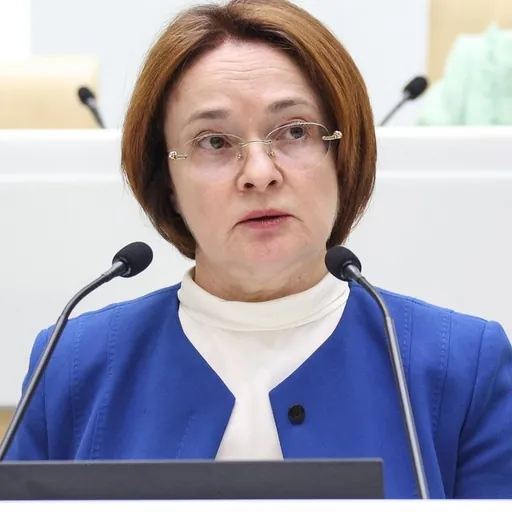
Elvira Nabiullina
Russian economist and Governor of the Bank of Russia
About Elvira Nabiullina
Born 1963. Elvira Nabiullina is a Russian economist, politician, banker and statesperson.
Elvira Sakhipzadovna Nabiullina (born 29 October 1963) is a Russian economist and current governor of the Central Bank of Russia. She was President Vladimir Putin's economic adviser from May 2012 to June 2013 after serving as the minister of economic development from September 2007 to May 2012. As of 2019, she was listed as the 53rd most powerful woman in the world by Forbes. She has the federal state civilian service rank of 1st class Active State Councillor of the Russian Federation.
Early life and education Nabiullina was born in Ufa, Bashkir ASSR, on 29 October 1963 into an ethnic Tatar family. Her father, Sakhipzada Saitzadayevich, was a driver, while her mother, Zuleikha Khamatnurovna, was a factory manager. Nabiullina graduated from school No. 31 of Ufa, followed by the Moscow State University Faculty of Economics in 1986. In subsequent years, she was selected for the 2007 Yale World Fellows program.
Career Between 1991 and 1994, Nabiullina worked at the USSR Science and Industry Union and its successor, the Russian Union of Industrialists and Entrepreneurs. She found working with then-deputy Prime Minister and Finance Minister Alexei Kudrin "difficult but always interesting" and remained in that position until 21 May 2012.
Succeeding Sergey Ignatyev in 2013, Nabiullina was appointed head of the Central Bank of Russia, becoming the second woman after Tatiana Paramonova to hold that position, and thus the first Russian woman in the G8. In May 2014, she was named one of the world's most powerful women by Forbes, which noted that she "has been given the difficult task of managing the ruble exchange rate during Russian military operation in Ukraine and annexation of Crimea and facilitating growth for an economy trying to avoid a recession". thus stabilizing the financial system and boosting foreign-investor confidence. Euromoney magazine named her their 2015 Central Bank Governor of the Year.
In 2017, the British magazine The Banker chose Nabiullina as "Central Banker of the Year, Europe".
On 28 February 2022, she gave a speech announcing a number of measures to combat the 2022 Russian financial crisis caused by the Russian invasion of Ukraine, including that the Central Bank of Russia's interest rate would rise to 20%, that the stock market be closed, and that capital controls would be instituted. In March 2022, it was reported that she had attempted to resign her position, only to be ordered to stay in post by Putin. Following the invasion, Nabiullina came under fire from both nationalist hawks, who questioned her loyalty to Putin, and Kremlin critics, who compared her to Hitler's Reich Minister of Armaments and War Production, Albert Speer. Despite the criticism, Nabiullina has managed to secure her long-standing position as head of the Central Bank thanks to Putin's trust and her effectiveness in maintaining macroeconomic stability. Insiders speak of the "Problem of 2027," as Nabiullina's contract and those of her team members expire that year. Working at the Central Bank pays less than in commercial banks and carries a higher risk of being hit by Western sanctions.
Nabiullina is regarded as the éminence grise to German Gref. She is a protégé of former economics minister Yevgeny Yasin, although by his later admission, after many years of Nabiullina's work in Putin's team, Yasin's and Nabiullina's views had diverged.
"Nabiullina's brooch" There is a belief in the Russian media that the head of the Central Bank uses brooches at public events to signal the state of the economy and the regulator's plans. In 2020, Nabiullina appeared at press conferences with a brooch of a blue wave, a dot, a tumbler, a stork. In March 2021, when the increase in the refinancing rate was announced for the first time in three years, she appeared with a hawk.
In September 2021, Nabiullina revealed the meaning of the brooches, which represent her own way of communication, an alternate language to "give the market a chance to reflect". Meanwhile, according to Nabiullina, the exact significance of any brooch should remain mysterious and is with rare exceptions ambiguous.
In her speech on 28 February 2022 announcing measures to alleviate the 2022 Russian financial crisis she wore black attire and no brooch. Sergei Guriev of Sciences Po speculated that it "should not be read as she disagreed with Putin's policy, but as a sign that it is time to bury normal monetary policy," while adding that "I am sure she was not part of the narrow circle making the decision on going to war." However, it is known that she considers the collapse of the Soviet Union a tragedy, while simultaneously being an advocate of liberal, market-based approaches. Specifically, Nabiullina has been critical of the flaws in Russia's 1990s reforms, stating: "Probably the biggest question I ask myself regarding the Gaidar reforms is: was it necessary to carry out privatization quickly? — Yes. It was necessary to create a class of private owners. But as a result of the privatization that took place, we created an atmosphere of distrust towards private property. And this problem has been haunting us for many, many years."
Nabiullina is not a proponent of conspiracy theories and acknowledges that there are purely economic reasons why not everyone has an interest in Russia's economic development unfolding in a particular way, and that there is a struggle of objective interests over different vectors of this development. She cites the lobbying efforts of natural monopolies as an example. In her view, the role of the government is to make decisions that promote the country's economic growth to a greater extent.
Nabiullina attributes the slowdown in Russia's economic growth by the mid-2010s to the insufficient quality of government institutions (especially the judicial and law enforcement systems) and high administrative barriers for businesses. From her perspective, the future of the Russian economy depends on the development of domestic investment, increased labor productivity, labor mobility, and improved efficiency of natural monopolies.
Personal life In the late 1980s, while studying at the graduate school of Moscow State University, Nabiullina married a lecturer there, Yaroslav Kuzminov. Kuzminov became rector of National Research University Higher School of Economics (HSE) (1994–2021), since July 2021 the academic supervisor of the HSE. They have a son, Vasiliy (born 13 August 1988), at present a Research Fellow at the HSE.
Nabiullina is fluent in French and English. She has a deep appreciation for the arts, prefers classical music, and loves Russian Poetry of the Silver Age as well as French cinema. Foulard scarves and neckerchiefs, along with brooches, are a signature element of her wardrobe. On 30 September 2022, after the Russian annexation of southern and eastern Ukraine, she was sanctioned by the United States. She was also sanctioned by Canada, New Zealand and the United Kingdom. On 19 October, she was included on Ukraine's sanctions list.
Awards Order of Honour (2018) Order "For Merit to the Fatherland", 4th class (2012) Order of Friendship (2011)
Don’t just read it —
keep it.
Full-length biographies made to live with: read them, listen on the way to work, watch them tonight.
- E-book
- Audio
- Video
Instant download · yours to keep · every purchase keeps this site free
Important facts
People in Elvira Nabiullina's life
Named in this biography and alive at the same time





Related people
Same field, nearest in time


Contemporaries
People whose lives overlapped Elvira Nabiullina's

Frequently asked questions
Who is Elvira Nabiullina?
Russian economist and Governor of the Bank of Russia
When was Elvira Nabiullina born?
Elvira Nabiullina was born on 29 October 1963 in Ufa.
What is Elvira Nabiullina's occupation?
Elvira Nabiullina is an economist, politician, banker and statesperson.
What nationality is Elvira Nabiullina?
Elvira Nabiullina is Russian.
Sources & further reading
· Wikipedia: Elvira Nabiullina
Cite this page
APA: Biography.guide. (2026). Elvira Nabiullina. https://biography.guide/elvira-nabiullina/
MLA: "Elvira Nabiullina." Biography.guide, https://biography.guide/elvira-nabiullina/.
Chicago: "Elvira Nabiullina." Biography.guide. https://biography.guide/elvira-nabiullina/.
Data last updated: 2026-09-22 · Spot an error? Report a correction.
Portrait: Wikimedia Commons · author & licence
Page generated 2026-09-27 05:04 UTC