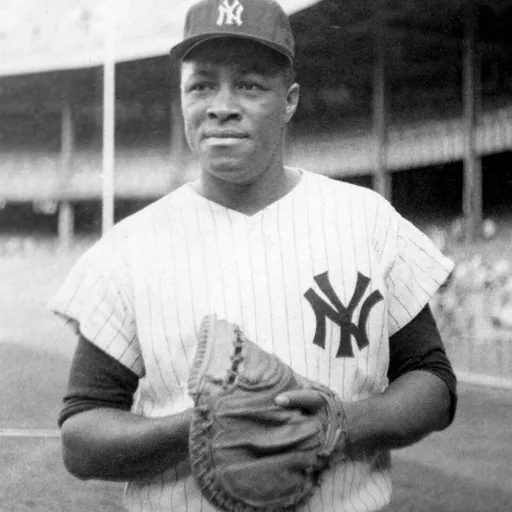
About Elston Howard
Lived 1929 – 1980 (aged 51). Elston Howard was an American baseball player.
Elston Gene Howard (February 23, 1929 – December 14, 1980) was an American professional baseball player who was a catcher and a left fielder. During a 14-year baseball career, he played in the Negro leagues and Major League Baseball (MLB) from 1948 through 1968, primarily for the New York Yankees. A 12-time All-Star, he also played for the Kansas City Monarchs and the Boston Red Sox. Howard served on the Yankees' coaching staff from 1969 to 1979.
In 1955, he was the first African American player on the Yankees roster, eight years after Jackie Robinson had broken MLB's color barrier in 1947. Howard was named the American League's Most Valuable Player for the 1963 pennant winners after finishing third in the league in slugging average and fifth in home runs, becoming the first black player in AL history to win the honor. He won Gold Glove Awards in 1963 and 1964, in the latter season setting AL records for putouts and total chances in a season. His lifetime fielding percentage of .993 as a catcher was a major league record from 1967 to 1973, and he retired among the AL career leaders in putouts (7th, 6,447) and total chances (9th, 6,977).
Early life Elston Gene Howard was born on February 23, 1929, in St. Louis, Missouri, to Travis Howard and Emaline Hill, a nurse at a local hospital. When he was six years old, his parents divorced and his mother remarried. Howard was a standout athlete at Vashon High School.
Professional career Negro leagues In 1948, nineteen-year-old Howard turned down college football scholarship offers from Illinois, Michigan, and Michigan State and instead signed to play professional baseball for $500 a month ($6,634.83 in 2025) with the Kansas City Monarchs of the Negro American League under manager Buck O'Neil. He was an outfielder for three seasons and in 1950 roomed with Ernie Banks.
He played with the Toronto Maple Leafs of the Class AAA International League in 1954, where he led the league in triples, with 16, to go along with 22 home runs, 109 runs batted in and a .330 average, winning the league's MVP award.
The Yankees assigned Bill Dickey to work with Howard in order to develop his catching skills.
New York Yankees (1955–1967) 1950s
Howard made the Yankees' Major League roster at the start of the 1955 season. On April 14, 1955 (the second game of the season), Howard made his major league debut when he entered the game in the sixth inning as a left fielder. Howard hit a single in his only plate appearance of the day. He became the first black player to play for the Yankees. Howard made his first start on April 28,
Howard struggled in 1967. He backed up Jake Gibbs and batted only .198 through the start of August.
Boston Red Sox (1967–1968) On August 3, 1967, Howard was traded to the Boston Red Sox for Pete Magrini and a player to be named later, Ron Klimkowski. Though he batted only .147 for Boston, he was effective in handling the pitchers; teammate Tony Conigliaro noted, "I don't think I ever saw a pitcher shake off one of his signs. They had too much respect for him." In 1967, Howard also took over Sherm Lollar's major-league record for career fielding average; Freehan moved ahead of him in 1973.
One of Howard's highlights during his time with the Red Sox occurred on August 27, 1967, when the Chicago White Sox were battling the Red Sox for the pennant. With Ken Berry on third base with one out in the bottom of the ninth inning and the Red Sox leading 4–3, Duane Josephson lined out to Jose Tartabull in right field. Not known for having a strong arm, Tartabull's throw sailed high and was caught by a leaping Howard, who blocked the plate with his left foot as he came down, and swipe tagged Berry — ending the game. For Red Sox fans, the play was considered a key event during their "Impossible Dream" season.
Howard had his last postseason highlight in the 1967 World Series against the Cardinals when his bases-loaded single in the ninth inning of Game 5 drove in two runs for a 3–0 lead. The hit was crucial, as former teammate Maris homered in the bottom of the inning for the Cardinals before the Red Sox closed out the 3–1 win. St. Louis, however, won the Series in seven games. It was the sixth losing World Series team Howard played on; he and Pee Wee Reese have the dubious distinction for playing on the most losing World Series teams.
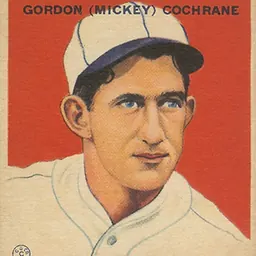
On October 29, 1968, Howard was released by the Red Sox. Over his 14-year career, he batted .274 with 167 home runs, 1,471 hits, 762 RBI, 619 runs, 218 doubles, 50 triples and nine stolen bases in 1,605 games. His .427 slugging average trailed those of only Dickey (.486), Berra (.482) and Mickey Cochrane (.478) among AL catchers. Defensively, he recorded a .993 fielding percentage as a catcher and an overall .992 fielding percentage. Howard also played at left and right field and first base. His 54 total World Series games placed him behind only teammates Berra and Mantle. Howard is also credited with being the first to use the extended index and pinky finger (corna) to indicate that there were two out in the inning, this being more visible to teammates in the outfield than the usual "two" gesture of the index and middle fingers.
Coaching career New York Yankees (1969–1979) Howard returned to the Yankees the following year, where he served as first-base coach from 1969 to 1979. He was the first black coach in the American League. The team won the AL pennant in 1976 and the World Series in 1977 and 1978. During a game against the Boston Red Sox at Fenway Park in June 1977, Howard and Yogi Berra were peacemakers during a dugout incident between Yankees player Reggie Jackson and Yankees manager Billy Martin.
After Howard's coaching career ended, he became an administrative assistant with the Yankees; however, that position did not last long due to declining health.
Death Howard was diagnosed with myocarditis, a rare heart disease that causes rapid heart failure. He was considering a heart transplant, but his condition quickly deteriorated.
Legacy
In Howard's memory, the Yankees wore black armbands on their sleeve during the 1981 season. On July 21, 1984, the Yankees retired Howard's uniform number 32 and dedicated a plaque in his honor for Monument Park at Yankee Stadium. On that day the Yankees also bestowed the same honors to Roger Maris who, unlike Howard, was still living. Howard's plaque describes him as "A man of great gentleness and dignity" and "one of the truly great Yankees."
Howard is credited with inventing the batting "doughnut", a circular lead weight with a rubber shell used by batters in the on-deck circle by placing it around a bat to make it feel heavier, so that it will feel lighter at the plate and easier to swing. Its widespread use caused the discontinuation of the practice of hitters swinging multiple bats at the same time while waiting to hit. Howard helped two New Jersey entrepreneurs, Frank Hamilton and Vince Salvucci, to market the bat weight and lent his name to the product.
In 2020, the baseball field on the former site of Yankee Stadium was renamed in Howard's honor. The field sits directly across the street from the new Stadium.
Howard was portrayed by Bobby Hosea in the 2001 film 61* and in the 2014 Broadway play Bronx Bombers.
His great-nephew is NBA player Josh Hart, who has described him as a role model.
Don’t just read it —
keep it.
Full-length biographies made to live with: read them, listen on the way to work, watch them tonight.
- E-book
- Audio
- Video
Instant download · yours to keep · every purchase keeps this site free
Important facts
People in Elston Howard's life
Named in this biography and alive at the same time





Related people
Same field, nearest in time
Contemporaries
People whose lives overlapped Elston Howard's


Frequently asked questions
Who was Elston Howard?
American baseball player and coach (1929-1980)
When was Elston Howard born?
Elston Howard was born on 23 February 1929 in St. Louis.
When did Elston Howard die?
Elston Howard died on 14 December 1980 in New York City.
What was Elston Howard's occupation?
Elston Howard was a baseball player.
What nationality was Elston Howard?
Elston Howard was American.
Sources & further reading
Cite this page
APA: Biography.guide. (2026). Elston Howard. https://biography.guide/elston-howard/
MLA: "Elston Howard." Biography.guide, https://biography.guide/elston-howard/.
Chicago: "Elston Howard." Biography.guide. https://biography.guide/elston-howard/.
Data last updated: 2026-09-24 · Spot an error? Report a correction.
Portrait: Wikimedia Commons · author & licence
Page generated 2026-09-27 05:08 UTC