
About Elsa M. Garmire
Born 1939. Elsa M. Garmire is an American physicist.
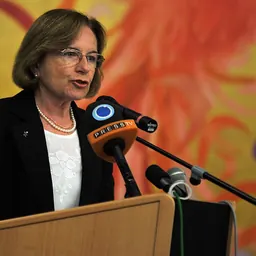
Elsa M. Garmire (b 1939 ) is an American physicist. She was the Sydney E. Junkins Professor of Engineering at Dartmouth College, where she had served as dean of Thayer School of Engineering. Elected to the American Academy of Arts and Sciences, the National Academy of Engineering, and the National Academy of Inventors, she helped pioneer laser technology and is an expert in nonlinear optics. She has patented devices to enhance optical communications including lasers, waveguides, and detectors.
Garmire was an Optical Society (OSA) board member from 1983 to 1985 and was elected vice president in 1991. She served as the 1993 OSA president and has been active on many awards committees. Garmire is currently a member of the OSA Presidential Advisory Committee. In 2019 Garmire was named the first woman to become an OSA Honorary Member "For contributions to nonlinear optics and optoelectronics, leadership in linking science and public policy, and for service to OSA".
Early life and education Elsa Meints Garmire was born in Buffalo, New York, on November 9, 1939. Her father worked as a chemical engineer, working on the design of chemistry labs for the Argonne National Laboratory. Her mother studied music and gave violin lessons but was mostly a stay-at-home wife. Garmire had two sisters, one elder and one younger. Early in her life, Garmire's family moved a lot as, despite having a PhD in chemistry, her father spent years finding a well-paying job during the Great Depression. Garmire decided to become a scientist when, in the sixth grade, she was handed a brochure about research scientist careers.
As a high school student in the 1950s, she topped her class, earning all A's. Garmire decided to join Radcliffe College, a former partner school to the male-only Harvard College, owing to its reputation as a challenging college. Garmire received her B.A. in physics in 1961 at Radcliffe College, one of three women studying physics there at the time. During her PhD, Garmire demonstrated important nonlinear effects produced by powerful laser beams acting on atoms and molecules.
Career and Research
Garmire spent her early career at California Institute of Technology as a senior research fellow. Following a couple of years in industry, Garmire joined the University of Southern California where she became William Hogue Professor of Electrical Engineering, professor of physics, and director of the Center for Laser Studies. In 1995, after 20 years at USC, Garmire moved to Dartmouth College where she served as dean of the Thayer School of Engineering. She was the first female dean, the Thayer School of Engineering. However, Garmire served as dean for only two years before returning to a faculty member position, as she preferred to stay in research.
Garmire was elected to the National Academy of Engineering in 1989 for contributions to nonlinear optics and optoelectronics and for leadership in education.
Work with laser art
In the summer of 1968, Garmire joined the organization Experiments in Art and Technology. She used laser light in artistic presentations, such as a July 1969 "laser wall" made of argon laser beams through which spectators could walk. For the Pepsi Pavilion at Expo '70 in Osaka, Garmire helped E.A.T. build "the world's largest hemispherical mirror".
In her Caltech lab, Garmire experimented with light patterns caused by shining laser beams through transparent random or structured materials, such as dried clear glue on glass or patterned Plexiglas. These diffused the coherent light into abstract shapes with pure colors, internal diffraction pattern texture, and a shimmering speckle. By rotating the diffusing material, the shapes would slowly evolve into new forms.
In November 1970 filmmakers Ivan Dryer and Dale Pelton visited Garmire's lab, filmed the moving patterns and set them to music. The resulting short movie, LaserImage, dissatisfied both Dryer and Garmire as it lacked the vibrant colors and speckle of live laser light. In December 1970, they proposed to the Griffith Observatory in Los Angeles to present a live laser show in the planetarium, to be called Laserium. The Griffith director at that time turned down the proposal.
She later mused, "I did not patent my idea. I'm a great believer that people should do it. In fact in 1971, I suggested that there could be a home laser light show, and I demonstrated it on television".
In January 1973 Dryer formed a company called Laser Images Inc., with Garmire as president. The company used lasers for a few concerts and special events.
In June 1973, Dryer did a demonstration at Caltech attended by the new director of the Griffith. He agreed to a one-month trial at the Griffith. The first Laserium show was held November 19, 1973. By the end of the trial, 500 people a night had to be turned away from the shows.
At some point, Garmire left the company, later saying "I loved it. I loved the classical music. And when they switched to the rock music, that's when I decided to absent myself." 2014, National Academy of Inventors (NAI) Charter Fellow 2004, National Associate of the National Academies 1996, Member, American Academy of Arts and Sciences 1994, Fellow, American Physical Society 1994, Achievement Award and Fellow, Society of Women Engineers 1989, Life Member, National Academy of Engineering 1980, Fellow and Life Member, Institute of Electronics and Electrical Engineers 1981, Fellow of The Optical Society of America (now The Optical Society)
Don’t just read it —
keep it.
Full-length biographies made to live with: read them, listen on the way to work, watch them tonight.
- E-book
- Audio
- Video
Instant download · yours to keep · every purchase keeps this site free
Important facts
People in Elsa M. Garmire's life
Named in this biography and alive at the same time

Related people
Same field, nearest in time



Contemporaries
People whose lives overlapped Elsa M. Garmire's





Frequently asked questions
Who is Elsa M. Garmire?
American physicist
When was Elsa M. Garmire born?
Elsa M. Garmire was born on 9 November 1939 in Buffalo.
What is Elsa M. Garmire's occupation?
Elsa M. Garmire is a physicist.
What nationality is Elsa M. Garmire?
Elsa M. Garmire is American.
Sources & further reading
Cite this page
APA: Biography.guide. (2026). Elsa M. Garmire. https://biography.guide/elsa-m-garmire/
MLA: "Elsa M. Garmire." Biography.guide, https://biography.guide/elsa-m-garmire/.
Chicago: "Elsa M. Garmire." Biography.guide. https://biography.guide/elsa-m-garmire/.
Data last updated: 2026-09-20 · Spot an error? Report a correction.
Page generated 2026-09-27 05:28 UTC