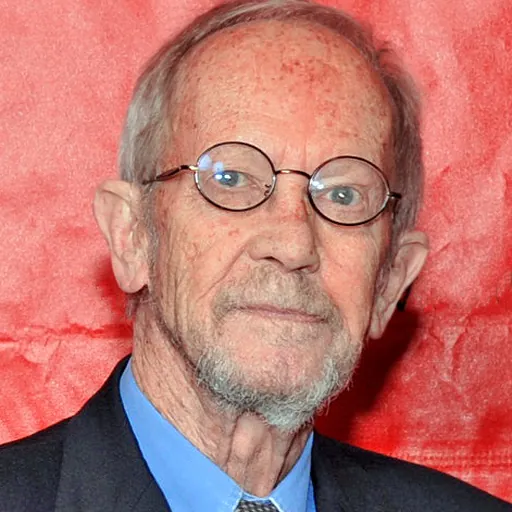
About Elmore Leonard
Lived 1925 – 2013 (aged 87). Elmore Leonard was an American screenwriter, writer, novelist, film producer, author and prose writer.
Elmore John Leonard Jr. (October 11, 1925 – August 20, 2013) was an American novelist, short story author and screenwriter. He was, according to British journalist Anthony Lane, "hailed as one of the best crime writers in the land". His earliest novels, published in the 1950s, were Westerns, but he went on to specialize in crime fiction and suspense thrillers, many of which have been adapted into motion pictures. Among his best-known works are Hombre, Swag, City Primeval, LaBrava, Glitz, Freaky Deaky, Get Shorty, Rum Punch, Out of Sight and Tishomingo Blues.
Leonard's short story "Three-Ten to Yuma" was adapted as the film 3:10 to Yuma (1957), which was remade in 2007. Rum Punch was adapted as the Quentin Tarantino film Jackie Brown (1997). Steven Soderbergh adapted Out of Sight in 1998 into a film of the same name. Get Shorty was adapted into an eponymous film in 1995 and in 2017 it was adapted into a television series of the same name. His writings were also the basis for The Tall T, as well as the FX television series Justified and Justified: City Primeval. Among other honors, he won the 2009 Pen Lifetime Award and the 2012 Medal For Distinguished Contribution to American Letters.
Early life and education Leonard was born in New Orleans, Louisiana, the son of Flora Amelia (née Rive) and Elmore John Leonard. Because his father worked as a site locator for General Motors, the family moved frequently for several years. In 1934, the family settled in Detroit. In the 1930s, there were two news items that would influence many of Leonard's works. From 1931, until they were killed in May 1934, gangsters Bonnie and Clyde were on a rampage. In 1934, the baseball team the Detroit Tigers made it to the World Series, winning the Series in 1935. Leonard developed lifelong fascinations with sports and crime. He graduated from the University of Detroit Jesuit High School in 1943 and, after being rejected for the Marines for weak eyesight, immediately joined the Navy, where he served with the Seabees for three years in the South Pacific, where he got the nickname "Dutch", after Tigers pitcher Dutch Leonard.
Enrolling at the University of Detroit in 1946, on the G.I. Bill, he pursued writing more seriously, entering short stories in contests and submitting them to magazines for publication. He graduated in 1950
Career Leonard had his first success in 1951 when Argosy magazine published his short story "Trail of the Apaches". During the 1950s and early '60s, he continued writing Westerns, publishing more than 30 short stories. His debut novel, The Bounty Hunters, was published in 1953 and was followed by four more Westerns. His early work already showed his affection for outsiders and underdogs. He developed his characters through dialogue, each defined by their manner of speech. In many stories, he favored Arizona and New Mexico as settings. Five of his westerns were adapted as movies before 1972: The Tall T (1957), 3:10 to Yuma (1957), Hombre (1967), Valdez Is Coming (1971), and Joe Kidd (1972).
In 1969, his first crime story, The Big Bounce, was published by Gold Medal Books. Leonard differed from well-known names writing in this genre—he was less interested in melodrama than in his characters and in realistic dialogue. He wrote the screenplay for, and the novelization of, Mr. Majestyk (both 1974); Anthony Lane called the latter "the best novel ever written about a melon grower." His next novel, Glitz (1985), an Atlantic City gambling story, was his breakout in the crime genre. It spent 16 weeks on The New York Times Best Seller list, and his subsequent crime novels were all bestsellers. In his review of Glitz, Stephen King placed Leonard in the company of Raymond Chandler, Dashiell Hammett and John D. MacDonald. Leonard believed that his books during the 1980s were becoming funnier and that he was developing a style that was more free and easy. His own favorites were Freaky Deaky (1988), about ex-hippie criminals, and the Dixie Mafia story Tishomingo Blues (2002). Some of Leonard's characters appear in several novels, including mobster Chili Palmer, bank robber Jack Foley and the U. S. Marshals Carl Webster and Raylan Givens.
At the time of his death his novels had sold tens of millions of copies. Among film adaptations of his work are Jackie Brown, (1997), based on Rum Punch and described as an "homage to the author's trademark rhythm and pace"; Nearly thirty movies were made from Leonard's novels, but for some critics his special style worked best in print. —before divorcing in 1977. His second marriage in 1979, to Joan Leanne Lancaster (aka Joan Shepard), ended with her death in 1993. Later that same year, he married Christine Kent; they divorced in 2012. Leonard spent the last years of his life with his family in Oakland County, Michigan. He suffered a stroke on July 29, 2013. Initial reports stated that he was recovering, but on August 20, 2013, Leonard died at his home in the Detroit suburb of Bloomfield Hills of stroke complications. He was 87 years old.
Style and influence Commended by critics for his gritty realism and strong dialogue, Leonard sometimes took liberties with grammar in the interest of speeding the story along.
Leonard has been called "the Dickens of Detroit" because of his intimate portraits of people from that city, though he said, "If I lived in Buffalo, I'd write about Buffalo." His ear for dialogue has been praised by writers such as Saul Bellow and Martin Amis. "Your prose makes Raymond Chandler look clumsy," Amis told Leonard at a Writers Guild event in Beverly Hills in 1998. Stephen King called Leonard "the great American writer." According to Charles Rzepka of Boston University, Leonard's mastery of free indirect discourse, a third-person narrative technique that gives the illusion of immediate access to a character's thoughts, "is unsurpassed in our time, and among the surest of all time, even if we include Jane Austen, Gustave Flaubert, and Hemingway in the mix."
Leonard often cited Hemingway as his most important influence but also criticized his lack of humor. Still, it was Leonard's affection for Hemingway, and for George V. Higgins, that led him to will his personal papers to the University of South Carolina, where many of Hemingway's and Higgins' papers are archived. Leonard's papers reside at the university's Irvin Department of Rare Books and Special Collections.
Leonard in turn had a very strong influence on a generation of crime writers that followed him, among them George Pelecanos, Michael Connelly, Dennis Lehane, and Laura Lippman.
Anthony Lane praised Leonard's ear for dialogue, comparing him to Dickens and Evelyn Waugh: As an example, Lennon cited a flirtatious line by Ernest "Stick" Stickley in Swag: "You're from somewhere, aren't you? Let me guess."
Awards and honors 1984 Edgar Award for Best Mystery Novel of 1983 for LaBrava. 1992 Grand Master Award for Lifetime Achievement from the Mystery Writers of America 2008 F. Scott Fitzgerald Literary Award for outstanding achievement in American literature; received during the 13th Annual F. Scott Fitzgerald Literary Conference held at Montgomery College in Rockville, Maryland, United States. 2010 Peabody Award, FX's Justified 2012 National Book Award, Medal for Distinguished Contribution
Leonard has been anthologized by the Library of America in four volumes: Westerns (Last Stand at Saber River, Hombre, Valdez is Coming, Forty Lashes Less One and eight short stories); Four Novels of the 1970s (Fifty-Two Pickup, Swag, Unknown Man No. 89, The Switch); Four Novels of the 1980s (City Primeval, LaBrava, Glitz, Freaky Deaky) and Four Later Novels (Get Shorty, Rum Punch, Out of Sight, Tishomingo Blues and the short story "Karen Makes Out".)
Works
Novels Year Novel Film adaptation ISBN1953The Bounty Hunters 1954 The Law at Randado 1990 – Border Shootout 1956 Escape from Five Shadows 1959 Last Stand at Saber River 1997 – Last Stand at Saber River 1961 Hombre 1967 – Hombre 1969 The Big Bounce 1969 – The Big Bounce 2004 – The Big Bounce The Moonshine War 1970 – The Moonshine War 1970 Valdez Is Coming 1971 – Valdez Is Coming 1972 Forty Lashes Less One 1974 Mr. Majestyk 1974 – Mr. Majestyk 52 Pickup 1984 – The Ambassador1986 – 52 Pick-Up 1976 Swag 1977 Unknown Man No. 89 The Hunted 1978 The Switch 2013 – Life of Crime 1979 Gunsights 1980 City Primeval 2023 – TV Series Justified: City Primeval Gold Coast 1997 – TV movie 1981 Split Images 1992 – TV movie 1982 Cat Chaser 1989 – Cat Chaser 1983 Stick 1985 – Stick LaBrava Edgar Award, Best Novel (1984) 1985 Glitz 1988 – TV movie 1987 Bandits Touch 1997 – Touch 1988 Freaky Deaky 2012 – Freaky Deaky 1989 Killshot 2008 – Killshot 1990 Get Shorty 1995 – Get Shorty2017 – TV series Get Shorty 1991 Maximum Bob 1998 – TV series Maximum Bob 1992 Rum Punch 1997 – Jackie Brown 1993 Pronto 1997 – TV movie2010 – TV series Justified 1995 Riding the Rap 2010 – TV series Justified 1996 Out of Sight 1998 – Out of Sight 2003 – TV series Karen Sisco 1998 Cuba Libre 1999 Be Cool 2005 – Be Cool 2000 Pagan Babies 2002 Tishomingo Blues 2004 Mr. Paradise A Coyote's in the House 2005 The Hot Kid 2006 Comfort to the Enemy Published serially in The New York Times 2007 Up in Honey's Room 2009 Road Dogs 2010 Djibouti 2012 Raylan 2010 – TV series Justified Leonard also contributed one chapter (the twelfth of thirteen) to the 1996 Miami Herald parody serial novel Naked Came the Manatee .
Collections
Year Collection ISBN 1998 The Tonto Woman and Other Western Stories 2002 When the Women Come Out to Dance Later reprint retitled Fire in the Hole 2004 The Complete Western Stories of Elmore Leonard 2006 Moment of Vengeance and Other Stories 2006 Blood Money and Other Stories 2006 Three-Ten To Yuma and Other Stories 2007 Trail of the Apache and Other Stories 2009 Comfort to the Enemy and Other Carl Webster Stories 2014 Charlie Martz and Other Stories: The Unpublished Stories of Elmore Leonard
Short stories
Screenplays Year Title Director Co-writers 1970 The Moonshine War Richard Quine 1972 Joe Kidd John Sturges 1974 Mr. Majestyk Richard Fleischer 1980 High Noon, Part II (TV) Jerry Jameson 1985 Stick Burt Reynolds Joseph Stinson 1986 52 Pick-Up John Frankenheimer John Steppling 1987 The Rosary Murders Fred Walton William X. Kienzle & Fred Walton Desperado (TV Movie) Virgil W. Vogel 1989 Cat Chaser Abel Ferrara James Borelli
Audiobooks Nearly all of Leonard's novels have been performed as audiobooks. A number of them (including The Big Bounce, Be Cool and The Tonto Woman) have been recorded more than once resulting in over 60 English-language audiobook versions of his novels. Many of the earlier recordings were abridgements, the last of which was Pagan Babies (2000) read by Steve Buscemi. Certain narrators have dominated the Elmore Leonard oeuvre, notably Frank Muller (11 audiobooks), Grover Gardner aka Alexander Adams (7), George Guidall (5), Mark Hammer (5), and Joe Mantegna (5). Other notable Leonard narrators include Liev Schreiber, Neil Patrick Harris, Tom Wopat, Arliss Howard, Joe Morton, Taye Diggs, Brian Dennehy, Bruce Boxleitner, Tom Skerritt, Robert Forster, Dylan Baker, Paul Rudd, Keith Carradine, Ed Asner, and Henry Rollins.
Nonfiction 10 Rules of Writing (2007) Foreword to Walter Mirisch's book I Thought We Were Making Movies, Not History
Adaptations Twenty-six of Leonard's novels and short stories have been adapted for the screen (19 as motion pictures and another seven as television programs).
Film Numerous Leonard novels and short stories have been adapted as films including Get Shorty (1990 novel, 1995 film), Out of Sight (1996 novel, 1998 film) and Rum Punch (1992 novel, 1997 film Jackie Brown). The novel 52 Pickup was first adapted very loosely into the 1984 film The Ambassador (1984), starring Robert Mitchum and, two years later, under the slightly altered 52 Pick-Up title starring Roy Scheider. Leonard has also written several screenplays based on his novels, plus original screenplays such as Joe Kidd (1972). The film Hombre (1967), starring Paul Newman, was an adaptation of Leonard's 1961 eponymous novel. His short story "Three-Ten to Yuma" (March 1953) and novels The Big Bounce (1969) and 52 Pickup (1974) have each been filmed twice.
Other novels filmed include: The Tall T (with Randolph Scott) (from "The Captives") 3:10 to Yuma (with Glenn Ford and Van Heflin) Hombre (with Paul Newman) Mr. Majestyk (with Charles Bronson) Jackie Brown (Pam Grier, Samuel L. Jackson, Robert De Niro) from Rum Punch The Big Bounce (with Ryan O'Neal) Valdez Is Coming (with Burt Lancaster) 52 Pick-Up (with Roy Scheider, Ann Margaret) Stick (with Burt Reynolds) The Moonshine War (with Alan Alda and Patrick McGoohan) Last Stand at Saber River (with Tom Selleck) Gold Coast (with David Caruso) Glitz (with Jimmy Smits) The Ambassador (Robert Mitchum, Rock Hudson, Ellen Burstyn) Cat Chaser (with Peter Weller) Out of Sight (George Clooney, Jennifer Lopez, Don Cheadle) Touch (with Christopher Walken) Pronto (with Peter Falk) Be Cool (with John Travolta, Harvey Keitel, Uma Thurman) The Big Bounce (with Morgan Freeman, Owen Wilson, Gary Sinise) Killshot (Diane Lane, Mickey Rourke). Get Shorty (with John Travolta, Gene Hackman, Danny DeVito) Freaky Deaky (with Christian Slater, Crispin Glover) Life of Crime (Jennifer Aniston) (from The Switch) 3:10 to Yuma (with Christian Bale, Russell Crowe, Peter Fonda) Border Shootout (with Glenn Ford) (from The Law at Randado) Split Images (with Gregory Harrison, Rebecca Jenkins) The Arrangement (with Bryan Greenberg) (from "When the Women Come Out to Dance")
Quentin Tarantino has optioned the right to adapt Leonard's novel Forty Lashes Less One (1972).
Television In 1992, Leonard played himself in a script he wrote and, with actor Paul Lazar dramatizing a scene from the novel Swag, appeared in a humorous television short about his writing process which aired on the Byline Showtime series on Showtime Networks. The 2010–15 FX series Justified was based around the popular Leonard character U.S. Marshal Raylan Givens from the novels Pronto, Riding the Rap, the eponymous Raylan, and the short story "Fire in the Hole". The short-lived 1998 TV series Maximum Bob was based on Leonard's 1991 novel of the same name. It aired on ABC for seven episodes and starred Beau Bridges. The TV series Karen Sisco (2003–04) starring Carla Gugino was based on the U.S. Marshall character from the film Out of Sight (1998) played by Jennifer Lopez. The 2017 Epix series Get Shorty is based on the novel of the same.
Don’t just read it —
keep it.
Full-length biographies made to live with: read them, listen on the way to work, watch them tonight.
- E-book
- Audio
- Video
Instant download · yours to keep · every purchase keeps this site free
Important facts
Family & relationships
People in Elmore Leonard's life
Named in this biography and alive at the same time






Related people
Same field, nearest in time



Contemporaries
People whose lives overlapped Elmore Leonard's


Frequently asked questions
Who was Elmore Leonard?
American novelist and screenwriter (1925–2013)
When was Elmore Leonard born?
Elmore Leonard was born on 11 October 1925 in New Orleans.
When did Elmore Leonard die?
Elmore Leonard died on 20 August 2013 in Detroit.
What was Elmore Leonard's occupation?
Elmore Leonard was a screenwriter, writer, novelist, film producer, author and prose writer.
What nationality was Elmore Leonard?
Elmore Leonard was American.
Sources & further reading
Cite this page
APA: Biography.guide. (2026). Elmore Leonard. https://biography.guide/elmore-leonard/
MLA: "Elmore Leonard." Biography.guide, https://biography.guide/elmore-leonard/.
Chicago: "Elmore Leonard." Biography.guide. https://biography.guide/elmore-leonard/.
Data last updated: 2026-09-24 · Spot an error? Report a correction.
Portrait: Wikimedia Commons · author & licence
Page generated 2026-09-27 05:08 UTC