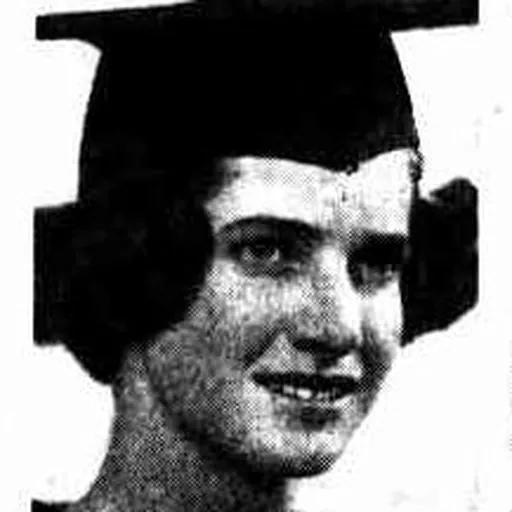
About Elizabeth Nesta Marks
Lived 1918 – 2002 (aged 84). Elizabeth Nesta Marks was an Australian entomologist, ecologist, epidemiologist and scientific collector.
Elizabeth Nesta "Pat" Marks (28 April 1918 – 25 October 2002) was an Australian entomologist who described 38 new mosquito species, as well as new species of fruit flies, bugs, cockroaches and ticks. She had a PhD in insect physiology from the University of Cambridge and was a member of the Royal Entomological Society of London.
Early life Marks was born in Dublin, Ireland, in 1918, and was known by the name Pat or Patricia for the Cathedral she was christened in (St Patrick's Cathedral). Her father, Ted (Edward Oswald) Marks, born in Brisbane in 1882, was a geologist and inventor (later an ophthalmologist) from a family of doctors. Ted Marks, travelled to Ireland twice to undertake his studies because of the absence of a university in Queensland. He left for Ireland in 1913 to conduct his medical studies and married Nesta Drury, also of Brisbane, in 1914. Their daughter Pat was born following his service in WW1 After attending St John's Cathedral School in Brisbane and the Glennie Memorial School in Toowoomba as a boarder, where she left as Dux of the school in 1934, she enrolled in the University of Queensland. She was interested in becoming a veterinarian, but her father encouraged her to pursue entomology. Marks excelled at swimming at school, was an accomplished horsewoman, getting her first horse at age 5, and participated in hockey at UQ. She also swam later for Cambridge. studying under supervisor, Dr Ronald Hamlyn-Harris. Dr Hamlyn-Harris was Brisbane's then leading entomologist studying the biological control of mosquitoes. Outbreaks of Dengue Fever affected both Brisbane and Cairns. the corethrellid midge Corethrella marksae is also named in her honor.
Study in Europe Marks worked for both the Queensland Health department and UQ until 1949 when she took leave to visit Europe. She visited Amsterdam, the London School of Hygiene and Tropical Medicine and the British Museum of Natural History (now Natural History Museum). Marks discovered a tiny marine insect on the reef near Heron Island, where a UQ research station was being established. It was named Corallocoris marksae in recognition of her discovery.
In 1958, Marks travelled to New Guinea for three months with funding from the Bishop Museum of Hawaii, and travelled to a remote region near the Mamberamo River. She would make later expeditions to New Guinea in 1959, 1961, 1966 and 1979.
Marks transferred to the QIMR when the Mosquito Control Committee was disbanded in 1973, working as the Principal Entomologist. However QIMR had no room for her until 1976, so she remained at UQ during that time. she joined the Samford Historical Society. She researched and championed protection of the Samford Bora rings (indigenous ceremonial sites) in the 1970s. Marks retired to Samford in 1982, raising and riding horses until she was 80. In 1990 she was appointed an Officer of the Order of Australia (AO) for her services to science, and in particular to entomology.
Elizabeth Nesta Marks died in 2002.
Writings
Marks, Elizabeth N. Studies of Queensland Mosquitoes. Brisbane: University of Queensland Press, 1947.
Other major publications included the Atlas of Common Queensland Mosquitoes (1966) and the 12-volume set The Culicidae of Australasia (1980–1989).
She published Insects of Australia, a history of Australian entomology in 1991.
In 2004, she co-wrote a memoir with Kathleen Cummins, Mosquitoes and Memories: Recollections of 'Patricia' Marks.
Legacy Elizabeth Marks alone or jointly described 38 new mosquito species (for example, Culiseta arenivaga Marks, 1968), She was well known for her practical streak, being able to solve problems with inventive solutions. She was equally famous for her Army metal soup ladle which was used to collect mosquito larvae and as an oar when an outboard motor might break down. This was published posthumously in 2004.
Over 70 boxes of her papers were donated to the University of Queensland Library upon her death. Many items relating to the social history of Queensland including furniture and cars were donated by Pat Marks and her extended family to the Queensland Museum, John Oxley Library at the State Library of Queensland, the Samford Museum and Queensland Art Gallery. The E.N. Marks' insect collection was donated to the University of Queensland.
The Marks family farm was sold off, but the old cottage now exists at the Queensland University of Technology’s Samford Ecological Research Facility (SERF).
Don’t just read it —
keep it.
Full-length biographies made to live with: read them, listen on the way to work, watch them tonight.
- E-book
- Audio
- Video
Instant download · yours to keep · every purchase keeps this site free
Important facts
more
Elizabeth N. Marks, E N Marks, MarksPeople in Elizabeth Nesta Marks's life
Named in this biography and alive at the same time





Related people
Same field, nearest in time
Contemporaries
People whose lives overlapped Elizabeth Nesta Marks's



Frequently asked questions
Who was Elizabeth Nesta Marks?
Australian entomologist (1918-2002)
When was Elizabeth Nesta Marks born?
Elizabeth Nesta Marks was born on 28 April 1918 in Dublin.
When did Elizabeth Nesta Marks die?
Elizabeth Nesta Marks died on 25 October 2002 in Brisbane.
What was Elizabeth Nesta Marks's occupation?
Elizabeth Nesta Marks was an entomologist, ecologist, epidemiologist and scientific collector.
What nationality was Elizabeth Nesta Marks?
Elizabeth Nesta Marks was Australian.
Sources & further reading
· Wikipedia: Elizabeth Nesta Marks
· DBpedia: Elizabeth Nesta Marks
Cite this page
APA: Biography.guide. (2026). Elizabeth Nesta Marks. https://biography.guide/elizabeth-nesta-marks/
MLA: "Elizabeth Nesta Marks." Biography.guide, https://biography.guide/elizabeth-nesta-marks/.
Chicago: "Elizabeth Nesta Marks." Biography.guide. https://biography.guide/elizabeth-nesta-marks/.
Data last updated: 2026-09-23 · Spot an error? Report a correction.
Portrait: Wikimedia Commons · author & licence
Page generated 2026-09-27 05:05 UTC