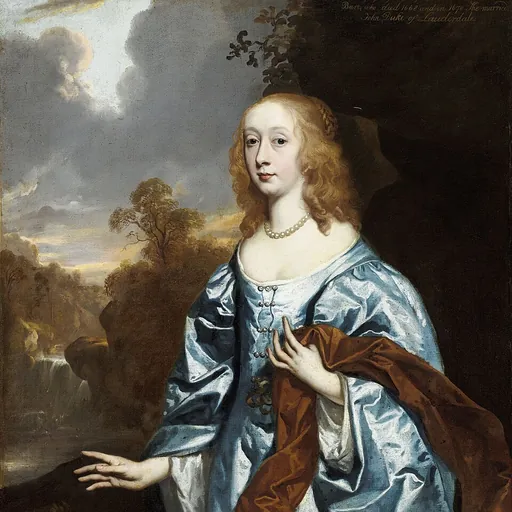
About Elizabeth Maitland, Duchess of Lauderdale
Lived 1626 – 1698 (aged 71). Elizabeth Maitland, Duchess of Lauderdale was an English spy.
Elizabeth Maitland, Duchess of Lauderdale (; 28 September 1626 – 5 June 1698) was a Scottish peeress. She was the eldest daughter of William Murray and his wife Catherine, the Earl and Countess of Dysart. She was raised in English court circles during the years leading up to the English Civil War and received a well-rounded education from her parents. Her first husband was Lionel Tollemache, with whom she had eleven children. In 1672, three years after Lionel's death, she married John Maitland and gained a prominent position in the restored court.
After her father's death, Maitland held the title of Countess of Dysart in her own right. After her remarriage in 1672, she was also the Duchess of Lauderdale. She was famous for the political influence she exercised and for her support for Charles II during his exile. As an associate of the secret Royalist organisation known as the Sealed Knot, she actively supported the return of the monarchy after the execution of Charles I. She was also a lifelong patron of artists, particularly Peter Lely. She died at the age of 71 at her family home, Ham House near Richmond by the Thames, and is buried in the nearby parish church.
Early life Murray was the eldest of the five daughters of William Murray, 1st Earl of Dysart, and his wife Catherine Bruce. Dysart was a close friend and groom of the bedchamber of Charles I. Murray's birth was recorded in the baptismal register at St. Martin-in-the-Fields in 1626. During that year, her parents moved to Ham House, near Richmond by the Thames, where she spent her childhood. Her father saw that she received a full education, which was unusual for women of the period, and her mother ensured she was prepared to run a household effectively.
English Civil War and first marriage During the English Civil War, Elizabeth's father was often away from the family in service to the King. Her mother took the opportunity to travel along the Thames to the court at Oxford, to spend time with William while also instructing her daughters in etiquette. Elizabeth developed a reputation for charisma and beauty, being described by Thomas Knyvett as "...a pretty witty Lass." After some years of searching for a suitable match, she married Sir Lionel Tollemache in 1648, a prudent choice for the daughter of a prominent Royalist given his apparent lack of political involvement, and one that created a stable marriage. The following year, Ham House was placed in the hands of trustees administered by Lionel, to help secure the estate from the threat of sequestration.
At the start of their marriage, Sir Lionel and Lady Dysart lived at Fakenham Magna in Suffolk, a wooded countryside near his family estate at Helmingham Hall and removed from much of the upheaval of war. They had eleven children, five of whom survived to adulthood:
Lionel Tollemache, 3rd Earl of Dysart (1649–1727), the eldest son, inherited the Earldom of Dysart on his mother's death in 1698. Thomas Tollemache (1651–1694), lieutenant-general and MP. Elizabeth Tollemache (1659–1735) married Archibald Campbell, 1st Duke of Argyll. William Tollemache (1661–1694) was a captain in the Royal Navy. Catherine Tollemache married James Stewart, Lord Doune and secondly John Gordon, 16th Earl of Sutherland.
alt=A richly attired young woman standing in front of a curtain, from which a black boy is emerging, offering her a platter of fruit. Elizabeth often based herself at Ham House after her mother's death in 1649. She became acquainted with the Parliamentarian Oliver Cromwell, probably when his army headquarters were located in nearby Kingston-upon-Thames in the summer of 1647, and the connection provided a cover for her own Royalist tendencies. She also used that friendship to successfully plead for the life of John Maitland, the royalist Earl of Lauderdale, after his capture at the Battle of Worcester. She and her husband were also granted the freehold of 75 acres surrounding Ham House in recognition of "the service done by the late Earl of Dysart and his daughter". Her enemies accused her of witchcraft because of her political influence and she was subject to unfounded accusations of having had a liaison with Cromwell. Her title as Countess of Dysart was secured by the grant of new Letters Patent on 5 December 1670, which also reaffirmed the ability of female heirs to inherit the title where no male heir existed.
Second marriage alt=A aristocratic man and woman, both richly attired and with long curly hair, seated together outside, with a landscape behind them. In 1669, her husband Lionel died in France and Elizabeth became the sole owner of Ham House, along with other properties including Framsden Hall in Suffolk. Soon after Lionel's death she became the mistress of John Maitland, Earl of Lauderdale,
In 1673, she and her husband initiated a series of alterations to Ham House to enlarge and modernise the property according to the latest style. The infill of the southern face of the house enabled the creation of a set of royal chambers on the first floor as well as separate apartments for the Duke and Duchess on the ground floor. Shortly after the completion of the apartments, Elizabeth commissioned the creation of a bathroom in the basement of the home, an indication of her attention to hygiene. The efforts to modernise the house and furnish it with luxury furnishings and artwork were used as an expression of their power and affluence.
Later life In early 1680, Elizabeth suffered a severe attack of gout which affected her health for the rest of her life. In the same year, John's health also deteriorated after suffering a stroke as well as bouts of scurvy and bladder stones. He resigned his government positions in September, at which point Elizabeth nursed him at Ham House. Maitland's death in April 1682 precipitated legal action by her brother-in-law Lord Tweedale over his debts and funeral expenses.
Elizabeth Murray was first described in popular literature in the 1975 book by Doreen Cripps, Elizabeth of the Sealed Knot, which was based on research within the Tollemache family archives. Several portraits of Elizabeth were painted throughout her life by a range of artists including Peter Lely, John Weesop, Joan Carlile and Benedetto Gennari. Her patronage of Lely extended over decades, with four paintings of her, including the double portrait with John Maitland which remains on view at Ham House.
Don’t just read it —
keep it.
Full-length biographies made to live with: read them, listen on the way to work, watch them tonight.
- E-book
- Audio
- Video
Instant download · yours to keep · every purchase keeps this site free
Important facts
Family & relationships
People in Elizabeth Maitland, Duchess of Lauderdale's life
Named in this biography and alive at the same time




Related people
Same field, nearest in time



Contemporaries
People whose lives overlapped Elizabeth Maitland, Duchess of Lauderdale's





Frequently asked questions
Who was Elizabeth Maitland, Duchess of Lauderdale?
Scottish noblewoman (1626-1698)
When was Elizabeth Maitland, Duchess of Lauderdale born?
Elizabeth Maitland, Duchess of Lauderdale was born on 28 September 1626 in London.
When did Elizabeth Maitland, Duchess of Lauderdale die?
Elizabeth Maitland, Duchess of Lauderdale died on 5 June 1698 in Ham House.
What was Elizabeth Maitland, Duchess of Lauderdale's occupation?
Elizabeth Maitland, Duchess of Lauderdale was a spy.
What nationality was Elizabeth Maitland, Duchess of Lauderdale?
Elizabeth Maitland, Duchess of Lauderdale was English.
Sources & further reading
· Wikipedia: Elizabeth Maitland, Duchess of Lauderdale
· DBpedia: Elizabeth Maitland, Duchess of Lauderdale
Cite this page
APA: Biography.guide. (2026). Elizabeth Maitland, Duchess of Lauderdale. https://biography.guide/elizabeth-maitland-duchess-of-lauderdale/
MLA: "Elizabeth Maitland, Duchess of Lauderdale." Biography.guide, https://biography.guide/elizabeth-maitland-duchess-of-lauderdale/.
Chicago: "Elizabeth Maitland, Duchess of Lauderdale." Biography.guide. https://biography.guide/elizabeth-maitland-duchess-of-lauderdale/.
Data last updated: 2026-09-20 · Spot an error? Report a correction.
Portrait: Wikimedia Commons · author & licence
Page generated 2026-09-27 04:57 UTC