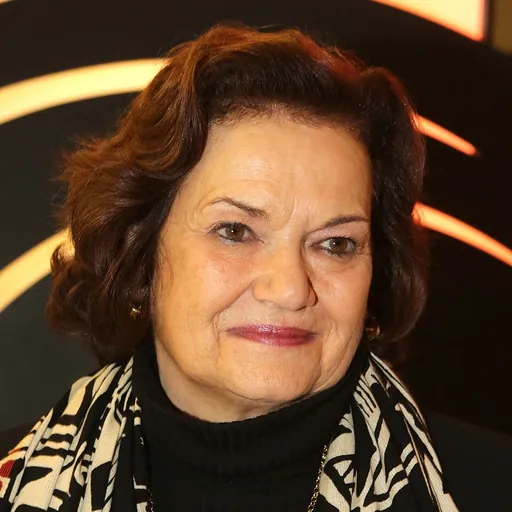
About Élisabeth Roudinesco
Born 1944. Élisabeth Roudinesco is a French historian and psychoanalyst.
Élisabeth Roudinesco (; born 10 September 1944) is a French scholar, historian and psychoanalyst. She conducts a seminar on the history of psychoanalysis at the École Normale Supérieure.
Roudinesco's work focuses mainly on psychiatry, psychology and psychoanalysis in France but also worldwide. She has written biographies of Jacques Lacan and Sigmund Freud. Her biography of Freud, Freud, In his Time and Ours, was awarded the "Prix Décembre" 2014 and The "Prix des Prix" 2014. With Michel Plon, she published a huge Dictionary of Psychoanalysis (7th édition in 2023), which was translated into many languages, though not yet into English. Her book Généalogies (also unpublished in English) was awarded The Best Book Prize by The Société française d'histoire de la médecine. Her work has been translated into thirty languages.
Life Roudinesco was born to half-Jewish parents in newly liberated Paris in September 1944, and grew up there. Her mother was Jenny Aubry, née Weiss, a daughter of the Judeo-Protestant bourgeoise, a renowned psychoanalyst and hospital neuro-paediatrician who spent her whole life looking after suffering children: abandoned, ill and in difficulty. She was an anglophile who, in the 1950s, introduced to France John Bowlby's theories on the importance of maternal care, and she worked in collaboration with the Tavistock Clinic in London. She was a friend of Jacques Lacan, and her sister was the feminist Louise Weiss, of the Javal family. Roudinesco's father was physician , of Romanian origin, who had "a passion for history and a phenomenal library". He was born in Bucharest in a Jewish and francophile milieu, and his father had been an editor.
She received her secondary education in Paris at the Collège Sévigné. She studied Literature at the Sorbonne, with a minor in Linguistics; her master's degree was supervised by Tzvetan Todorov, and her doctoral thesis, entitled Inscription du désir et roman du sujet [Inscription of the desire and novel of the subject], by Jean Levaillant at the University of Paris VIII in 1975.
She also took classes with Michel de Certeau, Gilles Deleuze and Michel Foucault at the time of her master's degree . She next defended her "habilitation à diriger des recherches" (H.D.R – the French accreditation needed to supervise doctoral dissertations) in 1991 with Michelle Perrot as supervisor and Alain Corbin, Dominique Lecourt, Jean-Claude Passeron, Robert Castel, and Serge Leclaire as members of the examining committee. This work was published under the title Généalogies.
From 1969 to 1981, she was a member of the École Freudienne de Paris, founded by psychoanalyst and philosopher Jacques Lacan. She was also a member of the editorial board of Action Poétique (1969–1979). She has written for French national newspapers, Libération (1986–1996), and then Le Monde since 1996.
For the past 30 years, she has been married to Olivier Bétourné, CEO of Éditions du Seuil.
Methodology
Literary In the 1970s, Elisabeth Roudinesco's first works dealt with literary criticism, notably with Raymond Roussel, Antonin Artaud, Bertolt Brecht and Louis-Ferdinand Céline. At that time, her work concerned linking a singular trajectory and an author's work, without resorting to psycho-biography, in other words, the psychologization of literary work by the clinical study of its author. This approach allowed her to demonstrate that most of 20th century literature has been influenced by the history of Freudianism and psychological medicine based on the theory of degeneration.
History of psychoanalysis in France From 1979, Elisabeth Roudinesco writes a history of psychoanalysis in France. At that time, the main model was still the biography, because the archives and documents of the psychoanalytical movement were still in the hand of Freud's heirs.
Indeed, this model corresponded to the historiographical trend centered on the notion of the founding father figure; a trend which is at the core of any quest of origins. However, this model has gradually declined.
Considering how psychoanalysis was established as a movement and system of thought, Elisabeth Roudinesco asserted that France was the only country where all the necessary conditions were gathered together, over a long period of time, to successfully establish Freudianism in scientific and cultural life. According to Elisabeth Roudinesco, this favorable situation dated back first to the French Revolution of 1789 which provided a scientific and legal legitimacy to reason, heed/gaze over madness, giving birth to the institution of the asylum. Then, the Dreyfus affair, which has precipitated the arrival of intellectuals' self-awareness as a class. Designating themselves as an 'avant-garde', they furnished fruitful and innovative ideas. Finally, the emergence of literary modernity with Baudelaire, Rimbaud and Lautréamont, who enunciate, in a new style of writing, the project of changing man through "I is another".
Ellenberger Scholarly historiography emerged with such work as Henri Ellenberger's The Discovery of the Unconscious: The History and Evolution of Dynamic Psychiatry, first published in 1970. Though this book had been known in English-speaking countries since that date, the book (published in French in 1974) remained largely unnoticed in France. Elisabeth Roudinesco republished it with a lengthy new preface in 1994.
In his work, Ellenberger developed a conceptuality of freudianism founded on archivistics and reference to the concepts of "mental tools", "long length" and "system of thought". This last category proposed presenting doctrines in their own terms and structures. The study of the system of thought of dynamic psychiatry, psychotherapies and psychological medicine no longer echoes back to a single founder, but to a plurality of singular itineraries, shattering the biographic model.
Positions
Since 1997, she has expressed her opinions on various subjects. She talked about subjects such as laicity, cloning, and genetics. She fiercely criticized INSERM's reports of experts over psychotherapies, as the reports were critical of psychoanalysis.
Don’t just read it —
keep it.
Full-length biographies made to live with: read them, listen on the way to work, watch them tonight.
- E-book
- Audio
- Video
Instant download · yours to keep · every purchase keeps this site free
Important facts
People in Élisabeth Roudinesco's life
Named in this biography and alive at the same time





Related people
Same field, nearest in time

Contemporaries
People whose lives overlapped Élisabeth Roudinesco's



Frequently asked questions
Who is Élisabeth Roudinesco?
French historian and psychoanalyst
When was Élisabeth Roudinesco born?
Élisabeth Roudinesco was born on 10 September 1944 in Paris.
What is Élisabeth Roudinesco's occupation?
Élisabeth Roudinesco is a historian and psychoanalyst.
What nationality is Élisabeth Roudinesco?
Élisabeth Roudinesco is French.
Sources & further reading
· Wikipedia: Élisabeth Roudinesco
· DBpedia: Élisabeth Roudinesco
Cite this page
APA: Biography.guide. (2026). Élisabeth Roudinesco. https://biography.guide/elisabeth-roudinesco/
MLA: "Élisabeth Roudinesco." Biography.guide, https://biography.guide/elisabeth-roudinesco/.
Chicago: "Élisabeth Roudinesco." Biography.guide. https://biography.guide/elisabeth-roudinesco/.
Data last updated: 2026-09-21 · Spot an error? Report a correction.
Portrait: Wikimedia Commons · author & licence
Page generated 2026-09-27 04:59 UTC