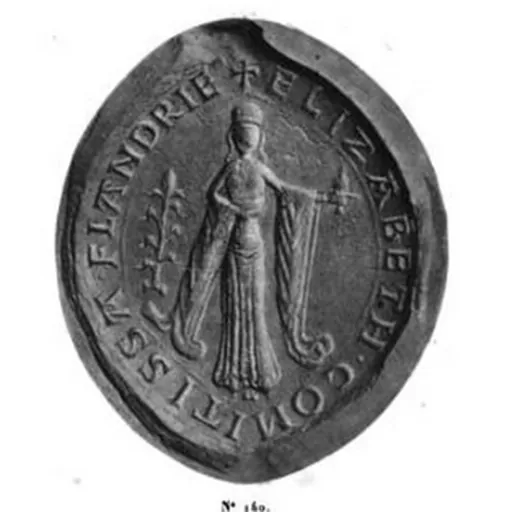
About Elisabeth, Countess of Vermandois
Lived 1143 – 1183 (aged 39–40). Elisabeth, Countess of Vermandois was a French politician.
Elisabeth (French: Élisabeth), also known as Isabelle Mabille (1143 – 28 March 1183), was ruling Countess of Vermandois from 1168 to 1183, and also Countess of Flanders by marriage to Philip I, Count of Flanders. She was the eldest daughter of Ralph I, Count of Vermandois and his second spouse, Petronilla of Aquitaine.
Life Elisabeth was the daughter of Count Ralph I of Vermandois and Petronilla of Aquitaine. Her father was a high-ranking noble closely tied to the French king. Her mother was the younger sister of Eleanor of Aquitaine, the Queen of France (r. 1137–1152) and then of England (r. 1152–1189). This made Elisabeth first cousin to both Richard I of England and John of England. Ralph had divorced his first wife, Eleonore. However, his marriage to Petronilla had been viewed as illegitimate by Pope Innocent II, the marriage was later legitimized by Pope Celestine II thus allowing Isabelle Mabile to possibly inherit.
Marriage
On 14 October 1152, Elisabeth's father died, and her brother Ralph was made Count of Vermandois. In 1159, Elisabeth married Philip I, Count of Flanders. Elisabeth’s dowry included land in Amiens, making her marriage politically valuable. Gislebert of Mons describes noble rule in the twelfth century as a territorial authority that depended heavily on dynastic marriage and inheritance claims. This helped explain Elisabeth’s political importance as Countess of Vermandois. As reflected in chronicles such as the Chronicle of Gislebert of Mons, political authority in the twelfth century was closely connected to hereditary claims, marriage alliances, and the consolidation of territories through inheritance. The following year, Elisabeth's brother Ralph married Philip's sister Margaret. In the same year, Hugh abdicated from his position as count to become a monk; therefore, Ralph succeeded as count, Elisabeth was then promoted to first in line, and her sister Eleonore was second. The sisters stayed closely associated to siblings and relatives: they supported each other politically, and their marriages linked multiple powerful regions.
Rule In 1167, Elisabeth's brother Ralph died of leprosy. As his marriage to Margaret had proved childless, Elisabeth inherited the County of Vermandois, which she ruled over jointly with her husband; this pushed Flemish authority further south, to its greatest extent thus far, and threatened to completely alter the balance of power in northern France.
When Elisabeth first became a countess, she was very young. Her mother-in-law, Countess Sybilla, was still active and powerful. Early on, Elisabeth mostly observed and learned, and appeared in documents as “wife of the count.” At the beginning of her rule, she had a more symbolic role rather than a governing one, but her authority developed gradually. Around age 16, Elisabeth became more active in ruling. She received her own lands, began appearing in official documents, and took part in political negotiations, religious patronage, and local governance. This shifted her role from simply a wife to a countess, an active political figure. Elisabeth’s responsibilities included supporting monasteries and churches, confirming land ownership and rights, enforcing authority over towns and officials, and participating in diplomacy. Because of this, Phillip had Walter beaten to death. Philip then obtained complete control of her lands in Vermandois from King Louis VII of France. In 1177, when Philip left for the Holy Land, he designated his sister Margaret and her second husband, Baldwin V, Count of Hainaut, as his heirs.
Elisabeth died at Arras on 28 March 1183 aged thirty-nine or forty, prompting King Philip II of France to seize Vermandois on behalf of her sister, Eleonore, who succeeded her. Elisabeth was buried at Amiens Cathedral.
Don’t just read it —
keep it.
Full-length biographies made to live with: read them, listen on the way to work, watch them tonight.
- E-book
- Audio
- Video
Instant download · yours to keep · every purchase keeps this site free
Important facts
People in Elisabeth, Countess of Vermandois's life
Named in this biography and alive at the same time

Related people
Same field, nearest in time

Contemporaries
People whose lives overlapped Elisabeth, Countess of Vermandois's
Frequently asked questions
Who was Elisabeth, Countess of Vermandois?
French noblewoman
When was Elisabeth, Countess of Vermandois born?
Elisabeth, Countess of Vermandois was born in 1143.
When did Elisabeth, Countess of Vermandois die?
Elisabeth, Countess of Vermandois died on 28 March 1183 in Arras.
What was Elisabeth, Countess of Vermandois's occupation?
Elisabeth, Countess of Vermandois was a politician.
What nationality was Elisabeth, Countess of Vermandois?
Elisabeth, Countess of Vermandois was French.
Sources & further reading
· Wikipedia: Elisabeth, Countess of Vermandois
· DBpedia: Elisabeth, Countess of Vermandois
Cite this page
APA: Biography.guide. (2026). Elisabeth, Countess of Vermandois. https://biography.guide/elisabeth-countess-of-vermandois/
MLA: "Elisabeth, Countess of Vermandois." Biography.guide, https://biography.guide/elisabeth-countess-of-vermandois/.
Chicago: "Elisabeth, Countess of Vermandois." Biography.guide. https://biography.guide/elisabeth-countess-of-vermandois/.
Data last updated: 2026-10-01 · Spot an error? Report a correction.
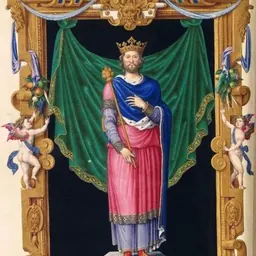
Portrait: Wikimedia Commons · author & licence
Page generated 2026-10-05 03:14 UTC