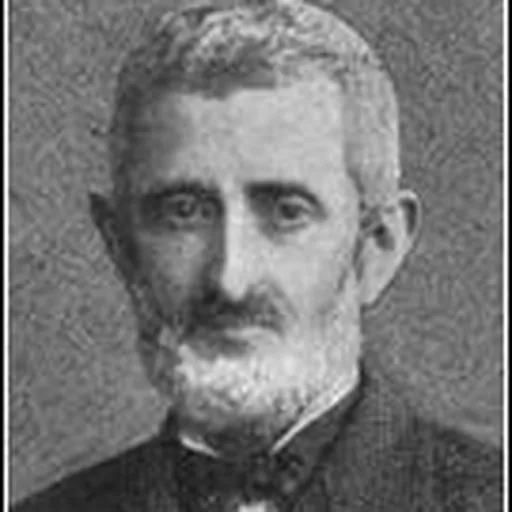
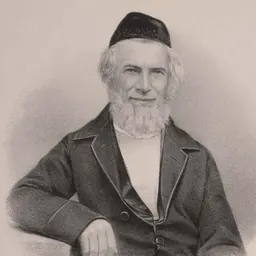
About Elijah Benamozegh
Lived 1823 – 1900 (aged 76). Elijah Benamozegh was an Italian rabbi, philosopher, biblical scholar and kabbalist.
Elijah Benamozegh (24 April 1823 – 6 February 1900), sometimes Elia or Eliyahu, was an Italian Sephardic Orthodox rabbi and renowned Jewish Kabbalist, highly respected in his day as one of Italy's most eminent Jewish scholars.
Life He was born in Livorno. The name Benamozegh means "son of Amazigh". His father (Abraham) and mother (Clara), Moroccan Jewish natives of Fez, Morocco, died when Elijah was only four years old. He entered school early, where, besides instruction in the elementary sciences, he received tuition in Hebrew, English, and French, excelling in the latter. Benamozegh was fluent in various languages,
In his theological works, Benamozegh suggested to explain the Christian dogmas of the Trinity and Incarnation as an oversimplified and corrupt version of the Kabbalistic-panentheistic doctrine of Divine Emanations. While he disagreed with the Trinitarian Christian theology, he considered it, unlike most other Orthodox rabbis, an erroneous misunderstanding of subtle Kabbalistic doctrines rather than a major deviation from monotheism. Moreover, he claimed that Christianity is too monotheistic in comparison with the Kabbalah, which views all Pagan deities in their essence as partial manifestations or faces of the Absolute. Similarly, Benamozegh criticized the Christian view of Jesus as incarnated God on monistic or panentheistic grounds. According to Benamozegh's Kabbalistic view, the entire world is an incarnation of the Shekhinah, the feminine aspect of Divinity. He believed that Hinduism is closer in this respect to mystical Judaism than Christianity.
Benamozegh offered a novel mystical interpretation of Ludwig Feuerbach's atheistic philosophy. Feuerbach wrote that God is merely a product of human mind. Benamozegh explained that Feuerbach is essentially right; However, what people call "God" is a limited human perception of the apophatic, Infinite Absolute.
Indeed, dualistic, panentheistic, and highly complex views of the Godhead are common in the Kabbalistic literature. A number of known rabbis criticized Kabbalah for Gnostic-like dualistic views of God.
A particular interest was evolutionary theory and its universalist implications. Over time, Benamozegh came to view Darwin's theory of the common descent of all life as evidence in support of Kabbalistic teachings, which he synthesized to offer a majestic vision of cosmic evolution, with radical implications for understanding the development of morality and religion itself.
Benamozegh's universalist views were recently promoted by Adin Steinsaltz, who made a somewhat similar attempt to unify all major world religions and philosophies.
Cosmopolitanism and patriotism Benamozegh considered himself, simultaneously, an Italian patriot and a cosmopolitan. He believed that authentic mystical core of the Jewish tradition, which he called "Hebraism" as opposed to more isolationist exoteric Judaism, is profoundly universal and capable of uniting all world religions and nations into one brotherly cosmopolitan network. While Benamozegh believed in the unique spiritual mission of the Jews, his idea of Jewish chosenness was far from narrow particularism. According to his worldview, the Jews are chosen to serve the humanity as a priestly people, by proving a common mystical ground that transcends the boundaries of the nations and religious traditions. He also emphasized the impact of other cultures on Judaism, starting from the ancient Egyptian paganism, as well as the great role of the proselytes in the Jewish history. Unlike some exclusivist Kabbalists, Benamozegh believed that Kabbalah is a universal theology that unites all human beings and views them as equals.
At the same time, Benamozegh was a staunch Italian patriot. He even wrote a daring formulation, based on the Jewish declaration of faith: O Israelites, that you will always love Italy, that you will love her with all your heart, with all your soul, with all your mind. Apparently, according to his panentheistic philosophy, Benamozegh viewed the Italian soil as a specially beloved expression of the Shekhinah.
Works "Emat Mafgia'" (The Fear of the Opponent), a refutation of Leon of Modena's attacks upon the Cabala, in 2 vols., Leghorn, 1858 "Ger Tzedek" (A Righteous Proselyte), critical notes on Targum Onkelos, ib., 1858 "Ner le-David" (Lamp of David), commentary on the Psalms, published together with the text, ib., 1858 "Em la-Mikra" (Matrix of Scripture), commentary on the Pentateuch containing critical, philological, archeological, and scientific notes on the dogmas, history, laws, and customs of the ancient peoples, published together with the text under the title "Torat Adonai," Leghorn and Paris, 1862–65 "Ta'am Leshad," refutation of Samuel David Luzzatto's dialogue on the Cabala, Leghorn, 1863 'Spinoza et la Kabbale', in L'Univers Israélite, Paris, 1863; (english translation "Spinoza and Kabbalah", éditions localement transcendantes, Puyméras, 2024) "Mebo Kelali," general introduction to the traditions of Judaism, published in "Ha-Lebanon," 1864, pp. 73 et seq. "Storia degli Esseni," Florence, 1865 "Morale Juive et Morale Chrétienne. Examen Comparatif Suivi de Quelques Réflexions sur les Principes de l'Islamisme," Paris, 1867 "Jewish and Christian Ethics with a Criticism on Mahomedism" (English translation of the above. E. Blochman, 1873) "Teologia Dogmatica ed Apologetica," Leghorn, 1877 (on metaphysics) "Le Crime de la Guerre Dénoncé à L'Humanité," Paris, 1881 (this work won for its author a medal and honorable mention from the League of Peace and Freedom, on the proposition of Jules Simon, Édouard Laboulaye, and Frédéric Passy) "Ya'aneh be-Esh" (He Will Answer Through Fire), discussion of cremation according to the Bible and the Talmud, Leghorn, 1886. "Israël et l'Humanité" (Israel and Humanity), discussion of universal religion and the roles of and relationships between Judaism, Christianity, and Islam, 1914 (posthumous, edited by ).
Don’t just read it —
keep it.
Full-length biographies made to live with: read them, listen on the way to work, watch them tonight.
- E-book
- Audio
- Video
Instant download · yours to keep · every purchase keeps this site free
Important facts
People in Elijah Benamozegh's life
Named in this biography and alive at the same time



Related people
Same field, nearest in time



Contemporaries
People whose lives overlapped Elijah Benamozegh's




Frequently asked questions
Who was Elijah Benamozegh?
Italian rabbi (1823–1900)
When was Elijah Benamozegh born?
Elijah Benamozegh was born on 24 April 1823 in Livorno.
When did Elijah Benamozegh die?
Elijah Benamozegh died on 2 February 1900 in Livorno.
What was Elijah Benamozegh's occupation?
Elijah Benamozegh was a rabbi, philosopher, biblical scholar and kabbalist.
What nationality was Elijah Benamozegh?
Elijah Benamozegh was Italian.
Sources & further reading
· Wikipedia: Elijah Benamozegh
Cite this page
APA: Biography.guide. (2026). Elijah Benamozegh. https://biography.guide/elijah-benamozegh/
MLA: "Elijah Benamozegh." Biography.guide, https://biography.guide/elijah-benamozegh/.
Chicago: "Elijah Benamozegh." Biography.guide. https://biography.guide/elijah-benamozegh/.
Data last updated: 2026-09-20 · Spot an error? Report a correction.
Page generated 2026-09-27 05:09 UTC