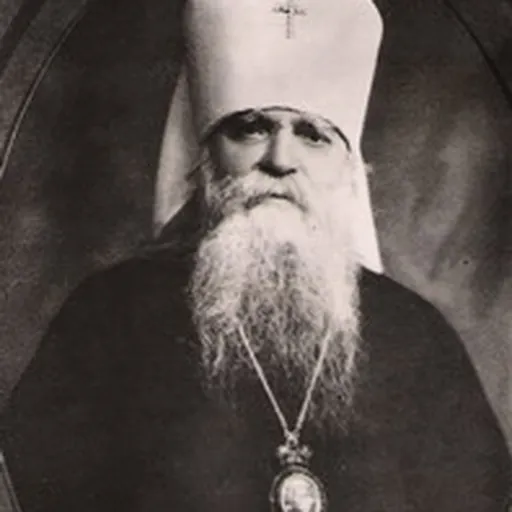
About Eleuteriusz
Lived 1868 – 1940 (aged 72). Eleuteriusz was a metropolitan and eastern Orthodox priest.
Biography
Early activity He was born into the family of a poor church psalmist in Kursk Governorate. He graduated from the theological seminary in Kursk and then taught at the church school in Yamskaya Sloboda, during which time he got married. Until 1917, he stayed at the Donskoy Monastery in Moscow. There, on 24 May 1920, he attended a meeting with representatives of the Polish Ministry of Religious Denominations and Public Enlightenment, who considered entrusting him with the administration of the Diocese of Chełm and Warsaw and, in the future, supporting efforts toward the autocephaly of the church in Poland. However, ultimately, the other cleric present at the meeting – Bishop Vladimir of Białystok – was deemed a better candidate.
On 28 June 1921, Patriarch Tikhon appointed him head of the Diocese of Vilnius and Lithuania with the title of archbishop. Traditionally, he also held the position of superior of the Monastery of the Holy Spirit in Vilnius. He also criticized the decision by some Orthodox bishops to hold discussions with the Polish state authorities regarding the future organization of the church. He participated in a council of Orthodox bishops in Poland on 30 May 1922, during which he opposed a declaration by Metropolitan George that Orthodox issues in Poland should be resolved without consultation with Moscow (i.e., neither with the patriarchate nor with the Bolshevik-supported Living Church). Together with locum tenens of the Grodno Diocese, Vladimir, he proposed an amendment stating that the council of Polish bishops, if faced with issues under the patriarch's jurisdiction, could only act unanimously. However, this amendment was not accepted, leading Eleutherius and Vladimir to leave the council proceedings. Both hierarchs issued their own statement, claiming that the actions of Metropolitan George and the bishops supporting him violated canon law. They emphasized that they would only support potential efforts for autocephaly if Patriarch Tikhon explicitly approved the Polish Church's independence. Citing poor health, Archbishop Eleutherius did not attend the next bishops' assembly on 15 June 1922, which voted to request autocephaly from the Ecumenical Patriarch of Constantinople. He was also not appointed to the Most Holy Synod of the church in Poland, established during the council. View of the Camaldolese monastery in Kraków, where Archbishop Eleutherius was forcibly confined for three months. The reason for his removal from the Vilnius cathedral and internment was his strong opposition to efforts to grant autocephalous status to the Orthodox Church in Poland In response, Archbishop Eleutherius convened a meeting of the clergy from his diocese in Vilnius, which on June 30 adopted a protest against the actions of Metropolitan George and other proponents of autocephaly, sending it to other canonical Orthodox Churches. Some Russian White émigré organizations also signed the letter. Archbishop Eleutherius refused to pay the required contributions to support the church and even forbade priests in his diocese from praying for Metropolitan George during services.
His outspoken opposition to George and the bishops supporting him led to his removal from the cathedral. On 6 September 1922, a synod composed of three hierarchs – Metropolitan George, Archbishop Dionysius Waledyński, and Bishop Alexander Inozemtsev – deemed his actions "non-canonical, illegal, and anarchistic" and relieved him of the administration of the Vilnius Diocese. On 14 September 1922, Archbishop Eleutherius was detained immediately after celebrating the Divine Liturgy in the monastery Church of the Holy Spirit in Vilnius and spent three months at the Camaldolese Priory in Kraków. Despite efforts to keep his internment secret, his situation came to light, sparking protests from Belarusian and Ukrainian minority deputies, as well as from the faithful of the Vilnius Diocese. In 1923, the Lithuanian government designated Kaunas as the seat of the Orthodox Church leader within Lithuania's borders. On 29 March 1922, the Lithuanian authorities, despite initial reservations, tentatively accepted Archbishop Eleutherius for this position and abandoned efforts to detach the Lithuanian diocese from the Russian Church; On 4 December 1924, Patriarch Tikhon awarded him the right to wear a diamond cross on his klobuk for his pastoral work. He also sought to establish Orthodox charitable associations in Lithuania. He was the initiator of the diocese's press organ, initially the Russian-language Lithuanian Diocesan News, later renamed Voice of the Lithuanian Orthodox Diocese. He contributed to the construction of a new cathedral in Kaunas, intended as a temporary seat for Vilnius bishops. His main focus, however, was the restoration of parish life, which had largely collapsed on Lithuanian territory after World War I due to the mass exodus of clergy and believers to Russia. Metropolitan Eleutherius reorganized several parishes in Lithuania, ordained new priests to minister in rural parishes, repaired existing churches, and initiated the construction of new ones to replace those built during the Tsarist era or those set up in Catholic churches requisitioned by the state, which Orthodox believers returned to their rightful owners after 1918.
During disputes between locum tenens of the Moscow Patriarchate, Metropolitan Sergius, and hierarchs opposed to his loyalty to Soviet authorities, he unequivocally supported the former. Initially, Metropolitan Sergius assigned the vacant exarch position to Archbishop Vladimir of Nice, the Exarchate's vicar bishop. However, when Archbishop Vladimir declined, Metropolitan Eleutherius was appointed as the new exarch. Despite this new role, he remained on the Lithuanian throne, continuing to reside in Kaunas. Archbishop Theodosius Feodosiev voluntarily relinquished the see to him and acknowledged the jurisdiction of the Russian Orthodox Church. On 20 December 1939, Metropolitan Sergius of Moscow and Kolomna confirmed Eleutherius' authority to govern the entire Vilnius and Lithuanian diocese within its pre-1914 borders. However, in the following year, afflicted by meningitis, he resigned and retired to the Monastery of the Holy Spirit in Vilnius, where he later died. He was buried in the monastery church.
His brother, Ivan (who took monastic vows under the name Isidore), was also an Orthodox bishop.
Don’t just read it —
keep it.
Full-length biographies made to live with: read them, listen on the way to work, watch them tonight.
- E-book
- Audio
- Video
Instant download · yours to keep · every purchase keeps this site free
Important facts
People in Eleuteriusz's life
Named in this biography and alive at the same time

Related people
Same field, nearest in time



Contemporaries
People whose lives overlapped Eleuteriusz's


Frequently asked questions
Who was Eleuteriusz?
clergyman of the Russian Orthodox Church (1868–1940)
When was Eleuteriusz born?
Eleuteriusz was born on 14 September 1868 in Novy Oskol.
When did Eleuteriusz die?
Eleuteriusz died on 31 December 1940 in Vilnius.
What was Eleuteriusz's occupation?
Eleuteriusz was a metropolitan and eastern Orthodox priest.
Sources & further reading
· DBpedia: Eleutherius Bogoyavlensky
Cite this page
APA: Biography.guide. (2026). Eleuteriusz. https://biography.guide/eleuteriusz/
MLA: "Eleuteriusz." Biography.guide, https://biography.guide/eleuteriusz/.
Chicago: "Eleuteriusz." Biography.guide. https://biography.guide/eleuteriusz/.
Data last updated: 2026-09-21 · Spot an error? Report a correction.
Portrait: Wikimedia Commons · author & licence
Page generated 2026-09-27 05:00 UTC