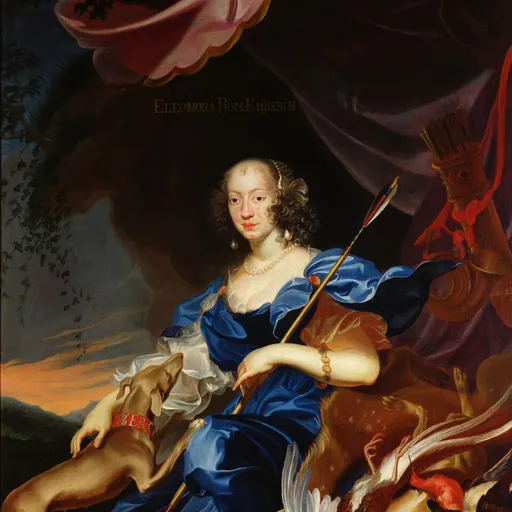
Eleonora Gonzaga
Austrian queen
About Eleonora Gonzaga
Lived 1630 – 1686 (aged 56). Eleonora Gonzaga was a German emperor.
Eleonora Gonzaga (18 November 1630 – 6 December 1686) was by birth Princess of Mantua, Nevers and Rethel from the Nevers branch of the House of Gonzaga, and was Holy Roman Empress, German Queen, Queen consort of Hungary and Bohemia by marriage to Emperor Ferdinand III.
Nicknamed the Younger (de: Jüngere) to distinguish herself from her namesake grandaunt, she was considered one of the most educated and virtuous women of her time. Fascinated by religious poetry, she founded a literary academy and was also a patron of musical theater. As Holy Roman Empress, she promoted the development of cultural and spiritual life at the Imperial court in Vienna, and despite being a staunch Catholic and benefactress of several monasteries, she had a tolerant attitude towards Protestantism.
She established two female orders: the Order of Virtuosity (1662) and the Order of the Starry Cross (1668).
Life Early years Eleonora was born on 18 November 1630 in Mantua, as the second child of Charles Gonzaga, styled Duke of Nevers (heir of the Duchy of Mantua), and his wife and cousin Maria Gonzaga (heiress to the Duchy of Montferrat). On her father's side her grandparents were Charles Gonzaga, Duke of Nevers and Rethel and Catherine of Mayenne—a member of the House of Lorraine —and on her mother's side her grandparents were Francesco IV Gonzaga, Duke of Mantua, and Margaret of Savoy.
She was named after her mother's paternal aunt Holy Roman Empress Eleonora, who was also her godmother. The marriage of Eleonora's parents was made with the purpose to reinforce the claims of the Nevers branch of the House of Gonzaga to the duchies of Mantua and Montferrat when the main line would become extinct. The duke of Nevers, a vassal of the Kingdom of France, had to face the opposition of Ferrante II Gonzaga, Duke of Guastalla, who counted with the support of the Holy Roman Empire, the Kingdom of Spain and Duchy of Savoy, and thus started the War of the Mantuan Succession, during which infant Eleonora, with her parents and older brother Charles had to leave Mantua, but returned one year later after the signing of the Treaty of Cherasco (19 June 1631), under which were recognized the rights of Duke Charles of Nevers over the duchies of Mantua (as the closest male relative of the extinct main line of the House of Gonzaga) and Montferrat (due to the marriage of his heir with Maria Gonzaga, the last surviving scion of the main Gonzaga line and heiress of that duchy, which was demonstrably heritable by females since the Gonzagas had acquired it through marriage to Margherita Paleologa in 1540); however one month later (30 August 1631), Eleonora's father died of tuberculosis, and began a series of political conflicts between Duke Charles and her daughter-in-law, who ended with the banishment of Margaret of Savoy (Maria's mother) from Mantua.
During this time, Eleonora lived in the Church of Sant'Orsola, where she remained with her mother until 1637, when after the death of her grandfather, her older brother became the new duke of Mantua and Montferrat under the regency of their mother Maria. The princess received an excellent education, being fluent in French, Spanish and Italian, well versed in literature, music and art, and expert in dances and embroidery. Already in her adolescence she manifested a poetic talent, which was expressed in her compositions of philosophical and religious poems.
Death The last years of Eleonora's life were overshadowed by the epidemic of plague in 1679 and beginning of the Great Turkish War in 1683, in which, although the empire won, serious material damage was inflicted on the possessions of the dowager empress. In both cases, she had to flee from Vienna: the first time to Prague and Linz, and in the second to Linz and Innsbruck. Eleanora died in Vienna on 6 December 1686 and was buried in the Imperial Crypt. 15= 15. Catalina Micaela of Spain
Don’t just read it —
keep it.
Full-length biographies made to live with: read them, listen on the way to work, watch them tonight.
- E-book
- Audio
- Video
Instant download · yours to keep · every purchase keeps this site free
Important facts
People in Eleonora Gonzaga's life
Named in this biography and alive at the same time
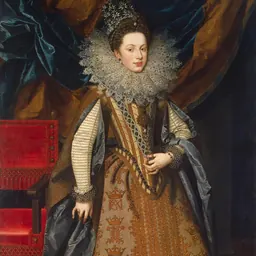

Related people
Same field, nearest in time

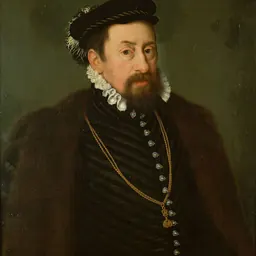
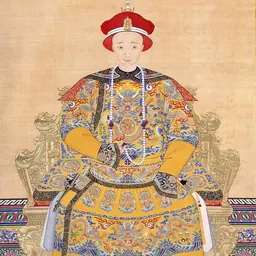

Contemporaries
People whose lives overlapped Eleonora Gonzaga's





Frequently asked questions
Who was Eleonora Gonzaga?
Austrian queen
When was Eleonora Gonzaga born?
Eleonora Gonzaga was born on 18 November 1630 in Mantua.
When did Eleonora Gonzaga die?
Eleonora Gonzaga died on 6 December 1686 in Vienna.
What was Eleonora Gonzaga's occupation?
Eleonora Gonzaga was an emperor.
What nationality was Eleonora Gonzaga?
Eleonora Gonzaga was German.
Sources & further reading
· DBpedia: Eleonora Gonzaga (born 1630)
Cite this page
APA: Biography.guide. (2026). Eleonora Gonzaga. https://biography.guide/eleonora-gonzaga-emperor/
MLA: "Eleonora Gonzaga." Biography.guide, https://biography.guide/eleonora-gonzaga-emperor/.
Chicago: "Eleonora Gonzaga." Biography.guide. https://biography.guide/eleonora-gonzaga-emperor/.
Data last updated: 2026-09-20 · Spot an error? Report a correction.
Portrait: Wikimedia Commons · author & licence
Page generated 2026-09-27 04:57 UTC