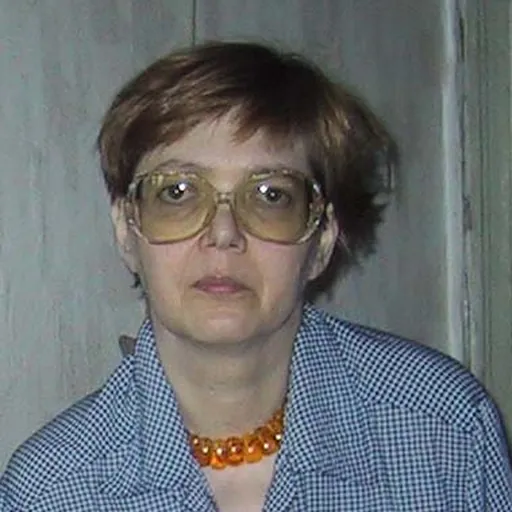
Elena Oznobkina
Russian philosopher and human rights activist
About Elena Oznobkina
Lived 1959 – 2010 (aged 50). Elena Oznobkina was a Russian linguist, philosopher, human rights defender, translator, pedagogue and university teacher.
Elena Vyacheslavovna Oznobkina (; 25 April 1959 – 10 March 2010) was a philosopher, theorist, historian of philosophy, lecturer, translator, editor, journalist, researcher of penitentiary systems, and Russian human rights activist. She is best known as a researcher of modern Western philosophy, a translator and editor of translations of Nietzsche and Husserl into Russian, a critic of the Russian penitentiary system, and the editor of the Russian edition of Index on Censorship magazine.
Life and career Born in Moscow USSR, Oznobkina grew up in a family, whose parents were a government official and an agricultural scientist. She received a typical cultured middle-class upbringing. Oznobkina attended Moscow State University from 1977 to 1982, majoring in the history of Western philosophy. She defended her Specialist Diploma thesis, entitled "The Unity of three Kant's Critiques", in 1982. After graduation, Oznobkina worked as a lecturer/assistant professor at the Moscow Institute of Agricultural Engineers, and did research as a part-time graduate student at the Institute of Philosophy of the Academy of Sciences of USSR.
She defended her Candidate of Science Dissertation (equivalent of PhD. thesis), entitled "Heidegger's Critique of Kant", in 1987, and become a researcher at the Institute of Philosophy of the Academy of Sciences of USSR in 1988.
She worked at the Institute of Philosophy since 1988, first, as a researcher, at the section of Postclassic Western Philosophy, and afterwards, as a senior researcher, at the section of the section of Analytical Anthropology until her death, which followed after a long period of incurable disease, which limited her to her apartment in the last years of her life.
As it often happens in Russian philosophy, her thought found its expression not in monographs, but mostly in articles, university courses, interviews, and reviews. Although these are "small forms", they were no less influential, than many books. As well, her editorship legacy is very influential in ideological culture of modern Russia.
Academic activity In 1982 Oznobkina started her academic career as Lecturer/Assistant Professor at the Moscow institute of Agricultural Engineers, where she delivered various courses on history of philosophy until 1987, when she became a full-time researcher. In 1993–2002, she was an invited lecturer at the Russian State University for the Humanities and at State Academic University for the Humanities. She developed and taught such courses as: "Introduction into Philosophical Anthropology", "Corporeality in Philosophy of Modernity", "Kant's Anthropology: Modern Revision", "Classic and Modern Philosophy of Punishment", and others.
Kant's Anthropology
In a series of lectures for Russian State University for the Humanities, Oznobkina built an interpretation of Kant, which is in many ways opposite to the classic for modern Russia, Merab Mamardashvili's interpretation. She insists that Kant's philosophical experience is very "aggressive", and entails removal of many phenomena from the space of classic European philosophy, due to natural language limitation. Oznobkina states that comparison of Kant's logic and classic logic allows to discover borders of Kant's "cultural utopia", and causes of incongruency of his philosophical language.
Editorship, translation and publishing activities In last 15 years, Oznobkina concentrated her research interests on the analytical critique of penitentiary system. She combined it with research on variegated aspects of the Russian and Soviet prison system, and the promotion of human rights of prisoners. She was one of editors of the Russian edition of the Index on Censorship magazine (from 1997
Human rights activism Starting in 1992 Oznobkina became active in human rights movement. She participated in activities of the "Glastnost Defence Foundation", and the Committee for Public Investigation on Chechnya (since 1994).
Other activities Oznobkina was an avid philatelist, and published several articles in Russian philatelist magazines.
Don’t just read it —
keep it.
Full-length biographies made to live with: read them, listen on the way to work, watch them tonight.
- E-book
- Audio
- Video
Instant download · yours to keep · every purchase keeps this site free
Important facts
People in Elena Oznobkina's life
Named in this biography and alive at the same time

Related people
Same field, nearest in time


Contemporaries
People whose lives overlapped Elena Oznobkina's


Frequently asked questions
Who was Elena Oznobkina?
Russian philosopher and human rights activist (1959–2010)
When was Elena Oznobkina born?
Elena Oznobkina was born on 25 April 1959 in Moscow.
When did Elena Oznobkina die?
Elena Oznobkina died on 14 March 2010 in Moscow.
What was Elena Oznobkina's occupation?
Elena Oznobkina was a linguist, philosopher, human rights defender, translator, pedagogue and university teacher.
What nationality was Elena Oznobkina?
Elena Oznobkina was Russian.
Sources & further reading
Cite this page
APA: Biography.guide. (2026). Elena Oznobkina. https://biography.guide/elena-oznobkina/
MLA: "Elena Oznobkina." Biography.guide, https://biography.guide/elena-oznobkina/.
Chicago: "Elena Oznobkina." Biography.guide. https://biography.guide/elena-oznobkina/.
Data last updated: 2026-09-20 · Spot an error? Report a correction.
Portrait: Wikimedia Commons · author & licence
Page generated 2026-09-27 04:57 UTC