
About Elena Mukhina
Lived 1960 – 2006 (aged 46). Elena Mukhina was a Russian artistic gymnast.
Elena Vyacheslavovna Mukhina (; first name sometimes rendered "Yelena", last name sometimes rendered "Muchina"; 1 June 196022 December 2006) was a Soviet gymnast who won the all-around title at the 1978 World Championships in Strasbourg, France. Her career was on the rise, and she was widely touted as the next great gymnastics star until 1979, when she broke a leg and missed several competitions. The rushed recovery from that injury, combined with pressure to master a dangerous and difficult tumbling move (the Thomas salto) caused her to break her neck two weeks before the opening of the 1980 Summer Olympics, leaving her permanently quadriplegic.
Early life Elena Mukhina was born 1 June 1960, in Moscow. She was raised by her grandmother, Anna Ivanovna after being orphaned at a young age; according to different sources, she was either orphaned at age five, or her mother died when she was three and her father left the family. . This increased pressure on Soviet gymnasts to return to winning competitions
She participated in the 1975 Spartakiad and, after a poor landing, suffered a spinal injury that made her unable to turn her head. She was supposed to wear a cervical collar to recover, but Klimenko daily brought her from the hospital to the gym to train without it. Mukhina was reportedly afraid to disclose injuries to her coach and would hide them from him.
In 1977, at the 1977 European Championships, she won silver and the all-around and three event titles in the balance beam, uneven bars, and floor exercise finals, along with a bronze medal on vault. Later in the year, she competed at the USSR Cup. There she ruptured her Achilles tendon and continued competing against medical advice, and she won the all-around silver medal. She was predicted to be a possible contender at the upcoming 1980 Summer Olympics in Moscow.
In 1979, while training for the 1979 World Artistic Gymnastics Championships, Mukhina, already suffering from fatigue from her workouts to the point where she struggled to cross the street in front of her gym before the pedestrian light changed, broke her leg.
With lingering weakness in her leg, and mounting exhaustion from the grueling weight loss workouts, Mukhina had great difficulty coming back up to speed on what was to be the new end element of one of her floor exercise tumbling passes, the Thomas salto. Despite Mukhina's warnings that the element was constantly causing minor injuries and had the potential to cause major injuries, she was pushed to keep the element in her floor routine.
Mukhina was sent to the pre-Olympic training camp at the Minsk Palace of Sport. She was under particular pressure as she was from Moscow, and she described herself as feeling like an animal being driven with a whip. While she wanted to be left alone, she claimed that Klimenko told her that would only happen if she crashed into the floor platform.
Following the injury, inconsistent information was released about the circumstances of the accident and her condition. For example, Soviet newspapers reported she had fallen during her dismount from the balance beam and had a blackout, but she then got back up to finish her floor exercise without knowing how badly she had been injured. The Associated Press reported on 8 July that she had been injured on a fall from the uneven bars with unknown injuries that would prevent her from competing at the Olympics, and later reporting said that she had broken her spine training a double salto on floor but that Soviet officials denied that she was paralyzed.
Soviet team coach Yuri Titov deflected inquiries about whether Mukhina would be trying for a comeback in 1984, even blaming her "injury" on attempting a skill that she "was not able to do but thought she needed to make the team [...] she suffered injury and missed her chance. [...] All the bad stories, they are not true." It was not until October 1981, more than a year after her accident, that an article in the state newspaper Pravda stated that she was paralyzed performing the Thomas salto.
Aftermath and later life
Aftermath of injury Mukhina became a recluse following the accident and rarely discussed it publicly. In one of her few interviews about the accident, published in Ogonyok magazine, she criticized the Soviet gymnastics program for valuing medals over the well-being of athletes:
...for our country, athletic successes and victories have always meant somewhat more than even simply the prestige of the nation. They embodied (and embody) the correctness of the political path we have chosen, the advantages of the system, and they are becoming a symbol of superiority. Hence the demand for victory – at any price. As for risk, well... We've always placed a high value on risk, and a human life was worth little in comparison with the prestige of the nation; we've been taught to believe this since childhood. [...] There are such concepts as the honor of the club, the honor of the team, the honor of the national squad, the honor of the flag. They are words behind which the person isn't perceived. I'm not condemning anyone or blaming anyone for what happened to me. Not Klimenko or especially the national team coach at that time, Shaniyazov. I feel sorry for Klimenko – he's a victim of the system, a member of the clan of grownups who are 'doing their job.' Shaniyazov I simply don't respect. And the others? I was injured because everyone around me was observing neutrality and keeping silent. After all, they saw that I wasn't ready to perform that element. But they kept quiet. Nobody stopped a person who, forgetting everything, was tearing forward – go, go, go!
Despite her criticism, Mukhina took some of the responsibility for not saying no to protect herself from further harm, and noted that her first thought as she lay on the floor with her neck severely broken was, "Thank God, I won't be going to the Olympics."
The Soviet Union awarded her the Order of the Badge of Honour in 1980 in response to her injury. In 1981,
Personal life Mukhina was given a larger apartment with a balcony she could access and a pension, along with a television. Other gymnasts and sports societies aided her and raised money, and she was also visited by medical students who attempted to help improve her paralysis.
Mukhina graduated from the Physical Culture Institute in 1984 and noted that she was "extremely grateful" to her teachers, as they had to come to her bedside to teach her and give exams. In a 1987 interview, she said that she was thinking about working in sports not as a coach but "on a mass scale", although her day-to-day life was focused on reading books and training in a manner inspired by Valentin Dikul, who made a significant recovery after a spinal injury. She also received letters from gymnasts she had competed against, as well as former teammate Yelena Davydova, whom she called "a real friend". After her injury, she continued to watch gymnastics competitions.
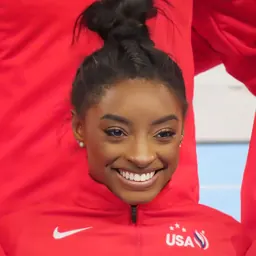
In late July 2021, many people compared Mukhina with Simone Biles, in defense of Biles' decision to pull out of the 2020 Tokyo Olympics while citing health concerns.
Death Mukhina was ill the last year of her life.
Eponymous skills Mukhina has two eponymous skills listed in the Code of Points. Apparatus Name Description DifficultyFloor exercise Mukhina Double salto bwd tucked with 1/1 turn (360°) E (0.5)Uneven bars Mukhina Hip circle hecht with back tucked salto D (0.4)
Don’t just read it —
keep it.
Full-length biographies made to live with: read them, listen on the way to work, watch them tonight.
- E-book
- Audio
- Video
Instant download · yours to keep · every purchase keeps this site free
Important facts
People in Elena Mukhina's life
Named in this biography and alive at the same time

Related people
Same field, nearest in time



Contemporaries
People whose lives overlapped Elena Mukhina's



Frequently asked questions
Who was Elena Mukhina?
Soviet artistic gymnast (1960–2006)
When was Elena Mukhina born?
Elena Mukhina was born on 1 June 1960 in Moscow.
When did Elena Mukhina die?
Elena Mukhina died on 22 December 2006 in Moscow.
What was Elena Mukhina's occupation?
Elena Mukhina was an artistic gymnast.
What nationality was Elena Mukhina?
Elena Mukhina was Russian.
Sources & further reading
Cite this page
APA: Biography.guide. (2026). Elena Mukhina. https://biography.guide/elena-mukhina/
MLA: "Elena Mukhina." Biography.guide, https://biography.guide/elena-mukhina/.
Chicago: "Elena Mukhina." Biography.guide. https://biography.guide/elena-mukhina/.
Data last updated: 2026-09-20 · Spot an error? Report a correction.
Page generated 2026-09-27 05:28 UTC