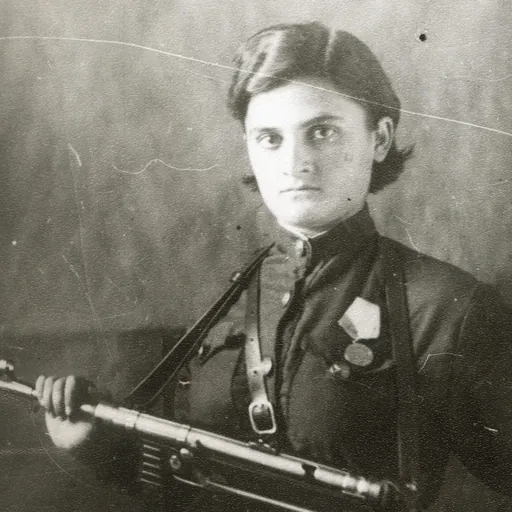
About Elena Drapkina
Lived 1924 – 2016 (aged 92). Elena Drapkina was a Belarusian partisan and dentist.
Elena Drapkina (born Elena Askrevna Levina, 1924 – 2016 ) was a Belarusian Jew who is best known for her participation in the anti-Nazi Partisan movement after escaping the Minsk Ghetto during the later years of the Holocaust. After liberation from World War II, Drapkina worked for the Minsk executive council and also completed dentistry school. Although raised as a secular Jew and Russian nationalist, she became more observant later in life to honor her late relatives and family members who had died in the Holocaust. In the mid-1990s and early 2000s, she further participated in several oral history projects documenting the experience of Jewish partisans.
Early life
Family and Judaism Elena Drapkina was born in Minsk, the capital of the Byelorussian Soviet Socialist Republic and a major city in Pale of Settlement home to ~71,000 Jews, in 1924. Her older brother, Hirsh, was born in 1920, and her younger brother, Saul, was born in 1929. Her parents, Osher Levin and Ginde Levina, They lived in a three-room apartment in a two story building, a decent-sized apartment for the time. Under Soviet rule, alternatives to Jewish culture were offered, such as options to leave the Pale for higher education and activities for children.
Significant Ghetto events On 20 November 1941, Drapkina survived a pogrom because she was able to hide in a hiding space prepared in advance by the inmates of the ghetto. Together with others, she hid underneath stairs covered with tin plates and laundry. The hiders did not move for an entire day and night. When finally leaving the spot, Drapkina saw one of her uncles being murdered in the living room. Drapkina’s mother and younger brother were found, taken away, and later murdered as a result of this pogrom.
Because the Judenrat refused to send 500 residents to be killed on 2 March 1942, German troops planned on raiding the ghetto. Drapkina received this information in advance from overhearing a conversation between German workers. During the raid, all of the children in the orphanage, patients at the hospital, and other innocent civilians were murdered by German and Lithuanian police. Drapkina's work column was assigned to mount a truck at the end of the day as a punishment. Their column was then escorted to the gate at the intersection of Chornaia and Obutkovo streets. When she was lined up to re-enter the ghetto, a German guard took her identity card, stating that she was a regular worker as opposed to a skilled worker, and tried to beat her. Eventually, she was let go and passed through the checkpoint. Besides her, only one other woman among her friends from the work column survived this selection at the gate.
Escape from the Ghetto A few days after the 1941 pogrom, Drapkina was offered a passport by two Russian workers. The passport stated that she was Polish, which would make it possible for her to leave the ghetto. Drapkina waited until another pogrom occurred at the end of July 1942 to execute her escape, with the hope that in her absence the Germans would simply assume that she was dead. She left immediately after. Like Drapkina, 6,000 out of 10,000 people ended up fleeing from the Minsk Ghetto, but most of them left around spring and fall of 1943. After exiting the ghetto, Drapkina met a non-Jewish woman who allowed her to live in her farmer's house west of Minsk and work for her as a housemaid.
Joining the partisans While working on the farm, Drapkina met a group of Soviet parachutists who were sent to that area to set up a partisan unit behind German front lines. They convinced her to join. The partisans' mission was to make Germans' lives miserable by sabotaging and destroying their infrastructure, help the local civilians restore and produce faith, as well as promote winning the war. Drapkina was 18 at the time and ended up serving for two years.
Drapkina's partisan group, referred to as an otriad, consisted of eight people at the time and was led by I. M. Timchuk. By February 1943, it had grown to 40 members. Every member had a specific job, and Drapkina was initially assigned to work in the kitchen. After declining this assignment, she was sent to work in the medical tent as a nurse. After telling the commander that she had hemophobia, she was finally sent into combat. Drapkina's ortriad included many women who joined because they felt threatened by German retaliation. Women were oftentimes kicked out of the partisan units for being pregnant, causing Drapkina to avoid romantic relationships.
In early 1944, Drapkina was appointed the commander of Morozova, a village that her brigade oversaw. She organized the evacuation of its inhabitants because an unknown troop was passing through the area. At the end of June 1944, her partisan group united with Soviet troops in anticipation of being liberated from the Nazi regime. Soviet troops liberated German occupied areas in June and July 1944.
Post-war life After her partisan group united with Soviet troops, Drapkina was demobilized. Like many other women fighters, she was not given any veteran benefits or public recognition for her service as a partisan.
Drapkina subsequently found work as a secretary at the headquarters of the Belorussian partisan movement in Minsk, provided her with a place in a dormitory and military-level food ration cards. Afterwards, she worked in the city’s executive council in a relatively high-ranking leadership position.
In mid-1945, as Victory Day was being celebrated, Drapkina moved to Leningrad to study dentistry. In Leningrad, she lived with her aunt, her only living relative given that the rest of her family had perished during the Holocaust. Her aunt convinced her to go to university, and she enrolled in courses at the university. Although she had not taken an academic exam since 9th grade and had not seen a newspaper since 1941, Drapkina successfully completed her coursework and subsequently worked as a dentist in Leningrad. In the early 1950s, she lived in fear of wide-spread anti-Semitic campaigns against Jewish doctors.
In 1945, she married Vul’f Drapkin, a military officer. He died in 1949 by succumbing to injuries from war. They had one son, whom Drapkina raised alone until she remarried.
Later life and legacy Later on in life, Drapkina expressed the desire to learn Yiddish and more about her Jewish heritage. She took Jewish culture classes and started going to synagogue. To commemorate her dead relatives, she began lighting a yahrzeit candle on their death anniversaries, a tradition that can be traced back to Jewish fast days, times of repentance, and commemorations of tragedies.
Drapkina also participated in multiple interviews in the late 1990s and early 2000s to provide testimony about her experiences during the war. As part of these oral history projects, some of which resulted in multimedia educational materials, she spoke at length about her life before, during, and following the Holocaust.
In 2008, Drapkina and others helped advocate for her friend Masha Bruskina's memorial to be identified under her name, as it was erected in the 1960's under "young woman/name unknown". This allowed for the Soviet and post-Soviet states to recognize Jewish female partisans.
Drapkina died in St. Petersburg, Russia, on 22 December 2016.
Don’t just read it —
keep it.
Full-length biographies made to live with: read them, listen on the way to work, watch them tonight.
- E-book
- Audio
- Video
Instant download · yours to keep · every purchase keeps this site free
Important facts
People in Elena Drapkina's life
Named in this biography and alive at the same time
Related people
Same field, nearest in time



Contemporaries
People whose lives overlapped Elena Drapkina's



Frequently asked questions
Who was Elena Drapkina?
Soviet Belarusian Jewish fighter
When was Elena Drapkina born?
Elena Drapkina was born on 5 November 1924.
When did Elena Drapkina die?
Elena Drapkina died on 22 December 2016.
What was Elena Drapkina's occupation?
Elena Drapkina was a partisan and dentist.
What nationality was Elena Drapkina?
Elena Drapkina was Belarusian.
Sources & further reading
Cite this page
APA: Biography.guide. (2026). Elena Drapkina. https://biography.guide/elena-drapkina/
MLA: "Elena Drapkina." Biography.guide, https://biography.guide/elena-drapkina/.
Chicago: "Elena Drapkina." Biography.guide. https://biography.guide/elena-drapkina/.
Data last updated: 2026-09-22 · Spot an error? Report a correction.
Portrait: Wikimedia Commons · author & licence
Page generated 2026-09-27 05:02 UTC