About El Vez
Born 1960. El Vez is an American composer and singer-songwriter.
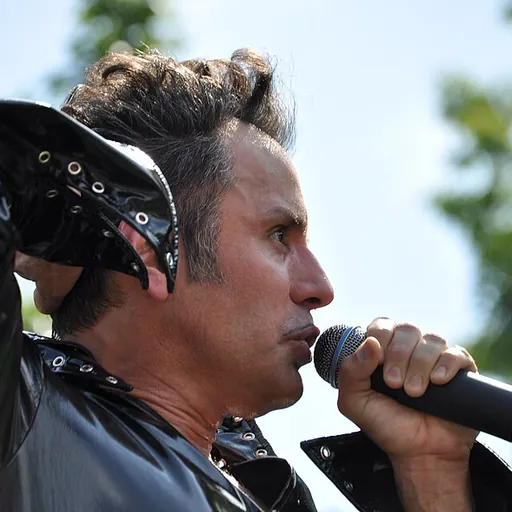
Infobox musical artist honorific_prefix = name = El Vez honorific_suffix = image = El Vez - 2009-07-25 14.jpg landscape =
caption = El Vez performing in Seattle in 2009 background = solo_singer birth_name = Robert Alan Lopez native_name = native_name_lang = alias = birth_date = birth_place = origin = Chula Vista, California death_date = death_place = genre = hlist|Latin rock|rock and roll better known by his stage name El Vez, is an American singer-songwriter and musician, who performs and records original material and covers classic rock songs. Mixing the styles of Elvis Presley and many other American rock artists with his own Latin-American heritage and music, he is known for expressing revolutionary views through the satire and humor in his songs.
Early life Lopez was born in Chula Vista, California in 1960. His family "floated somewhere between middle and lower-middle class. Our diet included government cheese and something we called 'poor people's chop suey' a few times a week." His grandparents were born in Mexico, and he frequently traveled there as a youth, visiting its museums and Mesoamerican pyramids, experiences he cited as influences on his later musical work. He would become more conscious and appreciative of his Mexican heritage later in life, but did not learn any Spanish until he took a few classes while attending Chula Vista High School. His second concert was the New York Dolls, whom he much preferred. Called the Main Street Brats, the group played their first show at a quinceañera in Mexico's Rosarito Beach. The lineup then changed; Lopez recruited his cousin Karton "Baba" Chanelle to play drums, and Chanelle's Sweetwater High School classmate Hector Penalosa to play bass, and they changed their name to the Zeros. Their first L.A. performance, at the Orpheum Theatre, was also the debut performance by the Germs, and was headlined by the Weirdos. Though only teenagers, the Zeros became regulars on the L.A. club scene, playing shows with bands such as the Dils, the Avengers, X, the Plugz, the Nerves, the Wipers, the Germs, Devo, and the Damned. "Those early shows were pretty inspiring", Lopez wrote forty years later; "I felt part of a movement, or something at least. Part of a music scene. It was a great feeling after years of misfitdom." He became a fan of the art of Gary Panter, the writings of Claude Bessy in Slash magazine and Craig Lee in LA Weekly, and performance artists such as the Kipper Kids and Johanna Went, and idolized Tomata du Plenty and his band the Screamers.
The Zeros' Mexican American heritage earned them the nickname "the Mexican Ramones", coined by a friend and solidified when it was used in a Los Angeles Times article. By mid-1978, however, the band was beginning to fracture: "Javier was complaining that Hector was playing in too many different bands", recalled Lopez in 2016; "That seemed to be the main complaint, though there were others." By that August, Penalosa had moved to Los Angeles and was replaced on bass by Lopez's younger brother Guy. Both Lopez brothers soon quit the band, also to move to Los Angeles, and the Zeros briefly disbanded. He supported himself with a job at a nearby Pizza Hut. That winter, he and Margot Olavarria, who had recently been dismissed from the Go-Go's, traveled to New York City, where Lopez stayed for a few months with friends who had transplanted from Los Angeles. There he met various local punk performers; attended shows at clubs such as CBGB, Max's Kansas City, and the Mudd Club; and went to Studio 54 "to pick fights with Steve Rubell."
Catholic Discipline (1979–1980)
Settling into Los Angeles, Lopez joined a band called the Johnnies as well as the short-lived group Catholic Discipline, in which he played a Farfisa Combo Compact keyboard. Consisting of personalities from the L.A. punk scene, Catholic Discipline was fronted by Slash magazine editor Claude "Kickboy Face" Bessy and also included Phranc of Nervous Gender as well as Craig Lee, music writer for LA Weekly and guitarist in the Bags. "I think we saw Catholic Discipline as a 'postpunk' band", said Lopez in 2016. "He was a nice guy and a good tipper", recalled Lopez in 2014. The gallery presented a show of Elvis Presley-themed works; Lopez hired an Elvis impersonator to appear at the opening, and dressed himself up as Elvis' manager, Colonel Tom Parker. Wearing gold lamé pants and an oversize gold sombrero, he sang along to the cassettes while giving the lyrics a Hispanic twist: "That's All Right Mama" became "Esta Bien Mamacita", "Blue Suede Shoes" became "Huaraches Azules", "Hound Dog" became "You Ain't Nothing But a Chihuahua", and so on.
The performance was well-received, and Lopez brought the act back to Los Angeles. A second EP, El Vez Calling, followed a few months later; its cover art parodied Presley's 1956 debut album Elvis Presley, while its title and back cover parodied the Clash's London Calling, the artwork of which was itself an homage to Elvis Presley. It consisted of two more reworked Elvis numbers, "(Marie's the Name) His Latest Flame" and "Lawdy Miss Clawdy" redone respectively as "Maria's the Name (of His Latest Flame)" (using Bow Wow Wow's 1982 version of "I Want Candy" as its musical foundation) and "Lordy Miss Lupe".
Also in 1991, the original lineup of the Zeros—Lopez, Escovedo, Chanelle, and Penalosa—reunited to play a benefit show for Lopez's former Catholic Discipline bandmate Craig Lee. The compilation album How Great Thou Art: The Greatest Hits of El Vez followed in 1994, combining the tracks from the three prior EPs with a version of "Samba Para Ti" featuring keyboardist Paul Morris of Rainbow and a recording of "How Great Thou Art"; the album's title and cover art were an homage to Elvis' 1967 album How Great Thou Art.
I think he's a real message of pride and a real positive idea of what America is: Elvis Presley being the greatest American entertainer success story, going from nothing to being one of the richest entertainers in the world. The idea of El Vez is you can do that also, and you don't have to be a white man. It's for blacks, Mexicans, women. Anyone can be a superstar. El Vez is the idea of the melting pot, and everyone's welcome. It's Elvis as the American Dream. — –Lopez in 1994 Several more Elvis songs were similarly given the El Vez treatment: "Suspicious Minds" became "Immigration Time", dealing with immigration rights; "Little Sister" was redone as "Chicanisma" (a Spanish grammatical gender inversion of the term Chicanismo), about the empowerment of Latina women; and "Baby Let's Play House" turned into "Safe (Baby Let's Play Safe)", with cautionary lyrics promoting safe sex.
In mid-1994 Lopez also began performing as a new character, Raul Raul, who he described to the Los Angeles Times as "a real angry Chicano beat poet. I enjoy it because he's a solo act with no props or dancing girls to fall back on. It's almost the opposite of El Vez, who is always so happy and positive-thinking. Raul Raul is yelling, spouting, finger-pointing at the 'white devil slave masters' and all that. But it's really humorous." The Zeros toured Spain in the spring of 1995, and a live album titled Over the Sun was recorded in Madrid that March and released later that year by Madrid's Imposible Records. Also in 1995 Munster Records released the El Vez live album El Vez Is Alive, documenting his performance at the 1991 Roskilde Festival in Denmark. Lopez began incorporating the Raul Raul character into his El Vez performances; in a New York Times review of his 1995 Christmas show in Manhattan, journalist Neil Strauss wrote: "The set's highlight was its most atypical moment, the reading of a poem by El Vez's alter ego, Raul Raul, an angry-young-man poet. As Vince Guaraldi's theme music from the Peanuts cartoons played in the background, he decried racism in the Sunday comics with lines like, 'Hey Charlie, I'm brown/Por que no Latinos in your stinking town?' Underneath the humor, there was a message. And underneath the message, there was more humor."
Continued work as El Vez and with the Zeros (1996–2004) In May 1996 Munster Records released the El Vez compilation album Never Been to Spain (Until Now) for the Spanish market. El Vez's next studio album, G.I. Ay, Ay! Blues, came out that September through Philadelphia's Big Pop Label; with a title and cover art parodying Elvis' G.I. Blues (1960), it found El Vez diversifying his musical palette even further and getting even more political with his lyrics. The EP A Lad from Spain? was released in 1998 by Sympathy for the Record Industry; consisting of alternate versions of previously released songs, its title and cover art parodied David Bowie's 1973 album Aladdin Sane. It was released on compact disc the following year as Son of a Lad from Spain?, with some of the tracks from the original EP as well as added songs, radio performances, and other recordings. Lopez reunited with the Zeros once again for their 1999 album Right Now! That November, El Vez released the gospel music-influenced studio album Boxing with God through Sympathy for the Record Industry, and in 2002 started his own label, Graciasland Records, through which he released a third Christmas album, Sno-Way José (its cover mimicking Bing Crosby's Merry Christmas).
In 2004 Lopez relocated from Los Angeles to Seattle, drawn by the city's eclectic art and theater scene. By the mid-2000s, El Vez had toured the United States, Canada, Mexico, Europe, and Australia, and had opened for such famous performers as David Bowie, Carlos Santana, and the B-52's.
McLeod also described El Vez's lyrical style:
Despite his use of humor, El Vez cannot be written off as a postmodern joke. His lyrics (many times rewrites of Elvis recordings or other popular songs) are very political and pro-Latino. Much like Rage Against the Machine, his songs are littered with references to the Zapatistas and other Mexican revolutionaries. Unlike the above-mentioned band, he does not beat the audience over the head with didactic polemics and testosterone-fueled monster chords. Instead, he relies on the obvious play on words ("Say It Loud, I'm Brown and I'm Proud" and "Misery Tren") and clever social satire (at the climax of "Immigration Time", sung to the tune of "Suspicious Minds", he shouts "I've got my green card...I want my gold card!"). or "The Mexican Elvis". He was also a contestant on The Weakest Link during an episode featuring Elvis impersonators.
He also performed "It's Now or Never", which was featured on the soundtrack of the 2009 feature film The Hangover.
Discography Year Artist Title Type Format Label Catalog
Don’t just read it —
keep it.
Full-length biographies made to live with: read them, listen on the way to work, watch them tonight.
- E-book
- Audio
- Video
Instant download · yours to keep · every purchase keeps this site free
Important facts
People in El Vez's life
Named in this biography and alive at the same time



Related people
Same field, nearest in time





Contemporaries
People whose lives overlapped El Vez's



Frequently asked questions
Who is El Vez?
American musician
When was El Vez born?
El Vez was born in 1960 in Chula Vista.
What is El Vez's occupation?
El Vez is a composer and singer-songwriter.
What nationality is El Vez?
El Vez is American.
Sources & further reading
Cite this page
APA: Biography.guide. (2026). El Vez. https://biography.guide/el-vez/
MLA: "El Vez." Biography.guide, https://biography.guide/el-vez/.
Chicago: "El Vez." Biography.guide. https://biography.guide/el-vez/.
Data last updated: 2026-09-22 · Spot an error? Report a correction.
Portrait: Wikimedia Commons · author & licence
Page generated 2026-09-27 05:02 UTC