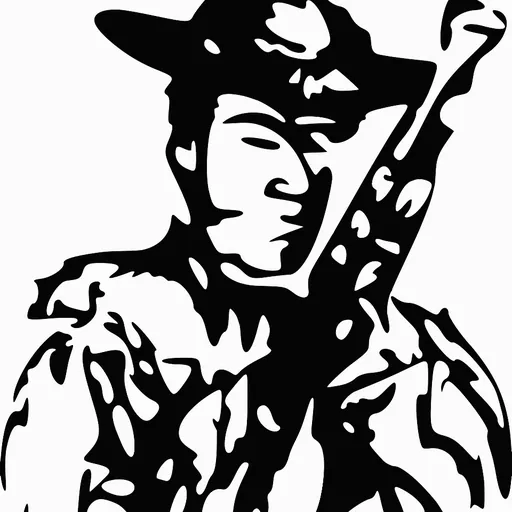
El Tuerto de Pirón
Spanish bandit of the 19th century
About El Tuerto de Pirón
Lived 1846 – 1914 (aged 68). El Tuerto de Pirón was a Spanish peasant, telegraphist, bandit and inmate.
Fernando Delgado Sanz (May 30, 1846 – July 5, 1914), better known as El Tuerto del Pirón or Tuerto Pirón, was a Spanish bandit. He worked mainly in the Sierra de Guadarrama and in the basin.
Biography Church of Santo Domingo de Pirón, in which he was baptized on June 6, 1846.
Childhood He was born in May 1846 in Santo Domingo de Pirón as the son of Ramón Delgado Adrados, a native of Escalona del Prado, and Ana Sanz de Ysabel, of Santo Domingo de Pirón.
Initiation In 1866 he returned to his hometown at the end of his military service and discovered that his girlfriend in the village had married a man from a rich and influential family.
It was then that he began his criminal career with his first crime, stealing the best lamb from the father of his former girlfriend and eating it with his friends in a cave in the Losana de Pirón area. He mocked and ridiculed the father by leaving the remains and skin of the animal at his door along with the text, "for the godfather." The story spread and he quickly became famous in the whole area.
Crimes After he committed his first crime, an influential person immediately asked the Civil Guard to hunt him down, so he lived as a robber, hiding in the Caves of the Vaquera and Murciganillos in Losana de Pirón and the old elm of Rascafría. His crimes included the theft of cattle, robbery of rich houses and churches, assaults on walkers and travelers, and the kidnapping for ransom of members of the bourgeoisie, nobility and clergy. He formed a band with rustlers from the area including some childhood friends. Their crimes became more and more serious and widespread. Despite the murky stories that were told about his deeds, he only committed one murder and allowed another by one of his companions, both traitors of the gang. Unlike most bandits, he was disgusted with blood.
One of his most famous crimes was the complicated church robbery of Tenzuela, in which he entering through the roof without leaving a single trace.
Death He died at age 68 on July 5, 1914, after being imprisoned for 26 years in the San Miguel de los Reyes Prison, Valencia province.
Description El Tuerto del Pirón was described as follows by the Civil Guard:Age, 35 years; stature, rather tall than short; wide and loaded on his back; Wide face; color, brown; shaved beard; with a little mustache. As a particular sign, a cataract in the left eye. He wears blue trousers, a brown cloth waistcoat, and a long checkered jacket or jacket; good black boots, and a wide hat or blue beret much used.According to an article published on August 16, 1921, in El Adelantado de Segovia, he would often walk through the city calmly greeting the Segovian citizens as they recognized him, but they were speechless with fear:The famous Segovian bandit did not shy away from appearing in public; taking, on the way, a seat in the cars of the land and getting off where he seemed. Courteously saying goodbye to the passengers who had recognized him, but who were careful to let him know to avoid dangerous inconveniences.
Reino of the Tuerto Río Pirón as it passed through Peñarrubias de Pirón, one of the places over which he had the most control.
He created a small band of rustlers among his childhood friends and others from the town of Espirdo, Segovia and Madrid. The most important were Barroso, Aquilino Benito Pérez, Consuegra and two brothers called Los Tormenta.
Their zone of power was called El Reino del Tuerto or País del Tuerto because of the power and control they exerted over the place. His crimes were famous throughout the province of Segovia and Madrid, for instance in the town of Rascafría where he was known for hiding in its centenary elm. He also was in towns as close to the Segovian capital as Tres Casas (now Trescasas) and Sonsoto, although in the latter two he was unsuccessful. Some of his actions were carried out in neighboring municipalities of the province of Valladolid with the province of Segovia. On both sides of the Sierra de Guadarrama he was known, sought after and highly feared.
Don’t just read it —
keep it.
Full-length biographies made to live with: read them, listen on the way to work, watch them tonight.
- E-book
- Audio
- Video
Instant download · yours to keep · every purchase keeps this site free
Important facts
People in El Tuerto de Pirón's life
Named in this biography and alive at the same time

Related people
Same field, nearest in time


Contemporaries
People whose lives overlapped El Tuerto de Pirón's





Frequently asked questions
Who was El Tuerto de Pirón?
Spanish bandit of the 19th century
When was El Tuerto de Pirón born?
El Tuerto de Pirón was born on 30 May 1846 in Santo Domingo de Pirón.
When did El Tuerto de Pirón die?
El Tuerto de Pirón died on 5 July 1914 in Monestir de Sant Miquel dels Reis.
What was El Tuerto de Pirón's occupation?
El Tuerto de Pirón was a peasant, telegraphist, bandit and inmate.
What nationality was El Tuerto de Pirón?
El Tuerto de Pirón was Spanish.
Sources & further reading
· Wikipedia: El Tuerto de Pirón
Cite this page
APA: Biography.guide. (2026). El Tuerto de Pirón. https://biography.guide/el-tuerto-de-piron/
MLA: "El Tuerto de Pirón." Biography.guide, https://biography.guide/el-tuerto-de-piron/.
Chicago: "El Tuerto de Pirón." Biography.guide. https://biography.guide/el-tuerto-de-piron/.
Data last updated: 2026-09-23 · Spot an error? Report a correction.
Portrait: Wikimedia Commons · author & licence
Page generated 2026-09-27 05:07 UTC