
Ekaterina Mikhailovna Khomyakova
Russian salon-holder
About Ekaterina Mikhailovna Khomyakova
Lived 1817 – 1852 (aged 34). Ekaterina Mikhailovna Khomyakova was a Russian.
Ekaterina Khomyakova (15 July 1817, Simbirsk — 26 January [7 February] 1852, Moscow) was the hostess of a literary salon, sister of the poet N. M. Yazykov, scholar P. M. Yazykov. The youthful love of N. A. Motovilov, an associate of Seraphim of Sarov, with whom the future administrator of the Seraphimo-Diveyevsky Convent discussed his interest.
She was the wife of the philosopher and poet A.S. Khomyakov, his literary secretary, and the mother of the Chairman of the State Duma N.A. Khomyakov. Several lyrical poems by N. M. Yazykov and A.S. Khomyakov are dedicated to her. The poem The Resurrection of Lazarus, written by A.S. Khomyakov on the occasion of his wife's death, was set to music by S.V. Rachmaninov in 1912. V. Rachmaninov. A model for the portraits of Karl Gampeln, Shandor Kozin and A.S. Khomyakov. According to Gogol scholars, E.M. Khomyakova was the invisible centre of the spiritual life of the Moscow Slavophile community. The letters of E.M. Khomyakova with the reactions of the inhabitants of Zamoskvorets to the death of Alexander Pushkin are of interest for Pushkin studies.
A close friend of E.M. Khomyakova was N.V. Gogol, and he regarded her as one of the most remarkable women of his time. In confidential conversations with her, the very secretive writer was very open, telling her about his plans for the future. The early death of E. M. Khomyakova was an irreparable loss for Gogol as well as for A.S. Khomyakov. Under her influence, the lonely writer had thoughts of his own imminent death, increased ascetic and mystical moods, culminating in illness. In the end, as a result of this and other circumstances, Gogol abandoned creative activity, burned his works and died soon.
Biography Ekaterina Mikhailovna belonged to the old noble Yazykov family, her father was ensign Mikhail Petrovich Yazykov (1767–1819), her mother Ekaterina Alexandrovna Yermolova (1777–1831) was the daughter of the Simbirsk noble leader A. F. Yermolov. They had three sons: Peter, Alexander, Nicholas, and three daughters: Praskovya, Alexandra and Ekaterina. She was the youngest daughter, two years after her birth her father died and Ekaterina lived only with her sick mother.
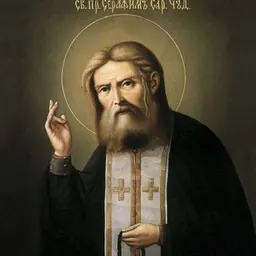
N. A. Motovilov
According to S. A. Nilus, in her early youth Ekaterina was in love with Nicolai Alexandrovich Motovilov, an associate of Seraphim of Sarov. His infatuation with her began around 1829, when he was nineteen and she was twelve. The Yazykovs' Simbirsk estates in Mokroy Bugurma and Russkaya Tsilna were located near the Motovilov estates.
According to Motovilov, Ekaterina Mikhailovna lived with her mother "as in a convent — she always read her morning and evening prayers, and as her mother was very religious and pious, there were often prayers and all-night services at her bedside. Having been brought up for more than ten years by such a God-fearing mother, she herself became like a nun. This is what I like most about her". — According to a new Synod decree, no man under 18 and no girl under 16 can marry. Shouldn't you wait eight or ten years for your God-ordained bride? How can you marry her now? You can't, she's still very young,' he gently explained to his companion, but Motovilov insisted.
— Who are you talking to me about? — he asked me.
— About Ekaterina Mikhailovna Yazykova.
— Ah!' he said. — Well, I am not talking about her, poor me, I am talking about the bride God has destined for you, and she, I assure you, your God, will not be more than eight years and a few months old.Nevertheless, for some time N. A. Motovilov continued to expect reciprocity from Ekaterina and planned to marry her. In May 1832, when Ekaterina was 14 years old (and he thought she was 16-17), he proposed to her, disobeying the elder, and received a final refusal,
For his disobedience Motovilov later earned Seraphim of Sarov's reproaches and the instruction to provide for the support of the Diveyev community, which Motovilov did.
The literary scholar V.I. Melnik doubts that it was all about Motovilov's enemies, because it is not known how the personal relations between Ekaterina Mikhailovna and Nicolai Alexandrovich developed. V. I. Melnik concludes from the subsequent events we that Ekaterina Mikhailovna was waiting for someone else.
Marriage
According to V. I. Melnik, Ekaterina Mikhailovna fell in love with Alexei Stepanovich Khomyakov immediately and irrevocably. Her letters to her brother were full of sentimental enthusiasm for her lover: "Oh Lord, I love him, if only he knew how much I love him!" Their love was mutual from the start,
This is the subject of a Khomyakov family legend (told by Alexei Stepanovich's biographer V. N. Lyaskovsky), according to which M. A. Khomyakova made her sons promise to keep their chastity until marriage. Khomyakov's love for Yazykova was preceded only by a strong feeling for the famous capital beauty Alexandra Osipovna Smirnova, who rejected his advances.
Different sources report different information, whether Alexei Stepanovich and Ekaterina Mikhailovna's meeting and closeness got immediately or gradually (Khomyakov was 13 years older than his wife and could visit the Yazykovs when she was still a child). Some biographers claim that Khomyakov married Yazykova, "with whom he had long been passionately in love".
If he had been in love from the moment of his engagement in 1832, as V. I. Melnik and some others mention, In addition, there is information that as early as 1834 A. S. Khomyakov was courting Z. N. Poltavtseva, a relative of Prince P. V. Dolgorukov, but was rejected by her, which also contradicts the version of a long-standing love affair with the young Khomyakov.
Khomyakov's biographer V. N. Lyaskovsky wrote at the end of the 19th century: "Through the poet N. M. Yazykov, who belonged to the Kireevsky circle, Alexei Stepanovich met his sister Katerina Mikhailovna, and on 5 July 1836 they were married ... in the house church of the Counts Panin on Nikitskaya in Moscow".
Valery Alekseev gives a different account of the circumstances of E. M. Khomyakova's marriage, without mentioning her engagement to A.S. Khomyakov in 1832. After the death of Ekaterina's mother in 1831, her older sister, Praskovya Mikhailovna (1807–1862), who was married to Pyotr Alexandrovich Bestuzhev, the leader of the nobility of the Syzran region of Simbirsk Governorate, took care of her upbringing. The Bestuzhevs lived on their estate in Repyovka, Syzransky uyezd, until the summer of 1835. In the autumn of the same year, the Bestuzhev family moved to Moscow with Ekaterina Mikhailovna. But, as B. V. Shaposhnikov ironically notes, this diary has not survived, and judging from the letters, it contributed little to "the development of her style". Nicolai, for his part, was happy for his younger sister and his friend. He wrote to his elder sister Praskovya: "...I don't know how to thank you! And she herself is so happy, so happy that I reread her letters every day: they are so beautiful, fresh, full of thought and the soul of Katusha. They're just lovely. By God, she is worthy of her happiness. Even before their marriage, in 1835, he dedicated a fragment of his poem Prayer to her. By 1850 there were already nine, and the family idyll was broken only by the death of the first two sons, Stepan and Fyodor, from diphtheria who died on the same day at the end of October 1838. Ekaterina Mikhailovna immersed herself in the household and the children's education, while fully sharing her husband's beliefs and being a reliable support for him in all family matters. He admitted being no less devoted to his wife than to his mother. As an admirer of the English language, he called Ekaterina Mikhailovna Kitty at home.
As a thinker, Khomyakov found strength and inspiration for his creative work in his family. The church historian and biographer of A. S. Khomyakov, N. M. Bogolyubov, wrote that in the 1837 poem The Late Lamp was Burning the poet described the influence of his wife on his creative inspiration. A contemporary researcher of Khomyakov's work, V. A. Koshelev, considers this poem to be the most intimate in his lyrical legacy and in its semantics comparable to Boris Pasternak's famous poem : "A candle glowed upon the desk, / A candle glowed...', where the image of the lamp-candle goes back to the Gospel of Matthew.
Thanks to his wife's kinship, Khomyakov gained one of his most loyal and diligent followers in the Slavophile doctrine - Dmitri Valuyev. He was Ekaterina Mikhailovna's nephew, the son of her elder sister Alexandra Mikhailovna. The young man was orphaned at an early age and lived first with the Kireyevsky-Yelagins, then with the Sverbeyevs, then with the Khomyakovs. Dmitri was a gifted young man and one of the most ardent Slavophiles of the early generation. Khomyakov had the kindest feelings for him. He treated Dmitri like a son and wrote to him: "Your loving father, A. Khomyakov". Alexei Stepanovich said to N.M. Yazykov: "Valuyev is not only dear, but necessary. He speaks less than all the others, he is almost alone in this".
But Ekaterina Mikhailovna treated her nephew differently. She said that Dmitry tortured her translations for the Library of Education, asking her three times a day if she was working (the Library of Education was founded by Valuyev in 1843). Ekaterina Mikhailovna was also unhappy that her nephew had completely torn her husband away from poetry, while D.A. Valuyev accused Khomyakov of working too little and wasting his energy on trifles instead of finishing the Notes on World History. But his activity was short-lived, he died at the end of 1845. but B. V. Shaposhnikov believed that her secretarial powers did not extend to her husband's literary activities and were limited to correspondence with relatives 'on all matters and trends of society'. He also included the translation work of E. M. Khomyakova for the Slavophile editions of D. A. Valuyev. The day of the reception at the Khomyakovs' house was set for Tuesday. Gogol scholar V. A. Voropaev believes that "Ekaterina Mikhailovna was an invisible centre of the spiritual life of the Moscow Slavophile community. This was confirmed by Gogol's behaviour during her illness and death".
Legacy The preserved correspondence of Ekaterina Mikhailovna includes 779 letters to brothers, sisters and other relatives.
After the revolution, Ekaterina Mikhailovna's letters became part of the Museum of the 1840''', opened on the initiative of the Khomyakovs' daughter Maria Alekseevna (1840–1919), who died shortly afterwards. From 1919 to 1929 the museum was located in the building of the Khomyakovs' ancestral home on Dog's Square. In 1929 the exhibits of the museum, including the letters of E. M. Khomyakova, were transferred to the State Historical Museum, and the museum in the Khomyakov house ceased to exist. From Gogol's letter to Yazykov dated 10 February 1842 we can learn about his attitude towards the Khomyakov family: "I love them, I rest my soul spending time with them".
On the other hand, Gogol had known the Yazykov family since the mid-1830s. In 1835 Gogol met Lyudmila Dmitrievna Kozhina, née Yazykova, at a Moscow literary salon (she was a cousin of the poet N. M. Yazykov). She was often visited by V. A. Zhukovsky, V. F. Odoevsky and M. S. Schepkin.
According to some reports, when Gogol arrived in Moscow in 1835, he read the newly completed Mirgorod and Arabesques at the Yazykov-Kozhiny house.
After meeting Ekaterina Mikhailovna, the writer became very attached to her. Gogol loved Khomyakova as the wife of his companion and as the sister of Yazykov. Е. M. Khomyakova, along with other friends of the writer and married ladies (A. P. Elagina, E. A. Sverbeyeva and E. G. Chertkova), was one of the guests at Gogol's birthday party, which he had arranged on 9 May 1842 at the house of M. P. Pogodin.
Having left Russia in 1842, Gogol was not able to return to his homeland until 1848, but before he returned to Moscow, the Khomyakovs met him in Germany. On their way to England on 13/25 July 1847, they saw each other in Frankfurt am Main, and on their way back to Russia from England in mid-August of the same year, they met in Ostend. Gogol's Slavophile friends, aware of the writer's attitude towards the Khomyakovs, tried to use their influence on the writer and to obtain from him in a roundabout way what could not be achieved directly. Thus F. V. Chizhov wrote to Ekaterina Mikhailovna, asking her to interest Govoroval in his work through A. S. Khomyakov. S. Khomyakov to interest Gogol in publishing a new Slavophile journal.
Ekaterina Mikhailovna was one of the few people to whom Gogol told of his intention to visit Jerusalem next year. Suddenly, on the 26th of January, we received a message from Sobornaya Square that Katerina Mikhailovna was dangerously ill: she had caught a cold, had a fever, and had also had a miscarriage, and now she was without hope... Alexei S. Stepanovich had changed so much that he amazed me, he had become an old man of sixty, and he said that there was no hope that Katerina Mikhailovna would live. She has received the Blessed Sacrament and is waiting for the end; she has already begun to rave... she caught a cold while walking in her garden, she got a fever and inflammation in her chest, and now, they say, she is on her last breath. 27th (Sunday). At noon we went to visit the sick woman at the Khomyakovs' house. When we reached the veranda, my heart froze: on the veranda we were told the fatal news that Ekaterina Mikhailovna had died yesterday at 11.30 a.m.!... Later in his diary, Khitrovo reported that Khomyakov blamed everything on the doctors, who had given calomel to his patient. In Khomyakov's opinion, his wife had died exhausted from premature labour. This was the main cause of death, according to the husband, and not the illness — she died more of exhaustion than of disease itself" (Khomyakov was not a professional doctor, but was interested in homeopathy and cured his serfs). Khomyakov considered Professor A.I. Overa to be directly responsible for his wife's death, while Professors S.I. Klimenkov, A.A. Alfonsky and, above all, P. N. Kildyushevsky advised Overa against calomel treatment. Other guests, however, justified Auvers on the grounds that the inflammation, fever and typhus left the French doctor no choice, and that he himself knew that the risk of aggravating the condition by taking calomel was too great. In February Yazykov's sister, Mrs Khomyakova, with whom he was on friendly terms, fell ill. Gogol had known her since childhood : her illness troubled him. He visited her often, and when she was already in danger, Dr Alfonsky was asked in front of him in what state he found her; he replied with a question: "I hope she has not been given calomel, which might ruin her? But Gogol knew that she had already been given calomel. He ran to the Count and said in an angry voice: "It's all over, she will die, they have given her a poisonous medicine! Unfortunately, the patient did indeed die soon after, and the death of someone dear to him hit him hard".M. I. Davidov, associate professor of the Perm State Medical Academy, spoke about the treatment of E. M. Khomyakova and the pharmacological effect of calomel. According to him, Gogol had a bitter experience of communication with doctors and had a negative attitude towards doctors in general, he consistently evaluated all the doctors' actions negatively. Therefore, when Alfonsky talked to Gogol about calomel, the writer raised the alarm about the poisonous drug in vain. In Davidov's opinion, A. A. Alfonsky, who was a professor of forensic medicine at Moscow University, 'made an inadmissible statement in the presence of the patient's relatives and friends', which was misinterpreted by those around him. Some of them, especially N.V. Gogol, were able to misunderstand his thoughts —which happened— and draw false conclusions about the correctness of the treatment and the qualifications of the doctors. Meanwhile, calomel was often used by 19th century doctors as an antibiotic and laxative without any negative consequences.
On Tuesday 29 November, Khomyakova's body was buried in the Danilov Monastery, not far from the graves of N. M. Yazykov and D. A. Valuev, E. M. Yazykova's nephew.
A. S. Khomyakov after his wife's death
Alexei Stepanovich was devastated by the sudden death of his wife. He shared his mother's grief, despite the fact that in recent years Khomiakova senior had accused her son of lacking filial love, which, according to V. I. Khitrovo, was due to maternal jealousy: "She wants him to love no one but her". At the funeral, Alexei Stepanovich himself carried the coffin to the grave with relatives and friends. I arrived in Moscow immediately after the funeral of Khomyakova, with whom we were friends. It is impossible to see Alexei Stepanovich's grief without awe — only a Christian can grieve like that, but God grant him that he may bear it and not fall. — He is deeply grieved, he has changed, he has lost a terrible weight and has turned yellow, but he prays cheerfully and works with all his strength. When he could no longer write, he reread what he had written or painted a portrait of the deceased in oils. He listens to all the services, morning and evening, and he is also busy with the children, but they are so young! They jumped around their mother's coffin, they were happy to see her dressed up, and they say that she flies with and around God.For a long time after the loss he was unable to come to his senses and take care of the household, which remained in a state of desolation all this time. In a letter to A. D. Bludova in 1855, he wrote that he had been sitting in his corner for more than three years.
His thoughts took a penitential turn. He came to the conclusion "that widowhood is a spiritual monasticism, that it is necessary to live in a more spiritual purity, that is, not to cling in the heart to any woman, but to remain faithful to her until the grave". At that time he liked to paint picturesque portraits of his deceased wife. The poet's heartfelt poem The Resurrection of Lazarus, written in 1852,
Again and again the philosopher's thoughts turned to the causes of Ekaterina Mikhailovna's death. Y. F. Samarin wrote that as soon as he heard about the misfortune of Alexei Stepanovich's family, he left St. Petersburg and came to Moscow to visit his friend. After a pause, Khomyakov was able to tell him the circumstances of the illness and death. Samarin concluded from Khomyakov's explanation that "Ekaterina Mikhailovna died, against all probability, due to a necessary combination of circumstances: he himself clearly understood the cause of the illness and, knowing exactly what means should have helped, he hesitated, contrary to his usual determination, to use them".
In another passage he wrote of his irreparable loss: "I owe much to my late Katenka, and I often hear inner reproaches that I have not yet developed and am not developing all the inheritance of spiritual goodness that I received from her". On 24 January P. A. Kulish wrote that Gogol viewed Khomyakova's death from his lofty vantage point and reconciled with her only at the coffin of the deceased. "But this did not save his heart from the fatal shock: he felt that he was suffering from the same disease that had killed his father — the fear of death".
However, Gogol's historian Yu. V. Mann believes that by the beginning of February the pain of losing Khomyakova had somewhat subsided in Gogol, until there were other circumstances not directly related to Khomyakova's death, namely meetings with Matthew Konstantinovsky and arguments with him in early February about Dead Souls, which did not allow the writer to finally come out of his depression. V. A. Voropaev and N. Urakova point out that the real reason for such an unexpected reaction of Gogol to the death of E.M. Khomyakova will hardly ever be fully unravelled, but one thing remains undeniable: it was the strongest spiritual shock. A. S. Khomyakov experienced a similar spiritual shock, but on a smaller scale. V. Alexeev agrees with this opinion: "You can express your assumptions, fantasise, try to penetrate into the details of the friendship between Khomyakov and Gogol, but all this will be an assumption, the author's own vision".
Don’t just read it —
keep it.
Full-length biographies made to live with: read them, listen on the way to work, watch them tonight.
- E-book
- Audio
- Video
Instant download · yours to keep · every purchase keeps this site free
Important facts
People in Ekaterina Mikhailovna Khomyakova's life
Named in this biography and alive at the same time

Contemporaries
People whose lives overlapped Ekaterina Mikhailovna Khomyakova's





Frequently asked questions
Who was Ekaterina Mikhailovna Khomyakova?
Russian salon-holder (1817-1852)
When was Ekaterina Mikhailovna Khomyakova born?
Ekaterina Mikhailovna Khomyakova was born on 15 July 1817 in Ulyanovsk.
When did Ekaterina Mikhailovna Khomyakova die?
Ekaterina Mikhailovna Khomyakova died on 26 January 1852 in Moscow.
What nationality was Ekaterina Mikhailovna Khomyakova?
Ekaterina Mikhailovna Khomyakova was Russian.
Sources & further reading
· Wikipedia: Ekaterina Mikhailovna Khomyakova
· DBpedia: Ekaterina Khomyakova
Cite this page
APA: Biography.guide. (2026). Ekaterina Mikhailovna Khomyakova. https://biography.guide/ekaterina-mikhailovna-khomyakova/
MLA: "Ekaterina Mikhailovna Khomyakova." Biography.guide, https://biography.guide/ekaterina-mikhailovna-khomyakova/.
Chicago: "Ekaterina Mikhailovna Khomyakova." Biography.guide. https://biography.guide/ekaterina-mikhailovna-khomyakova/.
Data last updated: 2026-09-20 · Spot an error? Report a correction.
Page generated 2026-09-27 05:29 UTC