
About Eileen Gray
Lived 1878 – 1976 (aged 98). Eileen Gray was an Irish architect and designer.
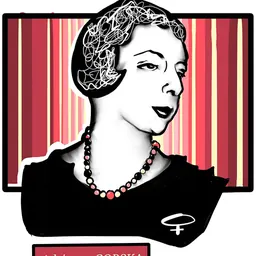
Eileen Gray (born Kathleen Eileen Moray Smith; 9 August 187831 October 1976) was an Irish interior designer, furniture designer and architect who became a pioneer of the Modern Movement in architecture. Over her career, she was associated with many notable European artists of her era, including Kathleen Scott, Adrienne Gorska, Le Corbusier, and the architect Jean Badovici, with whom she was romantically involved and who taught her architecture and collaborated with her on various buildings. Their most famous work is the house known as E-1027 in Roquebrune-Cap-Martin, France.
Early life Gray was born Kathleen Eileen Moray Smith on 9 August 1878 at Brownswood, an estate near Enniscorthy in County Wexford in the south-east of Ireland. She was the youngest of five children.
Her father, James McLaren Smith, was a Scottish landscape painter.
Her parents’ marriage ended in divorce when she was eleven and her father left Ireland to live and paint in Europe.
Gray split her upbringing between Brownswood House in Ireland and the family's home at No. 14 The Boltons, in Kensington, London.
Both Gray's brother and father died in 1900.
Gray's serious art education began in 1900 at the Slade School in London.
While at the Slade, Gray met furniture restorer Dean Charles in 1901. A 1920 issue of Harper's Bazaar describes the Rue de Lota apartment as ‘thoroughly modern although there is much feeling for the antique’. The chair's shape is reminiscent of the voluptuous figures of women in renaissance paintings, while the geometry calls back to the ideals of Werkbund. The Pirogue Day Bed was gondola-shaped and finished in patinated bronze lacquer, and is inspired by Polynesian dugout canoes. This "boat-bed" may also have been influenced by the Irish currach.
Le salon de verre (Glass Salon) designed by Paul Ruaud with furniture by Eileen Gray, for Madame Mathieu-Levy (Juliette Lévy) milliner of the boutique J. Suzanne Talbot, 9, rue de Lota, Paris, 1922 (published in L'Illustration, 27 May 1933) The critical and financial success of the project prompted Gray to open her own shop in 1922. The shop was named after an imaginary male owner “Jean” and Gray's love of the North African desert. Gray designed the facade of the shop herself.
Jean Désert closed due to financial losses in 1930. She studied theoretical and technical books, took drafting lessons, and arranged to have Adrienne Gorska take her along to building sites.
Gray and Badovici broke up and in 1931 Gray started work on a new house, Tempe à Pailla, above the nearby town of Menton. It was a small two bedroom house with a large terrace. Gray had expressed a wish that E-1027 be free of any decoration.
In 2013, The Observer critic Rowan Moore called it an “act of naked phallocracy” by a man asserting “his dominion, like a urinating dog, over the territory”, the nature of this "spasm of comic brutality" being "hotly debated" as "an act of vandalism... infringement of the original architect's intellectual property... a bravura improvement" or "just plain snobbery and sexism".
Other owners of E-1027 included Marie-Louise Schelbert, a friend of Corbusier's, and Heinz Peter Kägi. Architect Renaud Barrés is the current owner. German soldiers used the walls of E-1027 for target practice.
At a Paris auction of 1972, Yves Saint Laurent bought Le Destin and revived interest in Gray's career. They remain in production.
Gray was in an intermittent relationship with Marie-Louise Damien. Their relationship ended in 1938, after which they never saw each other again, despite both simultaneously living in Paris into their nineties.
Gray was also in a relationship with Jean Badovici, the Romanian architect and writer, for some time.
Having never lived in Ireland during her adult life, in her old age she reportedly stated, "I am without roots, but if I have any, they are in Ireland".
Posthumous
Gray's achievements were restricted during her lifetime. According to Reyner Banham, "[Eileen Gray's work] was, also, in its day, part of a personal style and philosophy of design which was, by the look of things, too rich for the punditry to take. And if the punditry didn't publish you, particularly in the great canon-defining compendia of the thirties, forties and fifties you dropped off the record, and ceased to be a part of the universe of scholarly discourse."
The National Museum of Ireland has a permanent exhibition of her work in the Collins Barracks site.
In February 2009, Gray's "Dragons" armchair made by her between 1917 and 1919 (acquired by her early patron Suzanne Talbot and later part of the Yves Saint Laurent and Pierre Bergé collection) was sold at auction in Paris for €21.9 million (US$28.3 million), setting an auction record for 20th-century decorative art.
Marco Orsini's documentary, Gray Matters, was released in 2014. A biopic on Gray's life by Mary McGuckian, The Price of Desire opened in 2016. A 2020 short film by Michel Pitiot, In Conversation with Eileen Gray, was based on an unreleased 1973 interview with Andrew Hodgkinson. In 2024 a Swiss documentary by Beatrice Minger and Christoph Schaub with the title Eileen Gray and the House by the Sea was screened at the Zurich Film Festival.
Exhibition history "Eileen Gray", Bard Graduate Center Gallery, New York City, 29 February – 12 July 2020. "Eileen Gray", Centre Pompidou, Paris, 20 February – 20 May 2013. "Eileen Gray", The Museum of Modern Art, New York, 6 February – 1 April 1980.
Don’t just read it —
keep it.
Full-length biographies made to live with: read them, listen on the way to work, watch them tonight.
- E-book
- Audio
- Video
Instant download · yours to keep · every purchase keeps this site free
Important facts
People in Eileen Gray's life
Named in this biography and alive at the same time







Related people
Same field, nearest in time



Contemporaries
People whose lives overlapped Eileen Gray's



Frequently asked questions
Who was Eileen Gray?
Irish architect and designer (1878–1976)
When was Eileen Gray born?
Eileen Gray was born on 8 August 1878 in Enniscorthy.
When did Eileen Gray die?
Eileen Gray died on 31 October 1976 in 14th arrondissement of Paris.
What was Eileen Gray's occupation?
Eileen Gray was an architect and designer.
What nationality was Eileen Gray?
Eileen Gray was Irish.
Sources & further reading
Cite this page
APA: Biography.guide. (2026). Eileen Gray. https://biography.guide/eileen-gray-architect/
MLA: "Eileen Gray." Biography.guide, https://biography.guide/eileen-gray-architect/.
Chicago: "Eileen Gray." Biography.guide. https://biography.guide/eileen-gray-architect/.
Data last updated: 2026-09-20 · Spot an error? Report a correction.
Page generated 2026-09-27 05:26 UTC