
About Eikō Hosoe
Lived 1933 – 2024 (aged 91). Eikō Hosoe was a Japanese photographer, film producer and university teacher.
was a Japanese photographer and filmmaker who emerged in the experimental arts movement of post-World War II Japan. Hosoe is best known for his dark, high contrast, black and white photographs of human bodies. His images are often psychologically charged, exploring subjects such as death, erotic obsession, and irrationality. Some of his photographs reference religion, philosophy and mythology, while others are nearly abstract, such as Man and Woman # 24, from 1960. He was professionally and personally affiliated with the writer Yukio Mishima and experimental artists of the 1960s such as the dancer Tatsumi Hijikata, though his work extends to a diversity of subjects. His photography is not only notable for its artistic influence but for its wider contribution to the reputations of his subjects.
Biography Hosoe was born on 18 March 1933 in Yonezawa, Yamagata, one of three sons of Yonejiro and Mitsu Hosoe. At birth Hosoe's name was "Toshihiro" (敏廣); he adopted the name "Eikoh" after World War II to symbolize a new Japan. He witnessed the firebombing of Tokyo in 1944 and his family was subsequently evacuated to his mother's village. He returned to Tokyo where he was primarily raised. He is the older brother of the designer Isao Hosoe.
In high school he was a member of the photography club and the English-Language club. The Jazz Film Laboratory was a multidisciplinary artistic project aimed at producing highly expressive and intense works such as Hosoe's 1960 short black and white film Navel and A-Bomb (Heso to genbaku). Other notable artistic affiliations of the time include Daido Moriyama, who worked as Hosoe's assistant in 1961. from an adrenal gland tumor.
Relationship with Hijikata
Hosoe first met Tatsumi Hijikata in 1958 when the latter's company performed an interpretation of Yukio Mishima's novel Kinjiki (Forbidden Colors), about secret homosexual desire. Munroe describes the kamaitachi as "a small invisible animal that was believed to attack people in the rice paddies at night. When it struck, a person would find his limbs and flesh sliced as if by a flying blade, but strangely, the wounds were bloodless." In the photographs, Hijikata is seen wandering ghost-like within the stark landscape, confronting farmers and children.
In 1968 Tadanori Yokoo designed the poster for Kamaitachi, which was both an exhibition and published in book form. This led to their well-known Killed by Roses or Ordeal by Roses (Bara-kei, 薔薇刑, 1961–1962). In these photographs, Hosoe created a series of dark, erotic images centered on the male body with Mishima dramatically posing. The nineties also saw other activities of Hosoe in America, such as conducting photography workshops in various places that focused on the nude model. He was awarded The Royal Photographic Society's Special 150th Anniversary Medal and Honorary Fellowship (HonFRPS) in recognition of a sustained, significant contribution to the art of photography in 2003.
Publications Hosoe, Eikoh, and Yukio Mishima. Killed by roses. Tokyo: Shueisha, 1963. Hosoe, Eikoh. 鎌鼬 = Kamaitachi. Tokyo: Gendai Shichosha, 1969. Hosoe, Eikoh. Embrace. Ashi sonorama co, 1971. Hosoe, Eikoh, Tadanori Yokoo, and Yukio Mishima. Ordeal by roses reedited. Tokyo: Shueisha, 1971. Hosoe, Eikoh. 薔薇刑 = Ba*ra*kei = Ordeal by roses: photographs of Yukio Mishima. New York: Aperture, 1985. . Hill, Ronald J. Eikoh Hosoe. Carmel, CA: Friends of Photography, 1986. . Hosoe, Eikoh. Eikoh Hosoe, meta. New York: International Center of Photography, 1991. . Holborn, Mark. Eikoh Hosoe (Aperture Masters of Photography). New York: Aperture, 1999. . Hosoe, Eikoh. 鎌鼬 = Kamaitachi. New York: Aperture, 2005. . Reprint edition. Hosoe, Eikoh, and Kazuo Ohno. Butterfly dream. Kyoto: Seigensha, 2006. . Hosoe, Eikoh. Deadly ashes: Pompeii, Auschwitz, Trinity Site, Hiroshima. Tokyo: Madosha, 2007. . Hosoe, Eikoh. 鎌鼬 = Kamaitachi. New York: Aperture, 2009. . Trade edition. Eikoh Hosoe. London: Mack, 2021. Edited by Yasufumi Nakamori. .
Don’t just read it —
keep it.
Full-length biographies made to live with: read them, listen on the way to work, watch them tonight.
- E-book
- Audio
- Video
Instant download · yours to keep · every purchase keeps this site free
Important facts
People in Eikō Hosoe's life
Named in this biography and alive at the same time
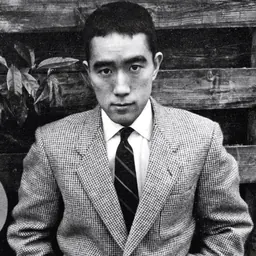



Related people
Same field, nearest in time



Contemporaries
People whose lives overlapped Eikō Hosoe's


Frequently asked questions
Who was Eikō Hosoe?
Japanese photographer (1933–2024)
When was Eikō Hosoe born?
Eikō Hosoe was born on 18 March 1933 in Yonezawa.
When did Eikō Hosoe die?
Eikō Hosoe died on 16 September 2024 in Tokyo.
What was Eikō Hosoe's occupation?
Eikō Hosoe was a photographer, film producer and university teacher.
What nationality was Eikō Hosoe?
Eikō Hosoe was Japanese.
Sources & further reading
Cite this page
APA: Biography.guide. (2026). Eikō Hosoe. https://biography.guide/eiko-hosoe/
MLA: "Eikō Hosoe." Biography.guide, https://biography.guide/eiko-hosoe/.
Chicago: "Eikō Hosoe." Biography.guide. https://biography.guide/eiko-hosoe/.
Data last updated: 2026-09-20 · Spot an error? Report a correction.
Page generated 2026-09-27 05:29 UTC