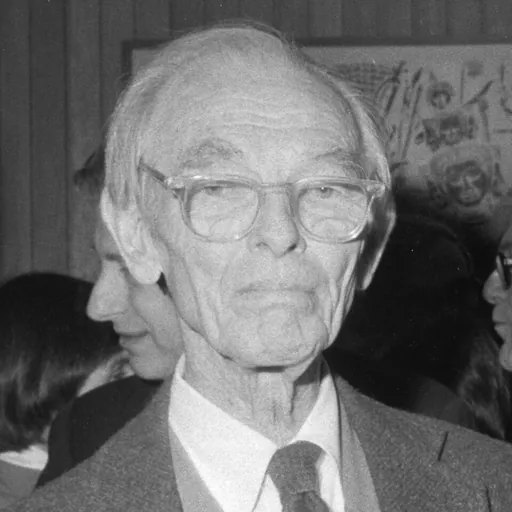
About Edwin C. Kemble
Lived 1889 – 1984 (aged 95). Edwin C. Kemble was an American physicist and university teacher.
Edwin Crawford Kemble (January 28, 1889, in Delaware, Ohio – March 12, 1984) was an American physicist who made contributions to the theory of quantum mechanics and molecular structure and spectroscopy. During World War II, he was a consultant to the Navy on acoustic detection of submarines and to the Army on Operation Alsos.
Education
Kemble began college in 1906 at Ohio Wesleyan University, but he stayed there only one year. He then transferred to the Case School of Applied Science, where he received his B.S. in physics in 1911. At Case, Kemble was a student of Dayton C. Miller, a nationally recognized scientist working in the field of acoustics. Upon graduation from Case, he spent the following year as a physics instructor at the Carnegie Institute of Technology in Pittsburgh, a school founded in response to the growing demand for education in technology, as was Case. During that year, Miller obtained a graduate fellowship for Kemble at Harvard; the fellowship was personally financed by Harvard Professor Wallace Sabine, a colleague of Miller's in acoustics. Kemble entered graduate school in 1913, with Percy Bridgman as his thesis advisor. This was the year Niels Bohr submitted his first paper on the Bohr model of the hydrogen atom. Universities in Europe were in the process of making the transition from the predominance of experimental physics to that of theoretical physics, as was the case in the United States. Bridgman, a well-known experimentalist, did, however, champion Kemble's interest in pursuing theoretical interests in physics. Kemble was drawn to the new quantum theories in a course on radiation by G. W. Pierce. It was while considering thesis topics that Kemble was drawn to the recently introduced quantum theory of molecular spectra. He received his Ph.D. in physics from Harvard in 1917.
Career
After Kemble received his doctorate, with World War I in progress, he spent a short time doing work which contributed to the war effort developing aircraft engines at Curtiss Aeroplane and Motor Company. As the War ended, he was laid off. While he did want to return to Harvard, a position could not immediately be found, so he spent a half semester teaching at Williams College, in Williamstown, Massachusetts. Bridgman had a plan to build up theory at Harvard, which consisted of restructuring from the emphasis on electromagnetism (radiotelegraphy, optics, and wave propagation) to radiation theory, quantum theory, photo-electricity, specific heats, X-ray crystal structure, and special topics in physics theory. Kemble accepted the challenge and returned to Harvard in 1919 as an assistant professor in the physics department, the year Arnold Sommerfeld published Atombau und Spektrallinien, which became the “bible” of atomic theory for the new generation of physicists who developed atomic and quantum physics. Kemble remained there the rest of his career as instructor (1919–1924), assistant professor (1924–1927), associate professor (1927–1930), and professor (1930–1957). He was made chairman of the department in 1940. His first graduate student was John Van Vleck. Many other doctoral students and postdoctoral students/researchers followed in the next fifteen years, including Robert S. Mulliken, John C. Slater, J. Robert Oppenheimer, Clarence Zener, James H. Bartlett, Eugene Feenberg, and J. L. Dunham. and Raymond T. Birge spoke for the west coast and the University of California, Berkeley.
During World War II, Kemble supervised the teaching of basic physics to military officers, consulted with for the Navy on acoustic detection of submarines, and near the end of the war consulted for the Army on Operation Alsos. The objective of Alsos was to investigate the German nuclear energy efforts, seize German nuclear resources, materials and personnel to further American research and to prevent their capture by the Soviets, and to discern how far the Germans had gone towards creating an atomic bomb. Samuel Goudsmit, a quantum physicist from the University of Michigan, was the scientific leader of ALSOS, and Lt. Col. Boris Pash, a former Manhattan Project security officer, was its military leader.
At the end of WW II, Kemble had the opportunity to continue his wartime interest in teaching physics to non-physicists. In reacting to the role science played in the war, James B. Conant, president of Harvard and former high-level administrator in the Manhattan Project, proposed teaching science to all Harvard undergraduates by teaching them the history of science and highlighting the importance of science to social change. Kemble joined I. Bernard Cohen, Gerald Holton, Thomas S. Kuhn, Philippe Le Corbeiller, and Leonard K. Nash in this project. In 1978, he married Martha Chadbourne Kettelle, his Radcliffe College fiancée from graduate student days.
Books Edwin C. Kemble and others Molecular Spectra in Gases (National Research Council, Washington DC, 1926) Edwin C. Kemble Physical Science, Its Structure and Development: From Geometric Astronomy to the Mechanical Theory of Heat (M.I.T. Press, 1966) Edwin C. Kemble Physical Science, Its Structure and Development—Vol. 2 (1970) Edwin C. Kemble The Fundamental Principles of Quantum Mechanics with Elementary Applications (McGraw Hill, 1937) (Dover, 1958 and 2005)
Selected Literature
Don’t just read it —
keep it.
Full-length biographies made to live with: read them, listen on the way to work, watch them tonight.
- E-book
- Audio
- Video
Instant download · yours to keep · every purchase keeps this site free
Important facts
People in Edwin C. Kemble's life
Named in this biography and alive at the same time




Related people
Same field, nearest in time

Contemporaries
People whose lives overlapped Edwin C. Kemble's




Frequently asked questions
Who was Edwin C. Kemble?
American physicist (1889–1984)
When was Edwin C. Kemble born?
Edwin C. Kemble was born on 28 January 1889 in Delaware.
When did Edwin C. Kemble die?
Edwin C. Kemble died on 12 March 1984.
What was Edwin C. Kemble's occupation?
Edwin C. Kemble was a physicist and university teacher.
What nationality was Edwin C. Kemble?
Edwin C. Kemble was American.
Sources & further reading
Cite this page
APA: Biography.guide. (2026). Edwin C. Kemble. https://biography.guide/edwin-c-kemble/
MLA: "Edwin C. Kemble." Biography.guide, https://biography.guide/edwin-c-kemble/.
Chicago: "Edwin C. Kemble." Biography.guide. https://biography.guide/edwin-c-kemble/.
Data last updated: 2026-09-20 · Spot an error? Report a correction.
Page generated 2026-09-27 05:10 UTC