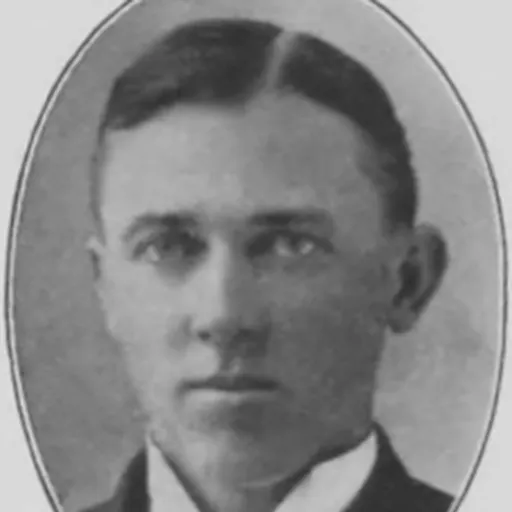
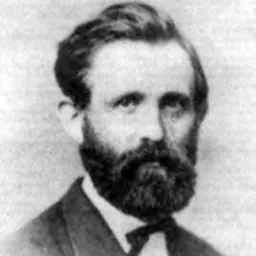
Edwin Bayer Branson
American geologist and paleontologist
About Edwin Bayer Branson
Lived 1877 – 1950 (aged 72). Edwin Bayer Branson was an American herpetologist, geologist and paleontologist.
Edwin Bayer Branson (May 11, 1877 – March 12, 1950) was an American geologist and paleontologist. He was a professor of geology at the University of Missouri for 37 years.
Biography
Branson was born in Belleville, Kansas, one of six children of John McDowell Branson and Harriet Melviney Bullen. He married Grace Muriel Colton in 1905 in Massachusetts. They had two sons, Carl Colton Branson and Edwin Robert Branson, both of whom became geologists.
From 1895–99, he taught in public schools in Powhattan, Kansas. It was named for him when he retired in 1947.
Branson served as vice president of the Paleontological Society of America. He was also a fellow and member of multiple academic societies, including the American Association for the Advancement of Science, the Geological Society of America, the Society of Economic Paleontologists and Mineralogists, the American Association of Petroleum Geologists, and the Missouri Academy of Sciences.
In 1931, he and Maurice Mehl described the extinct genus of heterostracan agnathan Cardipeltis in the Jefferson Formation of Utah.
In 1932, Branson and Mehl reported the presence of Carboniferous-aged fossil footprints of a new ichnospecies in the Tensleep Formation of Wyoming. They named the tracks Steganoposaurus belli and attributed them to an amphibian nearly three feet in length.
The same year, he and Mehl named a new kind of Late Triassic dinosaur footprint discovered in the Popo Agie Formation of western Wyoming. The new ichnogenus and species was named Agialopus wyomingensis.
In 1933, also with Mehl, he described the conodont species Wurmiella excavata.
In 1934, with Mehl, he described the conodont genera Pseudopolygnathus and Ancyrognathus.
In 1938, with Mehl, he reviewed the conodont genus Icriodus.
In 1941, he and Mehl described several conodont genera: Bactrognathus, Doliognathus, Scaliognathus, Staurognathus and Taphrognathus. Also in 1941, with C.C. Branson, he reviewed the geology of the Wind River Mountains in Wyoming.
In 1944, he described with Mehl the conodont genus Siphonodella.
In 1947, with his son Carl Colton Branson, he reviewed the Lower Silurian conodonts from Kentucky.
In 1951, with Mehl and C.C. Branson, he published an article about the Richmond Group conodonts of Kentucky and Indiana.
Don’t just read it —
keep it.
Full-length biographies made to live with: read them, listen on the way to work, watch them tonight.
- E-book
- Audio
- Video
Instant download · yours to keep · every purchase keeps this site free
Important facts
People in Edwin Bayer Branson's life
Named in this biography and alive at the same time


Related people
Same field, nearest in time



Contemporaries
People whose lives overlapped Edwin Bayer Branson's



Frequently asked questions
Who was Edwin Bayer Branson?
American geologist and paleontologist (1877–1950)
When was Edwin Bayer Branson born?
Edwin Bayer Branson was born on 11 May 1877 in Belleville.
When did Edwin Bayer Branson die?
Edwin Bayer Branson died on 12 March 1950 in Columbia.
What was Edwin Bayer Branson's occupation?
Edwin Bayer Branson was a herpetologist, geologist and paleontologist.
What nationality was Edwin Bayer Branson?
Edwin Bayer Branson was American.
Sources & further reading
· Wikipedia: Edwin Bayer Branson
Cite this page
APA: Biography.guide. (2026). Edwin Bayer Branson. https://biography.guide/edwin-bayer-branson/
MLA: "Edwin Bayer Branson." Biography.guide, https://biography.guide/edwin-bayer-branson/.
Chicago: "Edwin Bayer Branson." Biography.guide. https://biography.guide/edwin-bayer-branson/.
Data last updated: 2026-09-22 · Spot an error? Report a correction.
Portrait: Wikimedia Commons · author & licence
Page generated 2026-09-27 05:03 UTC