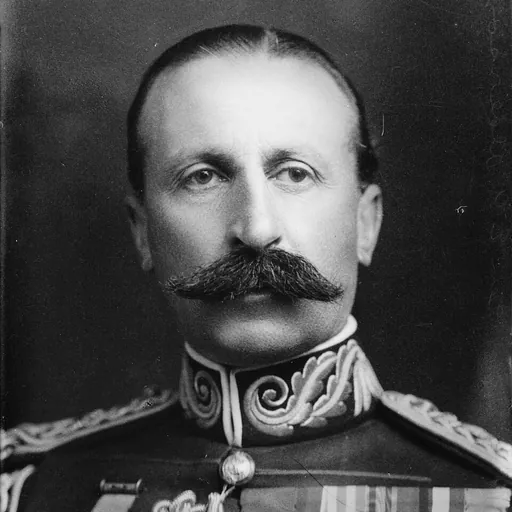
Edwin Alderson
British and Canadian First World War general
About Edwin Alderson
Lived 1859 – 1927 (aged 68). Edwin Alderson was a British military officer and lieutenant general.
Lieutenant-General Sir Edwin Alfred Hervey Alderson, KCB (8 April 1859 – 14 December 1927) was a senior British Army officer who served in several campaigns of the late nineteenth and early twentieth centuries. From 1915 to 1916 during the First World War he commanded the Canadian Expeditionary Force on the Western Front, during which time it saw heavy fighting.
Early life Born in 1859 in Capel St Mary, a village in Suffolk, Edwin Alderson was the son of Lieutenant-Colonel Edward Mott Alderson and his wife Catherine Harriett Swainson. He was educated at Ipswich School.
Early military career Aged 17, Alderson received a commission into the Norfolk Artillery Militia, and at 19 he was transferred to the 1st Foot (later Royal Scots Regiment) on 4 December 1878. He transferred again ten days later, replacing a promoted officer, to his father's regiment, the 97th (The Earl of Ulster's) Regiment of Foot (soon to become a battalion of the Queen's Own Royal West Kent Regiment). Joining the regiment in Halifax, Nova Scotia, Alderson was soon transferred to Gibraltar and later South Africa, where he was detached to the Mounted Infantry Depot at Laing's Nek. For his service in these campaigns, Alderson was promoted to captain, upon being transferred to the Queen's Own (Royal West Kent Regiment) in June 1886, and was stationed at Aldershot with the European Mounted Infantry Depot. The same year he married the daughter of the vicar of Syresham, Northamptonshire, a Miss Alice Mary Sergeant.
The next ten years of Alderson's career were spent on staff duties and with his old regiment in England and Ireland. He also undertook training at the Staff College, Camberley, from 1895 to 1896. and in 1896 was sent to Mashonaland as a commander of a regiment of local troops during the Second Matabele War. Following the campaign's successful conclusion he returned to Aldershot to serve as a deputy assistant adjutant general, taking over from Frederick Stopford. While there, he published his first book, With the Mounted Infantry and the Mashonaland Field Force, 1896, an account of the war and a thesis on the tactical uses of mounted infantry. A second book on military tactics followed in 1898 called The Counter-attack. His third book, "Pink and scarlet" was published in 1900 and was another tactical treatise concerning the relationship between fox-hunting and the cavalry, and the connection that these gentlemanly and military concerns had in training young officers and developing innovations in cavalry tactics. His experience with mounted infantry made him suitable for this role in fighting the highly mobile horsed Boer Commandos, as they moved in the latter part of the conflict to a strategy of hit and run attacks upon the British Expeditionary Force in South Africa. Alderson was instrumental in forming British counter-tactics and used his brigade to good effect against the Afrikaners, the troops under his command including two battalions of Canadian Mounted Rifles. The force was part of the 1st Mounted Infantry Brigade, under the overall command of experienced British soldier Edward Hutton, previously General-Officer-Commanding the Canadian Militia, who became a lifelong friend of Alderson's. appointment as a Companion of the Order of the Bath (CB) and to receive the ceremonial post of Aide-de-Camp to Queen Victoria (who died the same year). By 1901, Alderson's innovations had resulted in several victorious operations, and in July that year he was appointed Inspector General of Mounted infantry in the Natal District.
He was mentioned in despatches several times (including by Lord Roberts dated 31 March 1900, and by Lord Kitchener dated 23 June 1902 ), and received the Queen's South Africa Medal. After the end of the war in June 1902, Alderson stayed in South Africa another couple of months as Inspector General of Mounted Infantry, returning home on the SS Scot in November.
1902–1914 On his return, Alderson was attached to the 1st Army Corps, stationed at Aldershot. In May 1903 he was given command of the 2nd Infantry Brigade which was part of the 1st Division in the 1st Army Corps at Aldershot, and in December 1906 was promoted to the rank of major general. In 1908, he released a compilation of notes made on campaign entitled Lessons from 100 notes made in peace and war. The same year he was posted to India to command the 6th (Poona) Division based in Poona.
In 1912 he returned to England in semi-retirement on half-pay, However he was given larger duties when he was appointed by Field Marshal Lord Kitchener to lead the Canadian Expeditionary Force because of his experience with the Canadians in South Africa. Soon after his appointment he came into conflict with Sir Sam Hughes, Canadian Minister of Militia. Hughes had preceded his men and insisted that the Canadian contingent was not only fully trained and battle ready but also equipped with the best weaponry available. Alderson however, after reviewing the Canadian formation was concerned about its combat readiness, particularly regarding some of its commissioned officers, who appeared to owe their positions to political connections rather than through professional military qualifications, the degree of training of the troops had received, and the mechanically temperamental Ross rifle, a weapon personally approved by Hughes. made some headway in toughening the Canadian troops encamped in the wet, autumn weather, and dismissed some commissioned officers, appointed at Hughes' discretion, whom he thought incompetent. When Hughes' representative in England, Colonel John Wallace Carson, secured preferential accommodation for the Canadian soldiers at the expense of a British Army brigade, Alderson refused the barracks and in doing so, drew personal hostility from both Carson and Hughes upon himself. Carson wrote to the Canadian Prime Minister Robert Laird Borden that Alderson "does not treat our men with a firm iron hand covered with the velvet glove which their special temperaments require". The Algerians broke and fled, suffering over 6,000 casualties in a matter of minutes, and the Canadians were consequently forced to defend twice the length of the front line they had vacated. Although the Canadian Division held on for more than two days, ground was lost to the attacking Germans, and the Canadian Division suffered over 50% casualties (nearly 6,000 troops). Colonel Carson however, who reported personally to Hughes, downplayed the mishaps, and blamed the Division's heavy casualties on Alderson's leadership, indicating that it had only been saved from annihilation by the actions of Turner and Hughes. circulated a document listing ten deficiencies with the rifle and claiming 85% of Canadian soldiers no longer wished to use it. Hughes in response sent letters to 281 senior military figures backing the Ross, and attacking Alderson's character. Sir Herbert Plumer, the commander of British 2nd Army commanding the front, demanded Ketchen's immediate dismissal, and when Turner claimed that if Ketchen was dismissed he would resign, Alderson sought his dismissal as well.
Last years Alderson enjoyed an active retirement, becoming colonel of the Queen's Own Royal West Kent Regiment in November 1921, pursuing hunting and yachting with fervour, being an active master of foxhounds of the South Shropshire Hunt and member of the Royal Norfolk and Suffolk Yacht Club. He was also very concerned that the growing popularity of motor sports would result in the demise of these traditional pastimes and expended much energy promoting them.
Death Alderson died on 14 December 1927 at the Royal Hotel, Lowestoft
Reputation Alderson retained strong feelings about his treatment at the hands of Hughes and his allies, commenting to a friend that "Canadian politics have been too strong for all of us".
English military historian Alan Clark's book "The Donkeys" (1961), a polemical indictment of British General Staff incompetence in 1915 Western Front operations, contains a photograph of Alderson decorating a Canadian soldier with a medal, captioned "Donkey Decorates Lion", stating he was decorating the unnamed soldier for bravery at the Second Battle of Ypres (1915). In fact, the photograph was taken the following year, on 9 March 1916 "near Locre" (Loker), Belgium.
Namesake The name Mount Alderson was given in 1915 to one of the peaks in the Waterton Lakes National Park in Alberta, Canada.
Works With the Mounted Infantry and the Mashonaland Field Force, 1896 (1898) The Counter-attack (1898) Pink and Scarlet or Hunting as a School for Soldiering (1900) Lessons from 100 Notes Made in Peace and War (1908)
Don’t just read it —
keep it.
Full-length biographies made to live with: read them, listen on the way to work, watch them tonight.
- E-book
- Audio
- Video
Instant download · yours to keep · every purchase keeps this site free
Important facts
People in Edwin Alderson's life
Named in this biography and alive at the same time




Related people
Same field, nearest in time




Contemporaries
People whose lives overlapped Edwin Alderson's

Frequently asked questions
Who was Edwin Alderson?
British and Canadian First World War general (1859–1927)
When was Edwin Alderson born?
Edwin Alderson was born on 8 April 1859 in Capel St Mary.
When did Edwin Alderson die?
Edwin Alderson died on 14 December 1927 in Lowestoft.
What was Edwin Alderson's occupation?
Edwin Alderson was a military officer and lieutenant general.
What nationality was Edwin Alderson?
Edwin Alderson was British.
Sources & further reading
Cite this page
APA: Biography.guide. (2026). Edwin Alderson. https://biography.guide/edwin-alderson/
MLA: "Edwin Alderson." Biography.guide, https://biography.guide/edwin-alderson/.
Chicago: "Edwin Alderson." Biography.guide. https://biography.guide/edwin-alderson/.
Data last updated: 2026-09-20 · Spot an error? Report a correction.
Portrait: Wikimedia Commons · author & licence
Page generated 2026-09-27 04:58 UTC