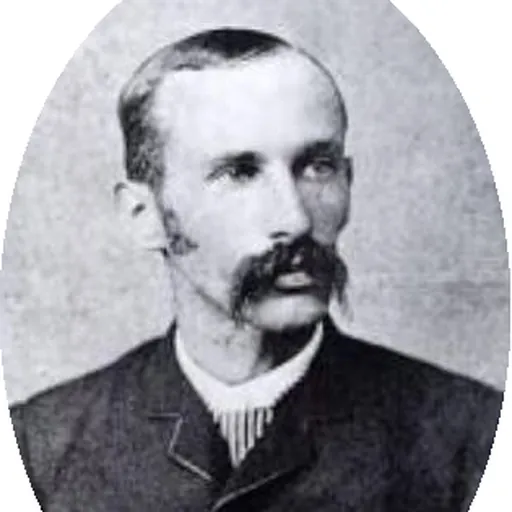
About Edward William Purvis
Lived 1857 – 1888 (aged 31). Edward William Purvis was a military personnel.
Colonel Edward William Purvis (July 4, 1857 – August 16, 1888) was a British army officer and settler of the Kingdom of Hawaii who served as Vice-Chamberlain during the reign of King Kalākaua. After resigning from the royal household, Purvis published two political satires aimed at undermining the image of the king and his prime minister, Walter M. Gibson, who had been responsible for the removal of Purvis' superior. These actions and other factors led to the demise of the Gibson regime and the Bayonet Constitution of 1887. Purvis died in the following year, after going to the United States to seek medical attention for his health. According to popular legend, he was an expert player of the Portuguese machete or cavaquinho and was believed to be the inspiration for the name of the Hawaiian ukulele.
Early life Purvis was born on July 4, 1857, into a family of Scottish descent. His parents were Robert Raaf Purvis and Annie Silburn Marshall. His paternal grandfather, William Purvis, who worked as a trader and ship captain, had settled in the Dutch East Indies in the 1810s while it was still part of the British Empire. The family lived in many places including Dutch East Indies, Brussels, and London. Educated at Cheltenham College and the Royal Military College, Sandhurst, Edward William Purvis served as a sub-lieutenant of the 70th (Surrey) Regiment of Foot in Bengal, where he learned Hindi, and later as a sub-lieutenant for the 31st (Huntingdonshire) Regiment of Foot in Chatham, Kent. Around 1879 he resigned his British Army post and traveled to the Hawaiian Islands, where his father and older brother Robert William Theodore Purvis had already settled, having arrived on December13, 1877; his brother Theodore had started a sugar plantation business on the island of Kauai. A distant cousin of theirs was William Herbert Purvis, known for introducing macadamia nuts to Hawaii.
Career in Hawaii Purvis standing on far right with Hawaiian Army Colonels James Harbottle Boyd, Curtis P. Iaukea and Charles Hastings Judd on the steps of the ʻIolani Palace, 1882
Purvis settled in Honolulu around 1879. On August26, 1882, he was created a major in the Hawaiian military and appointed as military instructor. He was also appointed as King Kalākaua's Vice-Chamberlain under Chamberlain Charles Hastings Judd. In 1882 he served as acting chamberlain during Judd's trip to Europe and was appointed as a member of the King's Staff with the rank of colonel on December23, 1884. By the end of August 1886, he had resigned the office of vice chamberlain after his superior Judd was dismissed from his post. Purvis had been asked to resign by the king at the instigation of the newly appointed prime minister, Walter M. Gibson, and the cabinet ministers. These works and other factors including the Aki opium scandal and the failed attempt to form a Polynesian Confederacy contributed to the demise of the Gibson administration and the passage of the Bayonet Constitution of 1887, which severely limited the power of the king.
Purvis made many friends among Hawaii's Portuguese immigrant community and became an expert player of the machete (otherwise known as the cavaquinho). Thus, it is popularly believed that the Hawaiian musical instrument, the ukulele (an adaption of these Portuguese instruments), was named for Purvis, as the term can be translated as "jumping flea"a nickname of the small, excitable, and quick-fingered Purvis. Modern scholarship has cast doubt on this popular legend, though. According to historians John King and Jim Tranquada, "it is unlikely that the nickname of a man who sought to undermine the king in the months prior to the imposition of the Bayonet Constitution of 1887 would have been applied to an instrument favored by native Hawaiians". In May 1888 he left the Hawaiian Islands for the United States for his health. Settling in Colorado Springs, Colorado, he initially wrote home stating that he was improving, but his condition worsened. His brother Theodore traveled all the way from Hawaii to see him for the last time before he died on August16, 1888. He was 31 years old at the time of his death. His brother-in-law Edmund William Holdsworth was chosen as administrator of his estate; Purvis' will, written on April22, left everything to his brother Theodore Purvis. His remains were interred in the Evergreen Cemetery in Colorado Springs.
Honors
Don’t just read it —
keep it.
Full-length biographies made to live with: read them, listen on the way to work, watch them tonight.
- E-book
- Audio
- Video
Instant download · yours to keep · every purchase keeps this site free
Important facts
People in Edward William Purvis's life
Named in this biography and alive at the same time




Related people
Same field, nearest in time



Contemporaries
People whose lives overlapped Edward William Purvis's




Frequently asked questions
Who was Edward William Purvis?
British army officer and settler in Hawaii
When was Edward William Purvis born?
Edward William Purvis was born on 4 July 1857.
When did Edward William Purvis die?
Edward William Purvis died on 16 August 1888 in Colorado Springs.
What was Edward William Purvis's occupation?
Edward William Purvis was a military personnel.
Sources & further reading
· Wikipedia: Edward William Purvis
· DBpedia: Edward William Purvis
Cite this page
APA: Biography.guide. (2026). Edward William Purvis. https://biography.guide/edward-william-purvis/
MLA: "Edward William Purvis." Biography.guide, https://biography.guide/edward-william-purvis/.
Chicago: "Edward William Purvis." Biography.guide. https://biography.guide/edward-william-purvis/.
Data last updated: 2026-09-23 · Spot an error? Report a correction.
Portrait: Wikimedia Commons · author & licence
Page generated 2026-09-27 05:06 UTC