
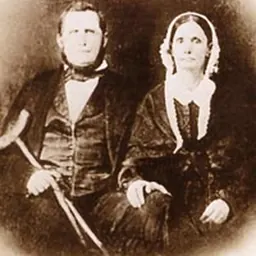
Edward Stone
American slave trader
About Edward Stone
Lived 1782 – 1826 (aged 43–44). Edward Stone was an American slave trader.
Edward Stone (September 17, 1826), also known as Ned Stone, was an American slave trader. He participated in the interregional slave trade between Maryland, Kentucky, Mississippi, and Louisiana. Stone had a slave jail under his house, the Grange, which was built in the 1810s near Paris, Kentucky. Stone was killed on the Ohio River in 1826 by slaves he was transporting south for sale.
Biography Edward Stone was originally from the Virginia Piedmont region and migrated to Bourbon County with three older brothers in the early 1800s. He began trading in slaves sometime before 1816. Stone was one of the handful of Kentucky slave traders who openly advertised early in the 19th century.
The Grange in Bourbon County, Kentucky was originally constructed to be his home. The early history of the house, located on the Lexington–Maysville Pike, was described in the 1973 application for the National Register of Historic Places:
Edward Stone began to build this splendid house in 1800. With his wife and eleven children he settled on his father's Revolutionary War land grant. At first they lived in a cabin while he built a kiln. After he built the kitchen and stables, they lived above the kitchen while building the rest of the house. After the foundation and cellar walls were formed they were allowed to settle for a couple of years to insure a firm foundation. After it was completed in 1816, Stone named it "Oakland". Underneath the entrance hall is a 24' x 12' masonry-walled room. The only ventilation is from an iron-barred window under the back porch in a two-foot thick wall. The doorway is 4' x 4' , raised 2 feet off the ground, and the door was solid iron. This room was the dungeon used in Stone's work as a slave trader...Following is an advertisement that Stone placed in the newspaper:
Stone also originally owned and likely built the neighboring Thomas Champ house, also known as Sulphur Spring. According to a history of the Maysville Road, "This house strongly resembles Rose Hill House [in Lexington] and The Grange in style."
In 1818, "Edw. Stone" of Flat Run, Bourbon County placed an ad in the local paper warning locals against "hunting, fowling, pulling down any of my plantation or woods pasture fencing, riding through, or in any manner, trespassing upon my plantation, as I am determined to prosecute, all who do it without liberty. Owners of Negroes had better give them ration, as they often ride after night." He was probably selling in Natchez that year with Jacob Jacoby, another Kentuckian, and Henry Turney.
The Western Citizen. (November 29, 1823). Stone & Keiningham The records of Concordia Parish, Louisiana show that Stone was selling there in 1820. In 1821 Stone and Thomas Phillips were partners in the slave trade. This business partnership with Thomas Phillips was concluded in 1823. One of their commercial enterprises was moving brown sugar from New Orleans to Kentucky. Stone was said to be one of the co-owners, with his partner at the time, Benjamin Keiningham, of the Paris, Kentucky slave coffle of summer 1822. In 1823, Stone listed for lease or sale the Indian Queen Hotel in Paris, Kentucky, preferring either "Land or Negroes" as the form of payment. The Indian Queen was more of a tavern than a hotel and was located at the corner of Main and Second in what was already a busy commercial center. In 1825 Kentucky slave trader John W. Anderson testified in a court case in Natchez, Mississippi, involving fight between Stone and a male slave.
In August 1826, Stone advertised for the recapture of a runaway slave. According to the African Americans of the Kentucky Borderlands database, Stone "placed a reward ad for the return of 22-yr-old Rowsley Peyton. Stone claimed that Peyton and his brother (unnamed) escaped on the night of August 22, stopping to steal horses and goods on their way. Rowley's brother was captured. Rowsley was born in Stafford County, Virginia where he was held by Mr. Kendall; he was literate."
1826 Ohio River slave rebellion
Stone, his nephew Howard Stone, and three other whites were killed on the Ohio River in 1826 by the people he was trafficking south. The news report about his slaying, now known as the 1826 Ohio River slave revolt, read as follows:
Information reached Louisville on Friday last of the murder of five white men by a gang of slaves on board of a flat boat in the river, about 100 miles below that place. They were owned by Howard and Edward Stone of Bourbon, who with David Cobb of Lexington, and a man named James Gray were conveying them to the Mississippi country for sale. These are the individuals that have been murdered. The fifth victim was a Mr. Davis who had taken his passage on board the boat at Louisville. The gang of slaves consisted of 75 in number, males and females, and of various ages; 56 of them have been lodged in the jail of Breckinridge county at Hardinsburgh. They were taken in Indiana. One of the unfortunate individuals, it is said, who was on deck when the butchery commenced below, swam from the boat to the shore, but was pursued and despatched. Some of the slaves had been lately purchased in Maryland. The second listing advertised two farms for rent, as well as the sale of 50 barrels of corn, 19 shoats, one hiefer, and "3 negroes," as well as other miscellaneous items that had been "left at the former sale." The brick building for housing slaves was slightly innovative according to a late 20th-century architectural historian: "Some planters even saw the double-pen cabin as the quintessential slave house and created new types of slave buildings by manipulating the double-pen form. At The Grange outside of Millersburg, Kentucky, for example, Edward Stone built a triple-pen house to serve as the quarter for his domestic slaves; it is a double-pen cabin plus an additional room."
After Stone's murder, John W. Anderson "took over the northern region's major slavetrading operations." Stone had had operations in Harrison County as well as in Bourbon County, while Anderson was based in Mason County "with its tobacco-based economy [which had] established the earliest recorded domestic slave-trading market in Kentucky at Washington, which is located on a hill above Maysville."
Don’t just read it —
keep it.
Full-length biographies made to live with: read them, listen on the way to work, watch them tonight.
- E-book
- Audio
- Video
Instant download · yours to keep · every purchase keeps this site free
Important facts
People in Edward Stone's life
Named in this biography and alive at the same time

Related people
Same field, nearest in time


Contemporaries
People whose lives overlapped Edward Stone's



Frequently asked questions
Who was Edward Stone?
American slave trader
When was Edward Stone born?
Edward Stone was born in 1782.
When did Edward Stone die?
Edward Stone died on 17 September 1826 in Ohio River.
What was Edward Stone's occupation?
Edward Stone was a slave trader.
What nationality was Edward Stone?
Edward Stone was American.
Sources & further reading
· DBpedia: Edward Stone (slave trader)
Cite this page
APA: Biography.guide. (2026). Edward Stone. https://biography.guide/edward-stone-slave-trader/
MLA: "Edward Stone." Biography.guide, https://biography.guide/edward-stone-slave-trader/.
Chicago: "Edward Stone." Biography.guide. https://biography.guide/edward-stone-slave-trader/.
Data last updated: 2026-09-20 · Spot an error? Report a correction.
Page generated 2026-09-27 05:01 UTC