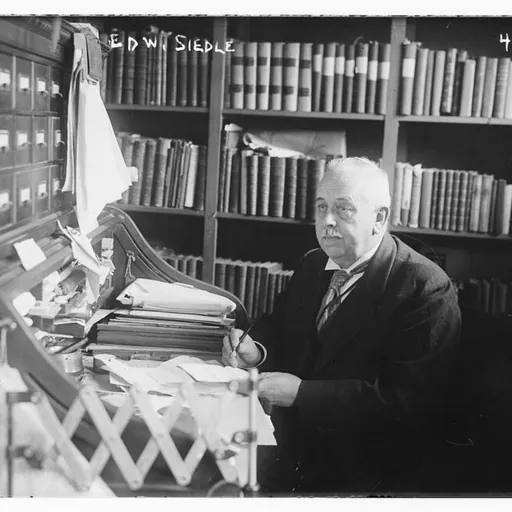
Edward Siedle
American technical director
About Edward Siedle
Lived 1858 – 1925 (aged 66). Edward Siedle was an American and British property master and technical director.
Edward Siedle (May 30, 1858 – March 30, 1925) was a British-American property master and technical director who worked mainly at the Metropolitan Opera. During his tenure at The Met, he was directly in charge of all technical elements through one of its most innovative eras.
Biography Siedle was born in Dulwich, England, on May 30, 1858. His parents were both German. He emigrated to the United States in 1878. In 1883, he married Caroline Siedle, a costume designer for theatre. They had a son named Edward Vincent Siedle who was born around 1888. The 1900 US Census lists their residence as Westchester. By 1907, they were living in Ludlow Park, Yonkers. Caroline died in 1907. Siedle remarried. His son, Edward Vincent Siedle, served on the Mexican border in 1916 and in France as a captain in the 369th United States Infantry. He received the Croix de Guerre.
Siedle was described as "a man large in frame, stooped, with a big cigar drooping from the corner of his mouth... He looked a bit like the Winston Churchill of today." He was rarely seen without a black fedora hat and a cigar in his mouth. His office was described as "cluttered with books, papers, boxes, wigs, and full of a truly startling and heterogeneous collection of furniture, hangings, materials, and odds and ends."
Siedle was a member of St. Cecile Lodge 568, F. & A. M.
He died on March 30, 1925, at his home in Port Chester, New York. He had become ill, stayed home for a few weeks, and died. His funeral was held in the Grand Lodge Room of the Masonic Hall on West Twenty-third street. Most of the staff of the Metropolitan Opera attended, including Gatti-Casazza and Edward Ziegler, as well as representatives of the Theatrical Protective Union and the Theatrical Mechanics' Association. His honorary pallbearers included Jefferson de Angelis, William D. Lang, Philip Crispano, John Nash and Gustave A. Weldhaas. The Masonic Quartet sang The Long Day Closes. He was buried at Woodlawn Cemetery. Siedle was replaced by Walter Jagemann, one of his long-time assistants.
Career Siedle began his career helping out the visiting property men at a theatre in his home town of Dulwich, where he received his first permanent job as "props" at the age of 17, receiving 2 shillings a week. After one season, a visiting showman brought him to London to be a regular props man at a small theatre. While there, one of his teachers was Bradwell (first name unknown), a famed property man and theatre mechanic. and became property master within the next decade.
Around 1900, he built a life-size elephant for Wang, where De Wolf Hopper sang "The Man With an Elephant on His Hands." It was such an achievement in the property business that it gained him fame and publicity. A 1909 news article called Siedle "he greatest master of properties in America", while a 1911 news article described him as "responsible for so many of the fine scenic effects at the opera house".
Siedle became the technical director at the Met before 1909. As technical director, Siedle was one of only two department heads (the other being Toscanini, the first conductor) to report directly to Gatti. The 1909 season had twenty new productions, including premieres or complete restagings. The scenery for the various operas was built and painted in Milan, Germany or Paris, as well as in New York by the Metropolitan's scenic artist, James Fox. In 1909, the estimated cost of the costumes and scenery for the season was over $100,000 (equivalent to $2.6 million in 2012). The cost of the scenery and properties for a single opera under Siedle's management ranged from $10,000 to $50,000. The decision to place the production of scenery, properties, costumes and effects in the hands of Edward Siedle was reached at a conference in Paris held by Gatti-Casazza, Puccini, Tito Ricordi, and his New York representative, Mr. Maxwell.
As technical director, Siedle was in charge of fifty stage carpenters, twenty property men, thirty electricians, five engineers, sixty wardrobe women. He oversaw the Met's seven storehouses (their locations included 40th St, between 7th and 8th Avenues; 41st St near 8th Avenue; 36th St near 11th Avenue; 50th Street near 11th Ave; 44th St near 11th Ave; and 41st St near 1st Ave). The storehouses of the Met held about one hundred complete productions, representing a total investment of $3,000,000
Under Siedle's reign, the technical department at the Met built up one of the finest musical and theatrical libraries in the US at the time. The Jolly Musketeer (with costume design by his wife, Caroline) – Jefferson De Angelis Opera Company – 1898 Wizard of Wiseland – Illinois Theatre – 1909 Monte Cristo – English's, Indianapolis – 1901 – (Playbill lists "Costumes, designs and effects by Edward and Caroline")
Technical Director: La fanciulla del west – 1910 Natoma – Philadelphia-Chicago Grand Opera Company – 1910 Mona – 1912 Cyrano – 1913 Grand Opera in Atlanta by the Metropolitan Opera Company – 1913 Julien – 1914 Die Walkure – Metropolitan Opera Company at City College Stadium – 1916 Cavalleria Rusticana – Metropolitan Opera Company at City College Stadium – 1916 Pagliacci – Metropolitan Opera Company at City College Stadium – 1916 Brian Boru – Philadelphia, Metropolitan Opera House – 1917 Don Carlos – 1920 Die Tote Stadt – 1921 Cosi Fan Tutti – 1922
Scenery Construction Supervisor L'oracolo – Philadelphia, Metropolitan Opera House – 1919 It was located at 538 W. 29th Street in Manhattan. In 1912, the Studio employed 18 men and 2 women in the shop.
For the fiftieth anniversary celebration of the Metropolitan Museum of Art, some of the decorations in the great hall of the Fifth Avenue Entrance were provided by Siedle Studios.
Siedle Studios Credits Mechanical and artistic properties The Wizard Prince of Arabia – Barnum & Bailey – 1914
Properties Natoma – Philadelphia-Chicago Grand Opera Company – 1910 Scandals – Apollo Theatre – 1926
Animal costumes Somewhere Else – Broadway Theatre – 1913
The Gay Musician In 1908, Siedle, along with Charles Campbell, wrote the book and lyrics to Julian Edward's comic opera, The Gay Musician. It had its first production in Baltimore. While successful in New York and praised for its music, the writing of Siedle and Campbell was criticized for being "slow" and "weighty". It returned to the West End Theatre in New York City at the end of 1908 after a successful tour across the US.
Don’t just read it —
keep it.
Full-length biographies made to live with: read them, listen on the way to work, watch them tonight.
- E-book
- Audio
- Video
Instant download · yours to keep · every purchase keeps this site free
Important facts
People in Edward Siedle's life
Named in this biography and alive at the same time




Related people
Same field, nearest in time

Contemporaries
People whose lives overlapped Edward Siedle's

Frequently asked questions
Who was Edward Siedle?
American technical director (1858–1925)
When was Edward Siedle born?
Edward Siedle was born on 30 May 1858 in Dulwich.
When did Edward Siedle die?
Edward Siedle died on 30 March 1925 in Port Chester.
What was Edward Siedle's occupation?
Edward Siedle was a property master and technical director.
What nationality was Edward Siedle?
Edward Siedle was American and British.
Sources & further reading
Cite this page
APA: Biography.guide. (2026). Edward Siedle. https://biography.guide/edward-siedle/
MLA: "Edward Siedle." Biography.guide, https://biography.guide/edward-siedle/.
Chicago: "Edward Siedle." Biography.guide. https://biography.guide/edward-siedle/.
Data last updated: 2026-09-21 · Spot an error? Report a correction.
Portrait: Wikimedia Commons · author & licence
Page generated 2026-09-27 05:01 UTC