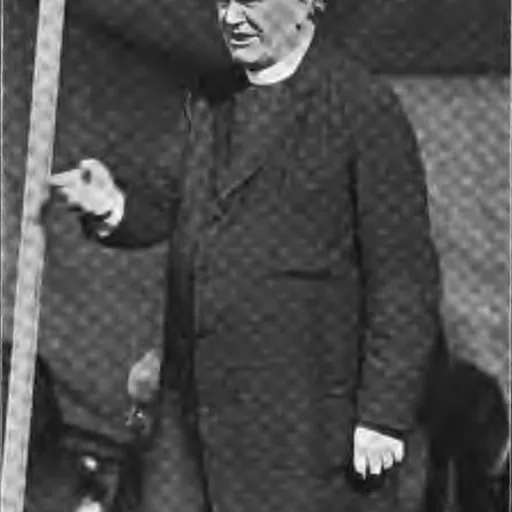
About Edward McGlynn
Lived 1837 – 1900 (aged 62). Edward McGlynn was an American chaplain and catholic priest.
Edward McGlynn (September 27, 1837 – January 7, 1900) was an American Catholic priest and social reformer who was controversial in Catholic circles for his acceptance of public schools. He actively promoted the political goals of Henry George and the single-tax movement and campaigned for George when he ran for mayor in 1886. McGlynn was censured and excommunicated from 1887 until 1892 on charges of disobedience and the suspicion of socialism.
Family and early life McGlynn as a student in Rome, 1859, front row, third from left. Edward McGlynn was born in New York City on September 27, 1837. His parents, Peter and Sarah McGlynn, had emigrated from Donegal, Ireland in 1824. His father became a contractor, acquiring a small fortune before dying in 1847, leaving a widow and ten children. McGlynn was first educated at the Thirteenth Street Grammar School and the Free Academy, now the City College of New York. When McGlynn was thirteen years of age, Archbishop Hughes, a family friend, and his pastor, Father Jeremiah Williams Cummings, arranged for him to attend the Urban College of the Propaganda in Rome. In 1859, after eight years in Rome, he transferred to the newly opened Pontifical North American College. He had received his doctorate in theology and philosophy, and was ordained a priest on March 24, 1860, in the Church of St. John Lateran.
Priesthood St. Joseph's Church in the Village. N. Washington Place, N.Y. ( ca. 1860 ) McGlynn's first assignment was as assistant to Rev. Thomas Farrell at St. Joseph's Church, New York. Father Farrell had been an ardent opponent of slavery and left $5,000 in his will for a Catholic church for blacks. This led to the establishment in 1883 of St. Benedict the Moor Parish in Hell's Kitchen. Father McGlynn next became acting pastor of St. Brigid's on Avenue B., and then St. James' in lower Manhattan. He next served at St. Ann's Church, Eighth Street. He was appointed chaplain of St. Joseph's Military Hospital at McGowan's Pass on the former grounds of Mount St. Vincent's Academy in Central Park, and retained this position until after the end of the Civil War in 1865.
In 1865, McGlynn's former pastor, Rev. Cummings, asked Archbishop Hughes to appoint McGlynn as his assistant. At the death of Cummings, the following year, McGlynn became pastor, at the age of twenty-nine, of St. Stephen's Church on East Twenty-eighth Street, one of the largest parishes in New York, where he served as pastor until 1887. During this time, Constantino Brumidi, who painted The Apotheosis of Washington on the dome of the Capitol building in Washington, painted a fresco of the Crucifixion in St. Stephen's Church, for which he also executed a Martyrdom of St. Stephen and an Assumption of Mary.
Controversy over parochial schools McGlynn in Green-Wood Cemetery, August 1898, speaking at the unveiling of a monument to Henry George. McGlynn first drew national attention and came into conflict with his ecclesiastical superiors over his opposition to parish schools, as he claimed that public schools were good enough for all American children. He refused to build a parochial school in his parish, despite the fact that the Second Plenary Council of Baltimore, held in 1866, stated a school should be established in every parish. James McMaster's New York Freeman called McGlynn a liberal Catholic. He also drew criticism for his open friendship with Protestant clergymen, even giving an address once in Henry Ward Beecher's church, even though Beecher was outspoken against Catholicism.
Advocacy of single tax McGlynn was deeply impressed by Henry George's Progress and Poverty. To conservatives, George's philosophy that the economic value derived from land, including natural resources should belong equally to all residents of a community, bordered on socialism. Archbishop Corrigan believed such reforms would violate an individual's right to private property. McGlynn met George in 1882 and took an active part in the 1886 failed campaign of Henry George for the office of Mayor of New York City.
Suspensions About four years previously, Cardinal Simeoni, prefect of the Congregation of the Propagation of the Faith, had directed the authorities of the Archdiocese to compel McGlynn to retract his views on the land question as opposed to Catholic teaching. McGlynn went ahead with the address, and later on election day, made the rounds of the polls with Henry George and Terence V. Powderly, of the Knights of Labor. McGlynn publicly criticized the letter. Toward the end of November, a second temporary suspension was imposed.
McGlynn's association with the Knights of Labor proved problematic. The Second Plenary Council of Baltimore had condemned secret societies. The Knights of Labor use of secrecy to help prevent employers from firing members, nevertheless, concerned a number of bishops. At the Third Plenary session in 1884, the members decided that the archbishops should determine whether a group fell under censure, and if they could not agree, the subject be referred to Rome. James Cardinal Gibbons, perhaps the most prominent American prelate at that time, was sympathetic to the labor. A copy of a letter Gibbons sent to the Propaganda in February 1887 opposing condemnation of the Knights of Labor wound up published the following month in the New York Herald. This increased the tension between Gibbons and Corrigan, although the influential Cardinal Manning of Westminster expressed support for Gibbons's views.
Burtsell wrote a long letter to Cardinal Gibbons explaining fully the canonical situation from McGlynn's viewpoint, which Gibbons passed on to Denis J. O'Connell, Rector of the North American College in Rome. Late in May, Cardinal Simeoni advised McGlynn to come to Rome within forty days under penalty of excommunication. McGlynn remained a friend of Henry George, delivering his eulogy in 1897.
Robert Emmett Curran, in Shaping American Catholicism: Maryland and New York, 1805-1915, argues that McGlynn's opponents went to Rome for help in suppressing him, giving the Vatican an opening to crack down on the growing independence of the American Church. Historians generally agree that Corrigan's handling of the McGlynn matter probably cost him a cardinalate. He celebrated his first Mass there on January 1, 1895.
Death After a six-week illness that reduced his robust physique to an emaciated appearance, he died primarily of Bright's disease in his Newburgh church rectory on January 7, 1900. His last audible words were, "Jesus, have mercy on me." Prayers had been offered in Catholic and Protestant churches for his recovery.
McGlynn's funeral at St. Mary's, which occasioned widespread expressions of sorrow and appreciation by members of both communities, was held at Newburgh on January 10 and was attended by a packed crowd, about a hundred Catholic priests, and all the city's Protestant clergymen, there by special invitation. His close friend of half a century, Rev. Dr. Burtsell, delivered the eulogy.
That night, some 30,000 people filed by McGlynn's coffin in his old parish of St. Stephen's. A second, similarly packed funeral was held there the next day, after which he was buried in Calvary Cemetery in Queens. A review of his personal affairs found that he was at least $10,000 in debt due to his charitable activities.
Burial and memorial Though McGlynn is actually buried in Calvary Cemetery, Queens (then the Archdiocese of New York's principal cemetery), a life-sized bronze statue of him stands in the non-denominational Woodlawn Cemetery in the Bronx. Supporters paid for the creation of the monument, but the archdiocese had refused to allow it to be placed on his grave, so they instead bought land in Woodlawn to erect it.
Don’t just read it —
keep it.
Full-length biographies made to live with: read them, listen on the way to work, watch them tonight.
- E-book
- Audio
- Video
Instant download · yours to keep · every purchase keeps this site free
Important facts
People in Edward McGlynn's life
Named in this biography and alive at the same time



Related people
Same field, nearest in time




Contemporaries
People whose lives overlapped Edward McGlynn's


Frequently asked questions
Who was Edward McGlynn?
American priest (1837–1900)
When was Edward McGlynn born?
Edward McGlynn was born on 27 September 1837 in New York City.
When did Edward McGlynn die?
Edward McGlynn died on 7 January 1900 in Newburgh (city), New York.
What was Edward McGlynn's occupation?
Edward McGlynn was a chaplain and catholic priest.
What nationality was Edward McGlynn?
Edward McGlynn was American.
Sources & further reading
Cite this page
APA: Biography.guide. (2026). Edward McGlynn. https://biography.guide/edward-mcglynn-chaplain/
MLA: "Edward McGlynn." Biography.guide, https://biography.guide/edward-mcglynn-chaplain/.
Chicago: "Edward McGlynn." Biography.guide. https://biography.guide/edward-mcglynn-chaplain/.
Data last updated: 2026-09-21 · Spot an error? Report a correction.
Portrait: Wikimedia Commons · author & licence
Page generated 2026-09-27 05:00 UTC