
About Edward Littleton
Lived 1480 – 1558 (aged 77–78). Edward Littleton was an English politician.
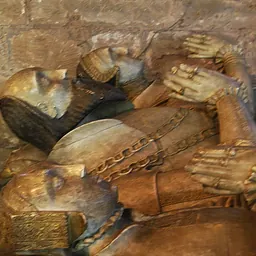
Tomb of Sir Edwarde Lyttelton and his wives, Helen Swynnerton and Isabel Wood, in Penkridge parish church. Attributed to the Royley workshop in Burton on Trent.
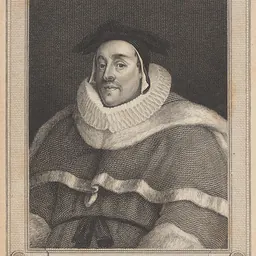
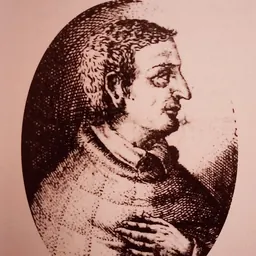
Sir Thomas de Littleton, grandfather of Edward Littleton. An 18th-century engraving after a 15th-century painting. William Wynnesbury of Pillaton Hall and his wife, grandparents of Edward Littleton. From their memorial, in the floor of the south chancel aisle, St. Michael's church, Penkridge. Richard Littleton and Alice Wynnesbury, Edward's parents, on incised slab of their recessed table tomb in the south nave aisle, St. Michael's church.
Edward Littleton or Edwarde Lyttelton (by 1489–1558) was a Staffordshire landowner from the extended Littleton/Lyttelton family. He also served as soldier and Member of Parliament for Staffordshire in the House of Commons of England, the lower house of the Parliament of England, five times.
Background and early life Edward Littleton's father was Richard Littleton, a younger son of the great 15th-century jurist, Thomas de Littleton. Richard had settled in Staffordshire, his mother's home county, and become surveyor to Edward Stafford, 3rd Duke of Buckingham. and for the 1555 Parliament, with Sir Thomas Giffard again.
Religious beliefs Littleton seems to have been a religious conservative, opposing the initial break with the Papacy. His main associates, like the Giffards, had similar attitudes. However, none of them opposed changes that benefited the landed gentry, particularly the dissolution of the monasteries. Unlike the northern gentry, who led the Pilgrimage of Grace, a large and threatening rebellion against the dissolution, the Staffordshire gentry, not least Littleton, clamoured to buy newly-marketable land and houses. However, the theological conservatism remained, with a strong attachment to traditional Catholic dogma. This fitted well with Henry VIII's own attitudes but Littleton still managed to turn it to his own disadvantage.
Littleton's most important intervention on a theological issue was in the case of George Blagge, at the time MP for Bedford. On 9 May 1546 Blagge was induced to deny the efficacy of the Mass, by trickery he alleged, while walking home after church. He was immediately summoned by Thomas Wriothesley, the Lord Chancellor, and sent to Newgate Prison. At his trial at the Guildhall, the main witnesses for the prosecution were Littleton and Sir Hugh Calverley, MP for Cheshire. On their evidence, Blagge was sentenced to be burned for heresy the following Wednesday. Fortunately for him, the Lord Privy Seal, John Russell, appealed on his behalf to the king, who had not heard of the proceedings to that point. Henry immediately pardoned Blagge and ordered Wriothesley to release him.
The real sin of Blagge seems to have been that he was openly opposed to the influence of Thomas Howard, 3rd Duke of Norfolk, who was one of the most powerful men in the country. Blagge feared that he would exercise too much influence over the future Edward VI and had said as much to Norfolk's son, Henry Howard, Earl of Surrey. It is unclear whether Blagge at that time actually held the Sacramentarian views imputed to him: five years later he gave evidence against Stephen Gardiner, specifically pinpointing the bishops traditional views on the Eucharist. However, in testifying against Blagge, Littleton was acting, consciously or not, in the interests of the Howard dynasty. Henry clearly shared Blagge's fears, and soon acted against both the Howards. So Littleton's part in the case did not endear him to the king. Still less did it endear him to the subsequent regime. This is probably part of the reason he stayed away from Parliament for some years.
Landowner Penkridge parish church today. Much of its external appearance seems to be the result of alterations in Perpendicular style made in the time of Edward Littleton. His acquisition of the deanery lease was a key step in his family's rise to fortune. Remains of Pillaton Old Hall, near Penkridge, Staffordshire. The original moated manor house became ruinous after the family moved to Teddesley Hall, but the Gatehouse and Chapel were restored in the 1880s. Sir William Paget, technically Littleton's overlord in the key estate of Pillaton, although he received only 16s. a year for it. Littleton consolidated and enlarge his family's holdings of land, taking advantage wherever possible of the revolution in land ownership carried through by the Tudor dynasty – in particular the Dissolution of the monasteries and of the chantries, which changed many relationships and created many opportunities. He was frequently involved in litigation and other disputes in his pursuit of these ends. probably since about, when Wulfric Spot donated land in the area. Dissolution placed overlordship in the hands of the king, and Henry VIII gave it to Sir William Paget in 1546: it was to rest in the Paget family's hands for at least two centuries. However, the Littletons, as terre tenants, were secure in possession of Pillaton. When Edward Littleton died in 1558, the rent they paid to the overlord amounted to just 16 shillings, while the estate was valued at £15 3s. 9d.
Black Ladies Priory, Brewood, was one of the very small houses swept away in the first round of dissolutions in 1536. Littleton and Thomas Giffard both petitioned the King for the right to buy the site and property. Both apparently received his consent. The competition for the priory does not seem to have affected relationship between Giffard and Littleton adversely. Haughmond Abbey in Shropshire was a much larger property, put on the market after the Suppression of Religious Houses Act 1539. Bishop Lee supported Littleton in his bid to buy the Abbey, and he acquired it in 1540. Two years later, he sold it, presumably at a profit, to Rowland Hill, a Shropshire-born businessman who was to become Lord Mayor of London seven years later.
John Dudley, later to become Earl of Warwick and Duke of Northumberland, pictured on a painted panel at Penshurst Place, Kent. In 1543 Littleton leased the deanery manor of Penkridge from the collegiate church of St. Michael and All Angels. This included everything from the site of the church itself and the canons' residential buildings, to paddocks in the town and areas of arable land and pasture, most of it farmed by tenants, around the town. This sparsely populated area was part of the royal forest of Cannock, sometimes (not quite accurately) called Cannock Chase: Cannock Chase originally referred to the bishop's hunting grounds, which were contiguous with the king's. The Hay was granted to Dudley in 1550. After his execution in 1553 it reverted to the Crown, but Dudley's widow, Jane Dudley, Duchess of Northumberland was granted a life's interest in it from 1554. However, she died only a year later and Littleton was able to buy the Hay. Two hundred years later it would become the site of a new home for the Littletons: Teddesley Hall.
Littleton clearly became both rich and locally powerful through his numerous dealings. Both Pillaton Hall and the parish church of St. Michael were greatly altered in the early to mid-16th century. The hall was rebuilt in typical Tudor style. The church acquired a Littleton family chapel in its south aisle and was partly rebuilt in Perpendicular style, with impressive square tower and east windows of local sandstone. Littleton must have played a significant part in all of these changes, although some may have continued in his son's time.
Contemporary assessments When he was sued by a son of Sampson Erdeswicke, the noted Staffordshire antiquarian, Littleton was described as:
"a man of great lands [who] beareth all the rule in those parts of the shire, and is greatly friended and allied."
This was intended as a criticism of Littleton. Stafford, a former friend who became his main enemy among the local magnates, described how, in his later years:
"after his ... dissembling fashion offered to have taken me by his hand and I told him he should neither have hand or heart of me for his evil, false and untrue report of me ... to the lord chancellor."
It appears that some contemporaries regarded Littleton as an upstart. While the local nobility and their retainers assumed a value system derived from feudal society, Littleton and other landed gentry were essentially rural entrepreneurs, making their fortunes in a profoundly changed rural economy.
Marriages and family Arms of Sir Edward Littleton impaled with those of his first wife, Helen Swynnerton, on their tomb in St Michael's church, Penkridge, Staffordshire. Arms of Sir Edward Littleton, impaled with those of his second wife, Isabel Wood. Littleton married twice: Helen Swynnerton, represented in gable hood, distinctive of an earlier stage in the history of fashion than Isabel Wood's dress. Helen Swynnerton, daughter of Humphrey Swynnerton of Swynnerton, was his first wife. They married before 1527 – perhaps long before. They had two sons and two daughters.
Isabel Wood, whose father is otherwise unknown, was his second wife. They married before April 1533. Isabel had been married twice before, firstly to Ralph Egerton of Wrinehill, and secondly to Sir John Draycott (died May 1522) of Paynsley Hall, near Draycott.
Littleton died on 10 October 1558 at Pillaton Hall. He was buried in St. Michael's church, apparently in the family chapel, and a large alabaster tomb for himself and both his wives was installed. This was later moved to the south side of the chancel, where it remains.
A son by Helen Swynnerton, Edward Littleton, succeeded him in his estates.
Don’t just read it —
keep it.
Full-length biographies made to live with: read them, listen on the way to work, watch them tonight.
- E-book
- Audio
- Video
Instant download · yours to keep · every purchase keeps this site free
Important facts
People in Edward Littleton's life
Named in this biography and alive at the same time





Related people
Same field, nearest in time


Contemporaries
People whose lives overlapped Edward Littleton's



Frequently asked questions
Who was Edward Littleton?
English politician, died 1558
When was Edward Littleton born?
Edward Littleton was born in 1480.
When did Edward Littleton die?
Edward Littleton died in 1558.
What was Edward Littleton's occupation?
Edward Littleton was a politician.
What nationality was Edward Littleton?
Edward Littleton was English.
Sources & further reading
· DBpedia: Edward Littleton (died 1558)
Cite this page
APA: Biography.guide. (2026). Edward Littleton. https://biography.guide/edward-littleton-politician/
MLA: "Edward Littleton." Biography.guide, https://biography.guide/edward-littleton-politician/.
Chicago: "Edward Littleton." Biography.guide. https://biography.guide/edward-littleton-politician/.
Data last updated: 2026-09-20 · Spot an error? Report a correction.
Page generated 2026-09-27 05:06 UTC