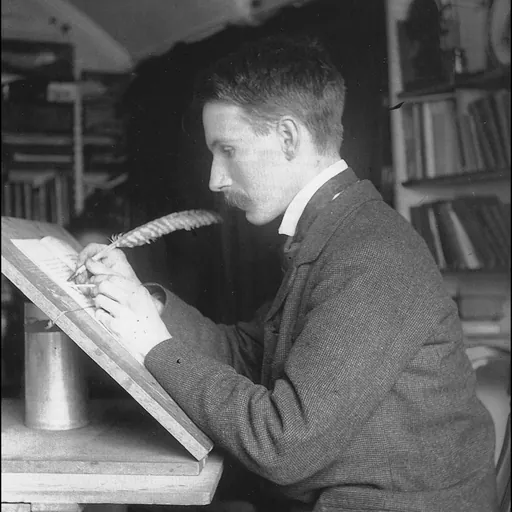
Edward Johnston
British craftsman, calligrapher and typographer
About Edward Johnston
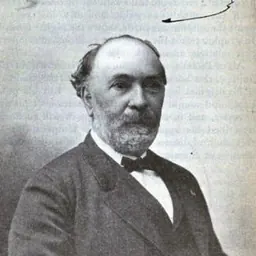
Lived 1872 – 1944 (aged 72). Edward Johnston was a British type designer, graphic designer, writer, calligrapher and illuminator.
Edward Johnston, CBE (11 February 1872 – 26 November 1944) was a Uruguayan-born British craftsman who is regarded, with Rudolf Koch, as the father of modern calligraphy, in the particular form of the broad-edged pen as a writing tool.
He is best known as the designer of Johnston, a sans-serif typeface that was used throughout the London Underground system until the 1980s. He also redesigned the famous roundel symbol used throughout the system.
Early life Johnston was born in Arazati in the countryside of San José, Uruguay. His father, Fowell Buxton Johnston (born 1839), was an officer in the 3rd Dragoon Guards, and the younger son of Scottish MP Andrew Johnston and his second wife, abolitionist Priscilla Buxton, daughter of Sir Thomas Fowell Buxton, 1st Baronet. Johnston's uncle (his father's elder brother), also Andrew Johnston, became an MP in Essex in the 1860s.
The family returned to England in 1875. With his father seeking work, and his mother ill, Johnston was raised by an aunt. He was educated at home, and enjoyed mathematics, technology, and creating illuminated manuscripts. His mother died in 1891, and he began to work for an uncle. He spent some time studying medicine at Edinburgh University but did not complete the course.
He published a handbook, Writing & Illuminating, & Lettering in 1906. He started a second book in the 1920s but it was unfinished at his death.
In 1913, Frank Pick commissioned him to design a typeface for London Underground, and the simple and clear sans-serif Johnston typeface was the result.
In 1913, Johnston was one of the editors of The Imprint, a periodical for the printing industry. For this paper, Monotype made a complete new font: Imprint, series 101, exclusively for use in The Imprint. Actually this was the first revival character font Monotype made. In the 9 issues of The Imprint, many articles about calligraphy were included.
He has also been credited for reviving the art of modern penmanship and lettering single-handedly through his books and teachings. Johnston also devised the simply crafted round calligraphic handwriting style, written with a broad pen, known today as the foundational hand (what Johnston originally called a slanted pen hand, which was developed from Roman and half-uncial forms).
He influenced a generation of British typographers and calligraphers, including Graily Hewitt, Irene Wellington, Harold Curwen and Stanley Morison, Alfred Fairbank, Florence Kingsford Cockerell, Eric Gill and Percy Delf Smith. He also influenced the transition from Gothic to Roman letters in Germany, and Anna Simons was a student. He also lectured in Dresden in 1912. In 1921, students of Johnston founded the Society of Scribes & Illuminators (SSI), probably the world's foremost calligraphy society.
Not all his students were happy with his decision to create a sans-serif design for the Underground, in a style thought of as modernist and industrial. His pupil Graily Hewitt privately wrote to a friend:In Johnston I have lost confidence. Despite all he did for us...he has undone too much by forsaking his standard of the Roman alphabet, giving the world, without safeguard or explanation, his block letters which disfigure our modern life. His prestige has obscured their vulgarity and commercialism.
Johnston also created a blackletter-influenced design for a 1929 German edition of Hamlet.
In 1959, Evelyn Waugh wrote in the Spectator, "Every schoolboy who learns the italic script, every townsman who reads the announcements of the Underground railway, everyone who studies the maps attached to modern travel books is seeing in the light of Johnston."
Personal life He met Greta Grieg, a Scottish schoolmistress, in 1900, and they were married in 1903. They had three daughters. They lived in London until moving, in 1912, to Ditchling, Sussex, where Eric Gill had settled in 1907. His wife died in 1936. He was appointed a CBE in 1939. He died at home in Ditchling, and is buried in St Margaret's churchyard.
Edward Johnston Memorial in Farringdon Station A memorial to Johnston was unveiled in 2019 at Farringdon Station. Designed by Fraser Muggeridge, it is dedicated to both Johnston and his underground alphabet. Compared to both signage and sculpture, the memorial is huge wood type mounted on the wall of the underground station at street level.
Publications An early sign showing Johnston's alphabet for the Underground. Note variant 'W'.
First publication of this text appeared in "The Imprint", 1913, vol. 1: pp. 7–14, vol. 2: pp. 128–133
Don’t just read it —
keep it.
Full-length biographies made to live with: read them, listen on the way to work, watch them tonight.
- E-book
- Audio
- Video
Instant download · yours to keep · every purchase keeps this site free
Important facts
People in Edward Johnston's life
Named in this biography and alive at the same time





Related people
Same field, nearest in time


Contemporaries
People whose lives overlapped Edward Johnston's


Frequently asked questions
Who was Edward Johnston?
British craftsman, calligrapher and typographer (1872–1944)
When was Edward Johnston born?
Edward Johnston was born on 11 February 1872 in San José de Mayo.
When did Edward Johnston die?
Edward Johnston died on 26 November 1944 in Ditchling.
What was Edward Johnston's occupation?
Edward Johnston was a type designer, graphic designer, writer, calligrapher and illuminator.
What nationality was Edward Johnston?
Edward Johnston was British.
Sources & further reading
Cite this page
APA: Biography.guide. (2026). Edward Johnston. https://biography.guide/edward-johnston-type-designer/
MLA: "Edward Johnston." Biography.guide, https://biography.guide/edward-johnston-type-designer/.
Chicago: "Edward Johnston." Biography.guide. https://biography.guide/edward-johnston-type-designer/.
Data last updated: 2026-09-22 · Spot an error? Report a correction.
Portrait: Wikimedia Commons · author & licence
Page generated 2026-09-27 05:01 UTC