About Edward Hungerford
Lived 1596 – 1648 (aged 51–52). Edward Hungerford was an English politician.
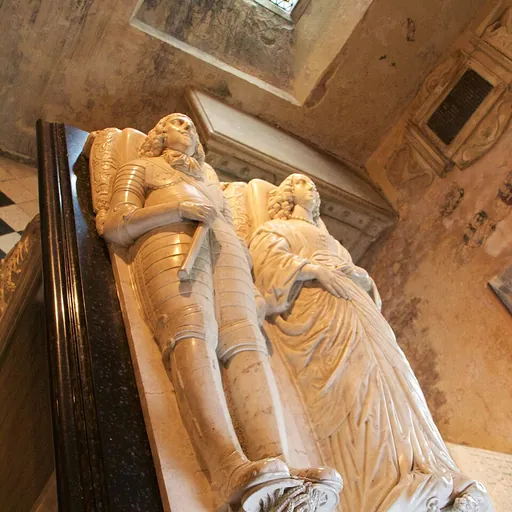
Monument to Sir Edward Hungerford (1596–1648) and his wife, St Leonard's Chapel, Farleigh Hungerford Castle. At his feet are shown the heraldic badges of Hungerford sickles and Peverell garb.
Sir Edward Hungerford (1596–1648) of Corsham, Wiltshire and of Farleigh Castle in Wiltshire (now Somerset), Member of Parliament, was a landowner and a Parliamentarian commander during the English Civil War. He occupied and plundered Salisbury in 1643, and took Wardour and Farleigh castles.
Origins and education Hungerford was the eldest son of Sir Anthony Hungerford (1564–1627) of Stock, Wiltshire and Black Bourton, Oxfordshire by his first wife Lucy Hungerford, a daughter of Sir Walter Hungerford (died c. 1596) of Farleigh Castle.
He was educated at Queen's College, Oxford from the age of 12, and admitted to the Middle Temple in 1613.
After taking part with Sir William Waller in the Battle of Lansdowne and Battle of Roundway Down, Hungerford besieged Lady Arundel in Wardour Castle, Wiltshire (2–8 May 1643). He treated the lady with little grace, carrying her with scant ceremony to Hatch and thence to Shaftesbury, and keeping her all the while "without a bed to lie on". he married Margaret Holliday, a daughter and coheiress of William Holliday, an Alderman of the City of London. She was the sister of Anne Holliday, wife of Sir Henry Mildmay of Wanstead, Essex, Master of the Jewel Office from 1620 to 1649.
The marriage was childless. She survived him until July 1672, when she was also buried at Farleigh.
Death and burial Hungerford died in 1648 and was buried in St Anne's Chapel, the north transept chapel of St Leonard's Chapel within the walls of Farleigh Castle. His magnificent tomb chest, with effigies of himself and his wife, survives.
Succession His will was proved on 26 October 1648. In 1653 his widow Margaret petitioned the Council of State to pay her £500, a small part of the sum borrowed from her husband by Parliament. Parliament had ordered repayment in 1649. Oliver Cromwell appears to have interested himself in her case. Sir Edward's reversionary interest in the Farleigh estates passed to his royalist brother Col. Anthony Hungerford (d. 1657).
Don’t just read it —
keep it.
Full-length biographies made to live with: read them, listen on the way to work, watch them tonight.
- E-book
- Audio
- Video
Instant download · yours to keep · every purchase keeps this site free
Important facts
People in Edward Hungerford's life
Named in this biography and alive at the same time




Related people
Same field, nearest in time
Contemporaries
People whose lives overlapped Edward Hungerford's



Frequently asked questions
Who was Edward Hungerford?
English politician (1596–1648)
When was Edward Hungerford born?
Edward Hungerford was born in 1596.
When did Edward Hungerford die?
Edward Hungerford died in 1648.
What was Edward Hungerford's occupation?
Edward Hungerford was a politician.
What nationality was Edward Hungerford?
Edward Hungerford was English.
Sources & further reading
· Wikipedia: Edward Hungerford
· DBpedia: Edward Hungerford (died 1648)
Cite this page
APA: Biography.guide. (2026). Edward Hungerford. https://biography.guide/edward-hungerford-politician-1596/
MLA: "Edward Hungerford." Biography.guide, https://biography.guide/edward-hungerford-politician-1596/.
Chicago: "Edward Hungerford." Biography.guide. https://biography.guide/edward-hungerford-politician-1596/.
Data last updated: 2026-09-21 · Spot an error? Report a correction.
Portrait: Wikimedia Commons · author & licence
Page generated 2026-09-27 04:58 UTC