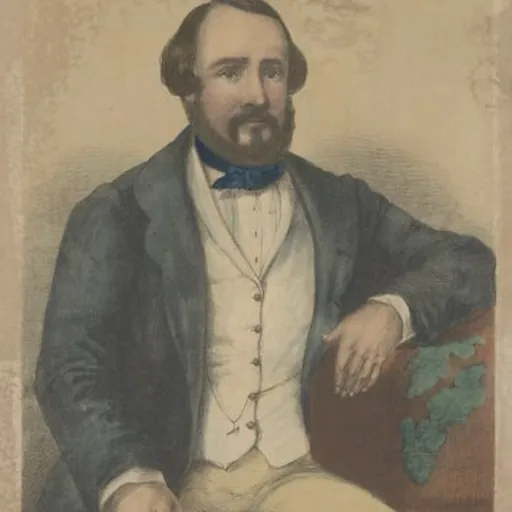
About Edward Hargraves
Lived 1816 – 1891 (aged 75). Edward Hargraves was an Australian and British adventurer, discoverer and sailor, known for Australian gold rushes.
Edward Hammond Hargraves (7 October 1816 – 29 October 1891) was an Australian gold prospector who led an expedition in the Macquarie River region of New South Wales in 1851, and publicised the resulting finds, starting the New South Wales gold rush.
Early life Edward Hammond Hargraves was born on 7 October 1816 in Gosport, Hampshire, England, the son of Elizabeth (née Whitcombe) and John Edward Hargraves. He was educated in Brighton and Lewes, but left school at the age of 14 to go to sea. He arrived in Sydney in 1832.
After his arrival in the colony of New South Wales, Hargraves worked on a property at Bathurst for a period and then went north to the Torres Strait, working in the bêche-de-mer and tortoiseshell industries. In 1834, he took up of land near Wollongong. He married Elizabeth Mackay in Sydney in 1836, and in 1839 they moved to East Gosford. Hargraves was an agent for the General Steam Navigation Company and also established the Fox Under The Hill Hotel. In 1843, he took up another property on the Manning River, leaving his wife behind to look after the hotel.
The Californian gold rush changed official attitudes. The rush to California left New South Wales with a shortage of workers and an economic depression. The new governor, Charles Augustus FitzRoy, felt that a discovery of gold could revive the colony's fortunes.
James Tom's brother William later said: "The reason why Mr Hargraves could not find gold in 1851 was this: He was too lazy to look for it in a proper manner; he always experimented on the higher instead of lower strata of the alluvial deposits he was taken to. [...] While in the Bathurst district, Hargraves never dug a hole a foot deep."
The Gold Discovery. – It is no longer any secret that gold has been found in the earth in several places in the western country. The fact was first established on the 12th February, 1851, by Mr. E. H. Hargraves, a resident of Brisbane Water, who returned from California a few months since. While in California, Mr. Hargraves felt persuaded that from the similarity of the geological formation there must be gold in several districts of this colony, and when he returned here his expectations were realized. What the value of the discovery may be it is impossible to say. Three men, who worked for three days with very imperfect machinery realized £2 4s. 8d. each per diem; whether they will continue to do so remains to be seen. The subject was brought under the consideration of the Government, who admitted Mr. Hargrave's claim for some consideration for the discovery, but of course could make no definite promise until the value of the gold field was ascertained. Mr. Stutchbury, the Geological Surveyor, is now in the district, and Mr. Hargraves has proceeded there to communicate with him, and in a few weeks we may expect definite information. At present all that is known is that there is gold over a considerable district; whether it is in sufficient quantities to pay for the trouble of obtaining it remains to be ascertained. Should it be found in large quantities a strict system of licensing diggers will be immediately necessary. — The Sydney Morning Herald, 2 May 1851 The government of Victoria promised him £5,000 although only £2,381 was actually given. Hargraves refused to share this money with Lister or the Tom brothers despite his earlier promises of a fair joint venture.
The goldfield was named Ophir after the biblical Ophir.
Contesting Hargraves' claims
By 1853, Lister and the Tom brothers realised they had been used by Hargraves. They campaigned for a separate reward and sought to downplay Hargraves' role in the gold discovery in the public eye. This book increased the animosity between Hargraves and his former companions.
Their bitter feud would continue until 1890, when a Legislative Assembly select committee finally credited Lister and the Tom brothers as the true discoverers of payable gold.
Later life and death In 1851, Hargraves was appointed Commissioner of Crown Lands in recognition for his reputed gold find.
In 1856, he purchased a landing at Budgewoi on the Central Coast of New South Wales. He went on to build "Norahville" (also called Hargraves House) at Noraville. Wollombi Aboriginal tribe members are known to have worked on the property. Some sources state that Hargraves had "befriended" the Aboriginal tribe members.
By the early 1860s, he was "virtually penniless". He asked Victoria for the balance of the £5,000 they had promised, and when it wasn't forthcoming, travelled to Melbourne and conducted a hateful campaign against members of parliament.
Legacy Hargraves left a small estate to his five surviving children. in Bendigo is one of the city's main shopping areas.
Don’t just read it —
keep it.
Full-length biographies made to live with: read them, listen on the way to work, watch them tonight.
- E-book
- Audio
- Video
Instant download · yours to keep · every purchase keeps this site free
Important facts
People in Edward Hargraves's life
Named in this biography and alive at the same time



Related people
Same field, nearest in time




Contemporaries
People whose lives overlapped Edward Hargraves's




Frequently asked questions
Who was Edward Hargraves?
Australian gold prospector (1816-1891)
When was Edward Hargraves born?
Edward Hargraves was born on 7 October 1816 in Gosport.
When did Edward Hargraves die?
Edward Hargraves died on 29 October 1891 in Sydney.
What was Edward Hargraves's occupation?
Edward Hargraves was an adventurer, discoverer and sailor.
What was Edward Hargraves known for?
Edward Hargraves was known for Australian gold rushes.
What nationality was Edward Hargraves?
Edward Hargraves was Australian and British.
Sources & further reading
Cite this page
APA: Biography.guide. (2026). Edward Hargraves. https://biography.guide/edward-hargraves/
MLA: "Edward Hargraves." Biography.guide, https://biography.guide/edward-hargraves/.
Chicago: "Edward Hargraves." Biography.guide. https://biography.guide/edward-hargraves/.
Data last updated: 2026-09-22 · Spot an error? Report a correction.
Portrait: Wikimedia Commons · author & licence
Page generated 2026-09-27 04:59 UTC