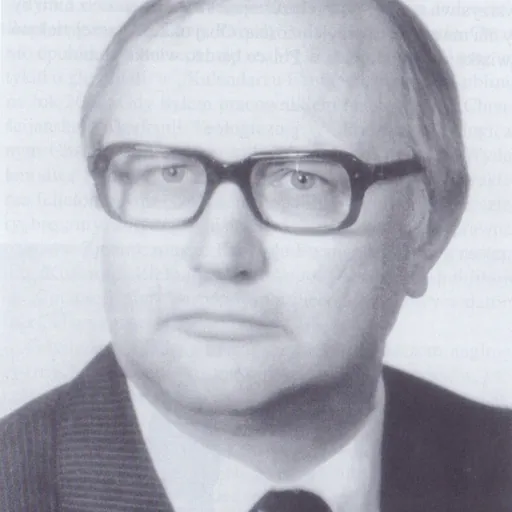
About Edward Czajko
Lived 1934 – 2025 (aged 90). Edward Czajko was a Polish pastor and presbyter.
Edward Czajko (22 September 1934 – 31 July 2025) was a Polish Pentecostal pastor, theologian, and writer. He served as the head of the United Evangelical Church from 1981 to 1988 and was a long-time pastor, author of numerous books and articles, and an active ecumenist. He was a co-founder of the Evangelical Alliance in the Republic of Poland and was critical of the Charismatic movement.
Early life and education Edward Czajko was born on 22 September 1934 in Kuzmichy, near Novogrudok, Poland. Raised in a Pentecostal family, his father, Władysław, was a preacher. In February 1946, due to the repatriation of Poles from Kresy, his family relocated to Trzcianka, Poland. In September 1950, his father was arrested during Operation B on charges of espionage for American imperialism.
On 3 July 1949, Czajko was baptized by . He served in the Polish Navy from 1954 to 1957.
On 1 January 1964, he married Irena Korniluk, daughter of , a prominent figure in the Church of Christ in Poland.
Clerical career In 1964, Czajko was ordained as a minister of the United Evangelical Church. He served as a regional presbyter for Greater Poland from 1965 to 1971, secretary of the United Evangelical Church from 1965 to 1971, a member of its leadership from 1972 to 1974, and treasurer from 1975 to 1981. According to Czajko, he authored a memorandum to the authorities advocating for radio broadcasts via Trans World Radio in Monte Carlo.
After the removal of Stanisław Krakiewicz from the United Evangelical Church Presidium in 1975, Czajko returned as treasurer.
From 1981 to 2001, he served as pastor of the Warsaw Pentecostal Congregation (from 1988 under the Pentecostal Church). He initiated the construction of the church and congregation's headquarters at 68/70 in Warsaw.
Conflict with Krakiewicz Editorial team of Chrześcijanin in 1988, from left: Mieczysław Kwiecień, Henryk Ryszard Tomaszewski, Mieczysław Czajko, Edward Czajko, and K. Krystoń Until autumn 1970, Czajko enjoyed the trust and support of United Evangelical Church president Stanisław Krakiewicz. In November 1970, he organized an inter-congregational youth meeting in Koszalin, against Krakiewicz's wishes, which included foreign guests. This event drew attention from religious and political authorities, who deemed Czajko an enemy of the Polish People's Republic. The Office for Religious Affairs accused him of creating an "independent Pentecostal movement operating beyond the control of both church and state authorities". This sparked a conflict with Krakiewicz, leading to Czajko's removal as head of the United Evangelical Church Bible School and eviction from his official residence at 10 Zagórna Street. In 1971, Krakiewicz pressured him not to run for the United Evangelical Church Presidium, and Czajko was also dismissed from the Christian Theological Academy.
Academic and publishing work
From 1966 to 1971, Czajko was an academic at the Christian Theological Academy.
From 1965 to 2008, he was associated with the editorial team of Chrześcijanin, serving as secretary from 1971 to 1981, program council chair from 1988 to 1990, and editor-in-chief from 1990 to 1991. He was a member of the European Pentecostal Theological Association, the European Pentecostal-Charismatic Research Association, and the Society for Pentecostal Studies.
He was a key co-founder of the Evangelical Alliance in the Republic of Poland and served as deputy chairman of its National Council from 2000 to 2003. Until 2004, he was a member of the National Committee of the .
Theological views
Czajko viewed Pentecostals as conservative evangelicals adhering to fundamentalist theology. He advocated for a classical and moderate form of Pentecostalism to preserve the church's character. From 1986, he frequently criticized aspects of the Charismatic movement, including the replacement of hymns about the cross with Old Testament-based refrains, a focus on temporal benefits over eternal ones, unbiblical demonology, Rema theology, and an obsession with novelty. In 1987, he critiqued David Yonggi Cho's teaching on positive confession, arguing that the Greek terms logos and rema both mean "word". In 1997, he criticized the Toronto Blessing and charismatic excess.
In 1989, following the fall of communism, he wrote: "There is an urgent need to strengthen ties with established Pentecostal churches and loosen connections with the so-called Pentecostal fringe, particularly the Rema movement and the positive confession movement, which are foreign to our Pentecostal tradition".
According to Mirosława Weremiejewicz, during the Polish People's Republic, Czajko maintained a compliant stance toward the authorities, claiming the church enjoyed full religious freedom. He described the martial law period as challenging only due to the temporary closure of Chrześcijanin. In 1992, he criticized Prime Minister Jan Olszewski for disrespecting his predecessors.
In 2005, after the publication of the Wildstein list, some Pentecostal clergy called for self-lustration using the Institute of National Remembrance archives. Czajko opposed this, arguing that the institute archives were products of a "demonic system".
Publications
Czajko published over 700 books and articles. In 2012, noted that he had the most extensive body of work among Polish Pentecostal authors.
Chrześcijanie ewangeliczni w Polsce, Warsaw, 1967 Wprowadzenie do dogmatyki, Warsaw, 1977; 2nd ed., Warsaw, 2000 Stare i nowe rzeczy, Warsaw, 1980 Z życia i czasu, Warsaw, 1983 W przedsionkach Pańskich, Warsaw, 1987 Kościół Zielonoświątkowy w Polsce, Warsaw, 1991 Zasady wiary Kościoła Zielonoświątkowego w Polsce, Warsaw, 1991 Zielonoświątkowcy, 1995 Historia Jezusa Chrystusa i Dzieje Apostolskie, 1995 Sytuacja ruchu zielonoświątkowego w perspektywie historycznej, Warsaw, 2000 Miniatury egzegetyczne, Warsaw, 2001 Tak oto biegnę, Warsaw, 2003 Duchowe dary łaski, Warsaw, 2004 Nasza wiara, Warsaw, 2009 Ludzie i idee, Warsaw, 2009 Nasza wiara. Próba dogmatyki zielonoświątkowej, Warsaw, 2014
Controversies In March 2017, Adam Ciućka, editor of Ekumenizm.pl, alleged that Czajko collaborated with the Security Service during the Polish People's Republic. Czajko responded that contacts with authorities, including Security Service officers, were a painful necessity of the time and not initiated by him. While necessary then, he acknowledged they appeared negative in hindsight. The Elders' Council of the Warsaw congregation defended him, arguing that Institute of National Remembrance archives provide only a partial historical record and reflect interpretations by Security Service officers.
Awards Czajko was awarded the Golden Cross of Merit and the Medal of the 40th Anniversary of People's Poland.
Don’t just read it —
keep it.
Full-length biographies made to live with: read them, listen on the way to work, watch them tonight.
- E-book
- Audio
- Video
Instant download · yours to keep · every purchase keeps this site free
Important facts
People in Edward Czajko's life
Named in this biography and alive at the same time




Related people
Same field, nearest in time



Contemporaries
People whose lives overlapped Edward Czajko's


Frequently asked questions
Who was Edward Czajko?
Polish Pentecostal pastor, theologian, and ecumenist
When was Edward Czajko born?
Edward Czajko was born on 22 September 1934 in Kuźmičy.
When did Edward Czajko die?
Edward Czajko died on 31 July 2025.
What was Edward Czajko's occupation?
Edward Czajko was a pastor and presbyter.
What nationality was Edward Czajko?
Edward Czajko was Polish.
Sources & further reading
Cite this page
APA: Biography.guide. (2026). Edward Czajko. https://biography.guide/edward-czajko/
MLA: "Edward Czajko." Biography.guide, https://biography.guide/edward-czajko/.
Chicago: "Edward Czajko." Biography.guide. https://biography.guide/edward-czajko/.
Data last updated: 2026-09-22 · Spot an error? Report a correction.
Portrait: Wikimedia Commons · author & licence
Page generated 2026-09-27 05:03 UTC