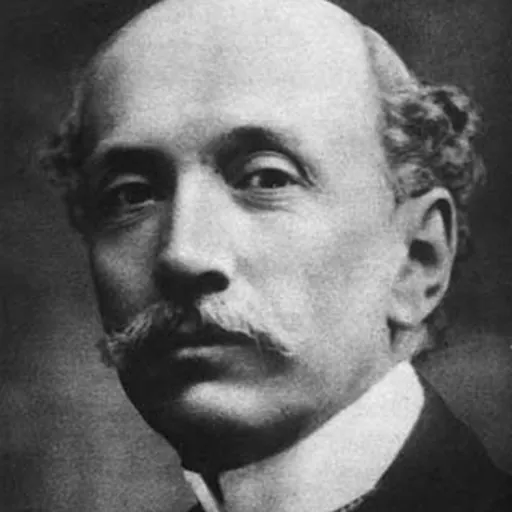
About Eduardo Dato
Lived 1856 – 1921 (aged 64). Eduardo Dato was a Spanish politician, diplomat, lawyer and jurist.
Eduardo Dato e Iradier (12 August 1856 – 8 March 1921) was a Spanish political leader during the Spanish Restoration period. He served three times as Spanish prime minister: from 27 October 1913 to 9 December 1915, from 11 June 1917 to 3 November 1917, and from 28 April 1920 until his assassination by Catalan anarchists. He also held eleven cabinet ministries, and was four times president of the Spanish Congress of Deputies.
Career Born in A Coruña, Spain, son of Carlos Dato y Granados (himself the son of Carlos Dato Camacho y Marín and wife Cayetana Ruperta Granados y García, de Vivancos e Acosta) and wife Rosa Lorenza Iradier e Arce, of Galician descent. He graduated in Law at the Complutense University in 1875. He opened his law office two years later. Elected to the Spanish parliament in 1883, he became Under-secretary for the Ministry of the Interior in 1892.
He held the position of Minister of the Interior and Minister of Justice over the next fifteen years. In 1907, he ran for and won the position of Mayor of Madrid. In 1910, he entered the Academy of Moral and Political Sciences. In 1913 he became prime minister for the first time. In 1915, he left that position, but would return to it for a short while in 1917. He became the 230th Minister for Foreign Affairs from 22 March 1918 to 9 November 1918. Then he moved to the post of Minister of State and stayed there until 1920, when he led the government as prime minister again.
Dato was a member of the International Permanent Court in The Hague (he became vice-president in 1913), member of the International Law Institute, administrator of the bank firm 'Banco Hipotecario' and president of the National Institute of Social Security, the Council of Public Instruction and the Academy of Jurisprudence and Legislation.
Assassination On 8 March 1921 in Madrid, while being driven from the parliament building and in front of the Puerta de Alcalá, Dato was assassinated by three Catalan anarchists, Luis Nicolau, Pedro Mateu, and Ramón Casanellas, who were riding a motorcycle. This was the second murder of a Spanish prime minister in less than a decade; in 1912 José Canalejas had been killed similarly. His assassination came amid rising unrest between trade unions, particularly the Confederación Nacional del Trabajo, and the government.
King Alfonso XIII of Spain posthumously made him a duke by bestowing the title "Duchess of Dato" on his widow.
Honours Dato was conferred with the following honours:
Chain of the Order of Charles III Knight Grand Cross of the First Class of the Order of St. Gregory the Great of the Holy See Grand Cross of the Order of Christ of Portugal. 340th Grand Cross of the Order of the Tower and Sword of Portugal. After he died, his wife was granted the title of Duchess of Dato in his honor.
Marriage and children He married María del Carmen de Barrenechea y Montegui, Dame of the Order of Noble Dames of Queen Maria Luisa of Spain and Grand Cross of the Order of Beneficence of Spain, of Basque descent (- Madrid, 1926), daughter of Juan José de Barrenechea e Urdampilleta (himself the son of Pedro de Barrenechea y Zubea and wife María Ignacia de Urdampilleta y Lagarto) and wife Micaela Montegui y Mercaide (herself the daughter of José Manuel Montegui and wife María de la Concepción Mercaide), and had three daughters: Isabel Dato y Barrenechea, 2nd Duchess of Dato, unmarried and without issue María del Carmen Dato y Barrenechea, 3rd Duchess of Dato (Madrid, 6 December 1885 – 1954), married to Eugenio Espinosa de los Monteros, and had issue, two sons María de la Concepción Dato y Barrenechea (Madrid, 2 May 1890 – Madrid, 16 September 1973), married in Paris, 25 April 1922 to Ernesto de Zulueta e Isasi, of the Marquesses of Álava Viscounts of Casa Blanca (Bilbao, 26 April 1892 – Madrid, 9 September 1969), a Spanish Diplomat, and had issue
Don’t just read it —
keep it.
Full-length biographies made to live with: read them, listen on the way to work, watch them tonight.
- E-book
- Audio
- Video
Instant download · yours to keep · every purchase keeps this site free
Important facts
People in Eduardo Dato's life
Named in this biography and alive at the same time

Related people
Same field, nearest in time




Contemporaries
People whose lives overlapped Eduardo Dato's






Frequently asked questions
Who was Eduardo Dato?
Spanish author (1856-1921)
When was Eduardo Dato born?
Eduardo Dato was born on 12 August 1856 in A Coruña.
When did Eduardo Dato die?
Eduardo Dato died on 8 March 1921 in Madrid.
What was Eduardo Dato's occupation?
Eduardo Dato was a politician, diplomat, lawyer and jurist.
What nationality was Eduardo Dato?
Eduardo Dato was Spanish.
Sources & further reading
Cite this page
APA: Biography.guide. (2026). Eduardo Dato. https://biography.guide/eduardo-dato/
MLA: "Eduardo Dato." Biography.guide, https://biography.guide/eduardo-dato/.
Chicago: "Eduardo Dato." Biography.guide. https://biography.guide/eduardo-dato/.
Data last updated: 2026-09-20 · Spot an error? Report a correction.
Portrait: Wikimedia Commons · author & licence
Page generated 2026-09-27 04:58 UTC