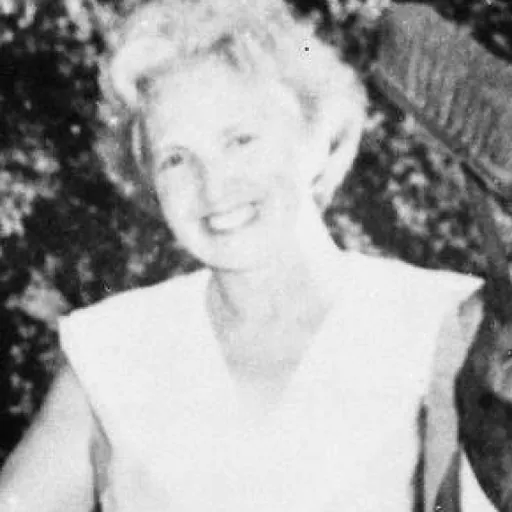
About Edna Manley
Lived 1900 – 1987 (aged 86). Edna Manley was a Jamaican and British artist, sculptor and writer.
Edna Swithenbank Manley (28 February 1900 – 9 February 1987) was a Jamaican artist, known primarily as a sculptor, although her oeuvre included significant drawings and paintings. Trained in British neoclassical tradition, Manley became a major figure in Jamaican art, with her work forming an important part of the National Gallery of Jamaica's permanent collection. Edna Manley was also an early supporter of art education in Jamaica, having both organised and taught art classes at the Junior Centre of the Institute of Jamaica throughout the 1940's.
These classes developed into a more formal setting with the establishment of Jamaica's first Art School, the Jamaica School of Art and Craft in 1950. The school would eventually expand into a college, and in 1995 was renamed the Edna Manley College of the Visual and Performing Arts in honour of the artist's pioneering role in Jamaican Art.
Edna Manley was the wife of Norman Manley, the founder of the Jamaican People's National Party and the 1st Premier of Jamaica. She is often considered the "mother of Jamaican art".
Personal life
Early life
She was born Edna Swithenbank on 28 February 1900. Her father died when she was nine, leaving his widow to raise all their nine children by herself.
Education
After leaving high school Edna studied art at several different institutions including St. Martin's School of Art in London. She also studied privately with Maurice Harding, the animal sculptor, going on to continue her art studies at the Regent Street Polytechnic as well as the St. Martin's School of Art in London. During this time, she had intentions of becoming a zoologist.
In 1921, she married her cousin, Norman Manley. The two met when Norman came to England for university, Edna was only 14 at the time and Norman was eight years her senior. They fell out of touch but later reunited after Norman finished school and while Edna was working at a pension office studying art on the side. In 1975, she decided to delve more into painting, giving up sculpting, due to her age and the strain it placed on her body. She maintained her own identity and did not live in the shadow of her famous husband. Edna Manley died on 2 February 1987, a few weeks short of her 87th birthday. She was an amazing woman in the eyes of many; a woman who carved her path independent of the name of her husband or son and continues to influence and inspire many artists to this day. Shortly after, the Beadseller was followed up by a male counterpart, The Listener (1922) which also reflected the geometric and cubist style she was exploring. This cubist influence can be directly credited to famous artist Pablo Picasso, who disrupted the European art world with his geometric and exploitative creations. Edna Manley was not safe from his influence as she studied all the art trends and ideas circulating in Europe before her departure to the Caribbean. The nude Eve is seen standing on a circular platform with her head facing behind her. The figure has one hand whose fingers are rolled into a fist to cover her pubis; similar to the arm gestures are a combination of the "Venus Pudica". The other hand is bent at the elbow and covers a breast while the back of the hand awkwardly rests on the shoulder with fingers curled inwards. In this pose of the arm we see the influence of Picasso's Two Nudes. The sculpture is seemingly filled with tension, as suggested by the clenching of the fists, the abnormal twist of the body and the awkward attempt to obscure a breast. The body gives a sense of youthfulness and its long hair flowing downwards onto the chest matches the curvy rhythm of her body. Wayne Brown has described the sculpture as "woman startled to look over her shoulder" an "image of nakedness surprised" yet, Manley seemed had removed all traces of expression from the face of the sculpture of her re-interpretation of Eve and instead focused the expressions into the pose of the figure. Her idea of this sculpture was to draw reference to the expulsion of Eve out of the Garden of Eden. The face looking backwards is also said to represent Eve looking back at the garden after her expulsion.
During the early 1920s, Edna Manley continuously sent her works back to England for exhibition which allowed the works to become greatly recognized by 1927. The first recognition she had received came from the French press, and her works were published in the Les Artistes D’Aujourd’Hui and La Revue Moderne. The author of the articles La Revue Moderne, Clement Morro, had significantly linked her with the modern abstractionists. In 1929, Edna Manley had returned to England with her most recently completed works namely; Eve, The boy and the reed, Torso, The ape ("Edna Manley (1900–1987). This small collection of sculptured has gained entry into the Goupil Summer exhibition which was a major event which took place annually in London.
Edna and Norman Manley were putting down roots in Jamaica and each was easing into their respective careers with notability. Edna's fledgling art career was taking off and Norman Manley was earning a reputation of being an astute lawyer. Recommendations were well written and submitted for him to be bestowed the enviable appointment of Kings Counsel (KC). This would no doubt boost his law career and came to fruition in August 1932. Despite the financial rewards from his law practice, being among the social elites and awarded the coveted title of KC, Norman Manley struggled with depression seemingly caused from not being able to represent something more meaningful. This sentiment was echoed in his letters to Edna who was away in England due to interest in her art. On returning home to Jamaica, she now too had her own precipitous path to navigate with being a wife, mother and backbone of her family as well as being an artist on the rise. These emotive feelings manifested themselves in the artwork titled Sun and Earth depicting a male and a female in deep embrace, the man's head resting on the chest of the woman. The woman stands erect as a support with one arm around his waist. With the international success of Eve, Boy with Reed and other works such as Dawn, Woman With Basket (in stone), Dance, Sixteen, Seventeen and Rachel the visions of self as an artist and the actual reality of life seems possible and gave her intrinsic strength to carry her family and her art into the unknown future. The aforementioned artworks had a new aesthetic not yet seen anywhere, "voluptuous" was the word used to describe the pieces. Cubism and other avant-garde movements dominated Europe at the time, but Edna Manley's pieces had an air of freshness to them which sparked countless curiosity all over London. Even though the essence of cubism was evident in her sculptures in terms of the positioning of the forms they did not have that hard angular rendering which was evident in her earlier works such as the Beadseller.
By 1934 Jamaica had been experiencing serious economic depression, marked by the decline in exports and the return of disheartened migrant workers from Cuba and Panama. Everywhere in Jamaica persons were clamoring for better pay, more jobs, better job conditions and housing as the common people buckled of under the weight of colonial marginalization. The economic crisis coupled with the agitation for change is creatively summed up in Edna Manley's most famous sculpture, Negro Aroused done in 1935. The sculpture, even though in the round has a high relief quality and depicts an African man with head upturned to the heavens atop square shoulders, a twisting torso and thick slab – like arms set in an unusual akimbo position. He seems to be communicating anguish while looking towards the heavens for a solution or the dawning of a better tomorrow. Other notable sculptures created during this time were, Pocomania, Market Woman, The Prayer, Young Negro, The Diggers and The Prophet.
The Prophet The Prophet (1935) at the National Gallery of Art's exhibition of Afro-Atlantic Histories in 2022. The Prophet is a carving of an African man with powerful, over-emphasized arms raised above his head, creating a diamond shape. His opened palms are affixed one in front of the other similar to when person is waking up and stretching after a deep sleep. The head is turned to the right, looking slightly down with a stern unapproachable face. There is a backward tilt in the upper torso which creates an open stance. Even though the sculpture is not full bodied and only represented from the tip the fingers down to mid thighs, it provokes a ready to fight alertness, combative stance in every sense. The simplification of the form gives it a towering presence of authority which forces the viewer to contend with the determined stare of the seer. The prophet embodies a warrior spirit that has been awoken and forced into action. It explains how the common people at that time were feeling, like that of a gunpowder keg waiting for that opportunistic spark to explode. Mrs. Manley describes The Prophet as:
"A figure that denounce, oh powerfully denounced, cruelty, poverty, injustice and it came, the prophet, the Amos who came down from the hills and denounce the world as he saw it. Denounced those that had so much and offered to the poor and weak so little".
Edna Manley's seemed to be that gauging mirror absorbing and reflecting the plight of the common people through her newfound aesthetic. With a significant body of work Mrs. Manley was ready to tackle England's art world, but before she did, she held her first solo show at the Mutual Life Assurance Society building on Barry Street Kingston Jamaica in January 1937. This was the first solo art show for anyone in Jamaica and was extremely successful, with more than eight hundred people passing through the exhibition. The show lasted for five days but before it ended persons were requesting for the state to purchase Negro Aroused. The sculpture was purchased through organized fundraisers and handed over to the Institute of Jamaica.
In England her exhibition opened on the second of March and lasted for twenty three days and was received with "lukewarm" reviews. Many critics and newspaper articles question her craftsmanship and approach. The lack of political understanding by the English critics who were far removed from the uprisings of political consciousness in Jamaica made it rather difficult for them to truly embrace the significance of the sculptures and only evaluated the pieces based on form. Later that same year Mrs. Manley got sick and spent a lengthy time recuperating. There were great upheavals in Jamaica in 1938, strikes and labour riots caused many arrests and even deaths. No place in Jamaica was spared from the unrest however Westmoreland and Kingston had the biggest foray as the common people pushed for better wages and jobs. A pugnacious agitator for change named Alexander Bustamante was at the front of the line defending the cause of common people, relentless remonstrating landed him in jail. The Peoples National Party (PNP) was also formed by Norman Manley who found his political stride and true purpose which was eluding him for many years. During this time Mrs. Manley completed several pieces of work, notably the piece titled Strike which was a response to the political turbulence going on in the county. The piece not only represented the mood of the people but also captures her deep involvement in political activism with her husband. She also design The Rising Sun logo for the PNP which represented the dawning of Jamaican politics. Other artworks done during 1938 – 1939, were Mrs. Molesworth, Tomorrow, Youth, In the Beginning, Idyll and The Sawyers. These carvings were labeled as "ecstatic carvings" by David Boxer to describe their stylistic similarities in form and movement.
Professional life and Horse of the Morning (1940s)
Edna Manley produced a number of famed sculpture including, “Negro Aroused” and many more which are a part of her permanent collection at the National Gallery (NGJ) leaning up to the 1940s. Some of her works between (1935) and (1940), are, "Mountain Girl", "The Prophet", and “Pocomania". "Before Thought", "The Forerunner", "Before Truth", and “Into the Mist” followed between (1941) and (1948). These are works that expressed her thoughts on her personal life with family relationship. Edna Manley also created works such as Digger, ink on paper (1940), Dispossessed, Sepia wash on paper and many others. According to the book Edna Manley Sculptor by David Boxer, "In July 1941, she records in a diary: Oh, but I want to carve my two Gods dark and light. I would like to carve them where the echoes of the mountains would take up the song, where the mists… round, where there’s freedom and light and no desire… I want an icy silence and an icy stillness and an icy loneliness… “ In creating the series Dying God, Edna Manley moves away from the elongated style of 1939/40/41 and began a new style. Accord to the book, "It is difficult to define; there are Blakean concepts and motifs, definitely, and motifs occasionally come from other Romantics-Fuseli and Redon perhaps; the works occasionally tend to be 'pictorial' rather than sculptural, yet we sense a unique personal involvement with the materials-yacca, mahogany, Guatemalan redwood, juniper cedar, primavera-and an attempt to capture in these woods the light of Nomdmi". Dying God carving are one of Mrs Manley most universal works and according to the book, one of her most private. Leading up to 1943 Mrs. Manley did an extensive amount of carvings such as, New World, Old World on a large scale just to name a few. In these carvings she mainly focused on design and details. According to the book by David Boxer, "The most successful carving of the Sun God, however, would abandon this system of the cycle of the sun and revert to the image of the spirited horse of the Forerunner. ” According to Edna Manley the Diary, "15 April 1943 the mountains help me to realize that I must not strain to work, not worry over what I produce. For me it must flow lawlessly. Of a choice of flawless and lawless it must be the latter. It was not always so, however".
Horse of the Morning (1943)
Manley carved Horse of the Morning in 1943; the carving was done using Guatemalan redwood. According to the National Gallery of Jamaica Blog, "Her work entered another phase in which she combined private symbolism, inspired by the Jamaican Blue Mountain landscape, with an almost painterly approach to form and surface. Horse of the Morning (1943), which was donated to the collection by Edna Manley’s son and former Prime Minister of Jamaica, the late Michael Manley, is arguably the best-known work of this cycle." Mrs. Manley went on to explained Horse of the Morning's genesis: according to the book by David Boxer, "It was early in the morning… I wanted to watch the dawn come up, and I went along the little path behind the house, and I did see him leap from behind the mountains. I saw him… he was there for an instant and then he was gone. But I did see him." The book went on to state that "Horse of the Morning presents a specific aspect of the Sun God, namely his sexual, libidinous self. Caught in a moment of searing erotic intensity with phallic leg and carefully articulated 'ping pong ball' eyes that red both on the suns and as symbols of a fully charged sexuality."
Professional life 1950s
Edna Manley promoted the development of Jamaican art as a teacher, coordinator and patron and contributed in the founding of the Jamaica school of art and craft in 1950. Although the 1950s and 1960s were less active years for Edna Manley, she produced a few works. National Gallery of Jamaica In 1951, Edna Manley was tasked her first public commission which involved the creation of a crucifix for the all saints Anglican church in downtown Kingston, The crucifix was devoted in commemoration of Joseph Francis an elder of the church on 10 December 1951. The sculpture of these years were subsequently secluded pieces and usually they were commissioned work.
Into the sun. a black man, astride a white horse with blazing sun eyes, charges across the heavens from the darkness of the day. Coming as it did during the early months of the campaign for the general election of 1955. The image is a descendant of negro aroused cast now as a man of action and set now in the context of the sun and moon symbolism developed in the forties. He is the herald of the new Jamaica charging forth and claiming his "place in the sun". in 1958 the chips started flying again and an impressive coda to the dying god series, growth resulted the basic idea involves themes exposited in the independent work such as the Sun God Heads of 1941 and The Horse of the Morning of 1943. The horse of the morning surmounted by the sun god, a head of infinite wisdom and energy. The link between the two zones in the top most figure of the bank of the sleeping figures who just begins to lift his head and opens his eyes as he re-awakes to another existence. Growth was completed in time for its inclusive in the all island exhibition of sculpture which opened in October 1958 at the institution of Jamaica, at which time it was acquired by the institute. In 1959, it saw the creation of a far more intimate carving a commission from friends the artist chose as the subject a young girl endearing embracing a small goat. Inspired by her 12-year-old granddaughter Rachel, who had come to Jamaica to live with Edna and Norman in 1949, which speaks to a since innocence. " Manley told Sculpture Review.
The original sculpture of "Negro Aroused" was created in 1935 and was first exhibited in 1937. From its exposure, "Negro Aroused" excited the public's imagination; it was acquired by public subscription and presented to the Institute of Jamaica to form a nucleus for its modern art collection. This collection in 1974 became the basis for the National Gallery of Jamaica collection.
In 1977, work began to enlarge the sculpture and to create a monument to the workers of Jamaica and the Worker's Movement that was born in 1938. Edna Manley was commissioned to recreate the work in bronze, at a scale three to four times that of the original. She was assisted by several young sculptors. Prior to being shipped to New York for bronzing, the seven-foot version was destroyed in a warehouse fire.
In 1982, Manley produced a third version, closer in size to the original, but it incorporated some subtle changes she had introduced in the destroyed sculpture.
In 1991, the sculpture was posthumously enlarged by utilizing the "scaling up" technique of bronze foundries for the enlargement of a sculpture. The third version was selected because it was closer in size to the destroyed version. The cost was met by public subscription.
Professional life (1960s) and The Bogle Statue Norman Manley entered politics, and founded the People's National Party in 1938. Although Edna Manley was hesitant at first, she quickly accepted her husband's place—and her own—in Jamaican politics. She also designed The Rising Sun logo for the People's National Party. The beginning of Jamaica's new government-—and the fall of colonialism-—was reflected in Manley's work, which at the time dealt with the cyclical, birth-and-death themes of the sun and moon. Her work was also heavily influenced by the nature that surrounded her at Nomdmi, the mountain retreat she had built with her husband. Her works were mostly of women and having mythological concepts. A few of these works include Youth Early and Night Flower. One of her works I Saw My Land (1960) shows the significance of Norman Manley to Jamaica as his goal was to deliver the country. In 1965, she created a statue of Paul Bogle to commemorate his martyrdom in Jamaica's 1865 Morant Bay Rebellion. The Morant Bay Rebellion was due to the unrepresentative nature of the Jamaican government and the economic problems that Jamaica was suffering from during this time. This meant that the mass of black Jamaicans had no feeling of being represented by their government. Paul Bogle was the leader and was hanged as punishment for leading the last large-scale rebellion for voting rights and an end to legal discrimination and economic oppression against African Jamaicans. He was recognized as a national hero in Jamaica in 1969.
The statue was highly controversial because it was the first Jamaican public monument to depict a black man in Jamaica. The statue was a commission in 1964 by Edward Seaga commemoration of the centenary of the Morant Bay Rebellion She was unable to get a proper description as there were not photographs available of Bogle at the time. This caused Edna to then see information elsewhere as this was very vague, they quoted that he was "black and shiny heavy marks of smallpox on face, especially on nose…large mouth, red thick lips; about five feet eight inches tall, broad shoulders… no whiskers.", so she visited Stony Gut and received a bit of information from an old woman who had said "But, Bogle was a BOLD man." the form of the statue was created and it was seen as a symbol of Bogle. She made various Maquette and sketches of Bogle.
The ' Bogle''' statue was made in 1965. She made numerous maquettes as her ideas constantly changed and her visions for the statue fluctuated. the finished piece stood tall and upright with a machete in hand having the blade point downwards. both elbows raised as his hands firmly held the machete showing his seriousness and passion. Prominent muscles and rib cage are seen along with sunken cheeks, broad nose and big eyes. This piece was seen as controversial once an image of how Paul Bogle actually looks surfaced as Morant Bay stakeholders wanted a new statue to be done that really looked like Bogle. The photographer is unknown. When Edna arrived to Morant Bay Court to put up the statue, she was met with rage from Bogle's followers wanting him alive and Edna was smug with her responses yet polite. Edna Manley stated: " He woke at night with his first attack of cardiac asthma." "It was my return to the world after that period of intense grief.
After creating several more profound carvings, including "Faun", "Message" and "Journey", Manley gave her carving tools away to a young Jamaican sculptor and declared that she would never work with wood again. Instead, she worked with modeled terracotta or plaster casts. During the 1970s, the major themes of Manley's work were expressions of her "grandmother," or "old woman" image, of matriarchal society, and memories of her life with her husband Norman.
Manley continued to sculpt until her death in 1987. Although a great deal of her work was intensely personal, she created a body of sculpture that embodies Jamaican culture and spirit. English novelist Sir Hugh Walpole, a collector of her work, spoke at the opening of her 1937 London show. "There is a very strange and curious spirit there and Mrs. Manley has got within that strange spirit," he remarked. "There is in Jamaica a beauty that finds its expression through her, that comes partly from the Jamaican material she uses, partly from her own individuality, and partly also, I think, from the sort of sense of beauty that the different people of Jamaica themselves possess." For Manley, expressing the beauty of Jamaica was second nature. "I carve as a Jamaican for Jamaica," she told Americas, "trying to understand our problems and living near to the heart of our people."
Professional life 1970s–1987
The late 1960s to early 1970s were a sad period in Edna Manley's life, where her husband Norman Manley was ill and died. Most of her works during this mourning period were intense and expresses grief, some of these works are: Angel (1970), Kingston parish church, Journey (1974), National Gallery of Jamaica Woman (1971), Adios (1971). Journey'' was the last wooden carving done by Edna Manley, all her works after that was modeled in clay and cast, she started exploring other Medias like drawing and painting. According to the book Edna Manley Sculptor by David Boxer "After a short break which saw the five completed Mourning Carvings exhibited at the Bolivar Gallery in an enormously successful one-man exhibition (her first include sculpture since 1948), Edna returned once again to carving and two more works were added to the series. ” The book also states "it is a symbol of the inner, frightened self and while she was carving the Faun, the initial ideas for Journey began to surface.
When Edna Manley died in 1987, she was accorded an official funeral and buried in the tomb of Norman Manley at the National Heroes Park, her work having earned her the unofficial title of "Mother of Jamaican Art"
Works Her works include:
"Whisper" "Into The Mist" "Before Thought " "Moon" "Eve (Ceremonial Dance)" "Into The Sun" "Growth" "The Ancestor" "The Mother" "Negro Aroused" "Pocomania" "Diggers" "Man and Woman" "Bead Sellers " "The Trees are Joyful" "Rainbow Serpent" "Rising Sun" "Prophet" "Ghetto Mother" "Mountain Women"
and others mentioned above.
Legacy The Jamaican School of Art was renamed the Edna Manley College of the Visual & Performing Arts in 1995 to commemorate her life; enduring legacy; and impact on Jamaican art, Caribbean Art and the art world as whole. The renaming of the institution was part of its reclassification as a tertiary institution. Edna Manley was selected in part because of her contributions to Jamaica's art, which included co-founding the school in 1950, a school that is still the only of its kind in the English-speaking Caribbean.
Diaries Her granddaughter Rachel Manley edited her diaries which were published in 1998.
Don’t just read it —
keep it.
Full-length biographies made to live with: read them, listen on the way to work, watch them tonight.
- E-book
- Audio
- Video
Instant download · yours to keep · every purchase keeps this site free
Important facts
Family & relationships
People in Edna Manley's life
Named in this biography and alive at the same time




Related people
Same field, nearest in time




Contemporaries
People whose lives overlapped Edna Manley's

Frequently asked questions
Who was Edna Manley?
Jamaican sculptor (1900-1987)
When was Edna Manley born?
Edna Manley was born on 1 March 1900 in Yorkshire.
When did Edna Manley die?
Edna Manley died on 2 February 1987 in Kingston.
What was Edna Manley's occupation?
Edna Manley was an artist, sculptor and writer.
What nationality was Edna Manley?
Edna Manley was Jamaican and British.
Sources & further reading
Cite this page
APA: Biography.guide. (2026). Edna Manley. https://biography.guide/edna-manley/
MLA: "Edna Manley." Biography.guide, https://biography.guide/edna-manley/.
Chicago: "Edna Manley." Biography.guide. https://biography.guide/edna-manley/.
Data last updated: 2026-09-24 · Spot an error? Report a correction.
Portrait: Wikimedia Commons · author & licence
Page generated 2026-09-27 05:09 UTC