
About Edmund Teske
Lived 1911 – 1996 (aged 85). Edmund Teske was an American photographer.
Edmund Rudolph Teske (March 7, 1911 – November 22, 1996) was a 20th-century American photographer who combined a career of taking portraits of artists, musicians and entertainers with a prolific output of experimental photography. His use of techniques like: combined prints, montages and solarizations led to "often romantic and mysterious images". Although he exhibited extensively and was well known within artistic photography circles during his lifetime, his work was not widely known by the public. He has been called "one of the forgotten greats of American photography."
Biography
Teske was born in Chicago, the eldest of three children born to Rudolph and Olga Teske. His parents were from Poland. When he was 8 years old his family moved to Wisconsin Rapids, Wisconsin, where they took up farming. During this period Teske developed his first artistic interests by experimenting with painting and poetry.
In 1921 his family moved back to Chicago, and Teske began to study music, primarily the piano and saxophone. Two years later his grammar school teacher, Mabel Morehouse, introduced him to photography and let him develop his own photos in the school darkroom.
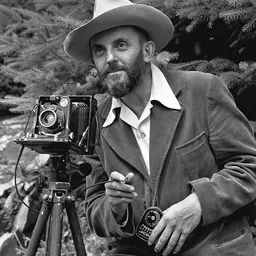
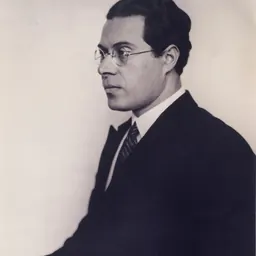
The professional relationship with Wright greatly enhanced Teske's reputation, and over the next five years Teske met and sometimes worked with some of the greatest photographers of the time, including Ansel Adams, Paul Strand, László Moholy-Nagy and Berenice Abbott. He taught briefly with Moholy-Nagy at the New Bauhaus in Chicago, and in 1939 he worked as an assistant in Abbott's studio in New York.
When World War II broke out, Teske was drafted for military duty, but he failed his medical exam for "asocial tendencies, psychoneurosis and emotional instability." in the context of his exploration of Vedantic philosophy.
As Teske continued to contemplate the complex teachings of Vedanta, his delved further into using his photography to translate his feelings into imagery. Throughout the 1950s he experimented with new chemical and manipulative techniques, culminating in 1958 when he perfected a combination of photographic print toning and solarization. Edward Steichen coined the term "duotone solarization" to describe this new technique.
In 1959 the Museum of Modern Art purchased nine of his prints, further escalating his fame within the photographic world. The 1960s and '70s were the busiest time in his career. During this period he was given at least eighteen one-man exhibitions and took part in more than two dozen other group exhibitions. He met and sometimes taught with many of the important photographers of the time, including Aaron Siskind, Harry Callahan, Wynn Bullock, Jack Welpott, and Judy Dater. During this period he also befriended Jim Morrison, lead singer of The Doors, and took a series of informal portraits of Morrison and his girlfriend Pamela Courson.
During the last twenty years of his life Teske both worked and lived in his studio in East Hollywood, where he regularly taught workshops and mentored both younger and older photographers who sought his knowledge about art and philosophy. When he was asked by a reporter if he had any advice to give to new photographers, Teske replied, "Yes. Meditate!"
Around 1990 Teske embarked on assembling a comprehensive autobiographical collection of his work. Within a short time he had created a six-volume maquette he called ‘’Emanations," which he hoped would not only show his work as he wanted it to be seen but also tell the story of his life. He never found a publisher for the work.
The 1994 Northridge earthquake severely damaged Teske's studio, and he was forced to move out. He was living by himself in downtown Los Angeles when he died in his bed on November 22, 1996.
In his obituary in the Los Angeles Times, photographic historian Weston Naef wrote that Teske will "enter the history books as the grand master of a style of picture that is taken for granted now that computers have created ways to cut and paste images seamlessly."
Teske was given a posthumous retrospective at the J. Paul Getty Museum in 2004.
Don’t just read it —
keep it.
Full-length biographies made to live with: read them, listen on the way to work, watch them tonight.
- E-book
- Audio
- Video
Instant download · yours to keep · every purchase keeps this site free
Important facts
People in Edmund Teske's life
Named in this biography and alive at the same time





Related people
Same field, nearest in time

Contemporaries
People whose lives overlapped Edmund Teske's






Frequently asked questions
Who was Edmund Teske?
American photographer (1911–1996)
When was Edmund Teske born?
Edmund Teske was born on 7 March 1911 in Chicago.
When did Edmund Teske die?
Edmund Teske died on 22 November 1996 in Los Angeles.
What was Edmund Teske's occupation?
Edmund Teske was a photographer.
What nationality was Edmund Teske?
Edmund Teske was American.
Sources & further reading
Cite this page
APA: Biography.guide. (2026). Edmund Teske. https://biography.guide/edmund-teske/
MLA: "Edmund Teske." Biography.guide, https://biography.guide/edmund-teske/.
Chicago: "Edmund Teske." Biography.guide. https://biography.guide/edmund-teske/.
Data last updated: 2026-09-20 · Spot an error? Report a correction.
Page generated 2026-09-27 05:05 UTC