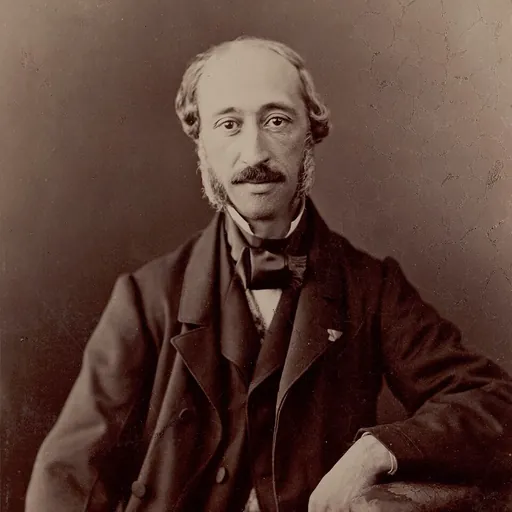
About Edmond Becquerel
Lived 1820 – 1891 (aged 71). Edmond Becquerel was a French physicist, photographer, university teacher and chemist, known for Overhead projector, Phosphoroscope and Photovoltaic effect.
Alexandre-Edmond Becquerel (; 24 March 1820 – 11 May 1891) was a French physicist who studied the solar spectrum, magnetism, electricity, and optics. In 1839, he discovered the photovoltaic effect, the operating principle of the solar cell, which he invented in the same year. He is also known for his work in luminescence and phosphorescence. He was the son of Antoine César Becquerel and the father of Henri Becquerel, the discoverer of radioactivity.
Biography
Born in Paris, Becquerel was the pupil-turned-successor of his father at the Muséum national d'histoire naturelle. He was also appointed professor at the short-lived Agronomic Institute in Versailles in 1849, and in 1853, received the Chair of Physics at the Conservatoire des arts et métiers. He was associated with his father in much of his work.
The first photovoltaic device
In 1839, at age 19, while experimenting in his father's laboratory, Becquerel created the world's first photovoltaic cell. In this experiment, he placed silver chloride in an acidic solution and illuminated it while it was connected to platinum electrodes, thus generating voltage and current. Because of this work, the photovoltaic effect has also been known as the "Becquerel effect". In practice this technique was rarely used. In 1848 he produced color photographs of the solar spectrum, and also of camera images, by a technique later found to be akin to the Lippmann interference method, but the camera exposures required were impractically long and the images could not be stabilized, their colors persisting only if kept in total darkness, however this work is based on the discoveries of J. T. Seebeck prior to 1810.
Other studies
Becquerel paid special attention to the study of light, investigating the photochemical effects and spectroscopic characters of solar radiation and the electric arc light, and the phenomena of phosphorescence, particularly as displayed by the sulfides and by compounds of uranium. It was in connection with these latter inquiries that he devised his phosphoroscope, an apparatus which enabled the interval between exposure to the source of light and observation of the resulting effects to be varied at will and accurately measured.
He investigated the diamagnetic and paramagnetic properties of substances and was keenly interested in the phenomena of electrochemical decomposition, accumulating much evidence in favor of Faraday's law of electrolysis and proposing a modified statement of it which was intended to cover certain apparent exceptions. In 1853, Becquerel discovered thermionic emission.
Publications
In 1867 and 1868 Becquerel published La lumière, ses causes et ses effets (Light, its Causes and Effects), a two-volume treatise which became a standard text. His many papers, essays, and commentaries appeared in French scientific journals, mainly the French Academy of Sciences' widely distributed Comptes Rendus, from 1839 until shortly before his death in 1891.
Honors and awards
Becquerel was elected a member of the Royal Swedish Academy of Sciences in 1886.
The Becquerel Prize for "outstanding merit in photovoltaics" is awarded annually at the European Photovoltaic Solar Energy Conference and Exhibition (EU PVSEC).
Don’t just read it —
keep it.
Full-length biographies made to live with: read them, listen on the way to work, watch them tonight.
- E-book
- Audio
- Video
Instant download · yours to keep · every purchase keeps this site free
Important facts
Family & relationships
People in Edmond Becquerel's life
Named in this biography and alive at the same time

Related people
Same field, nearest in time




Contemporaries
People whose lives overlapped Edmond Becquerel's



Frequently asked questions
Who was Edmond Becquerel?
French physicist (1820-1891)
When was Edmond Becquerel born?
Edmond Becquerel was born on 24 March 1820 in former 1st arrondissement of Paris.
When did Edmond Becquerel die?
Edmond Becquerel died on 11 May 1891 in Paris.
What was Edmond Becquerel's occupation?
Edmond Becquerel was a physicist, photographer, university teacher and chemist.
What was Edmond Becquerel known for?
Edmond Becquerel was known for Overhead projector, Phosphoroscope, Photovoltaic effect and Thermionic emission.
What nationality was Edmond Becquerel?
Edmond Becquerel was French.
Sources & further reading
Cite this page
APA: Biography.guide. (2026). Edmond Becquerel. https://biography.guide/edmond-becquerel/
MLA: "Edmond Becquerel." Biography.guide, https://biography.guide/edmond-becquerel/.
Chicago: "Edmond Becquerel." Biography.guide. https://biography.guide/edmond-becquerel/.
Data last updated: 2026-09-21 · Spot an error? Report a correction.
Portrait: Wikimedia Commons · author & licence
Page generated 2026-09-27 05:00 UTC