
About Edith S. Sampson
Lived 1898 – 1979 (aged 80). Edith S. Sampson was an American lawyer, judge, social worker and diplomat, known for Black people in the United States.
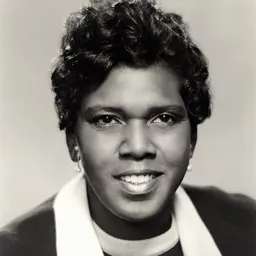
Edith Spurlock Sampson (October 13, 1901 – October 8, 1979) born to Louis Spurlock, a launderer, and Elizabeth A. McGruder. She later returned to school and graduated from Peabody High School in Pittsburgh. She then went to work for Associated Charities and studied at the New York School of Social Work. After she received the highest grade in a criminology course, George Kirchwey of Columbia, one of her instructors, encouraged her to become an attorney. As a high school student, Barbara Jordan (later a trailblazing attorney and Democratic politician in her own right) was inspired by Sampson's example as a lawyer and political speaker after hearing the Chicago attorney address an assembly at Phyllis Wheatley High School in Houston.
She also stated that "I would rather be a Negro in America than a citizen in any other land." Supreme Court Justice William O. Douglas said that her actions "created more good will and understanding in India than any other single act by any American".
Sampson also attacked Soviet communism directly by comparing it to slavery and accusing, in particular, the Soviet Union of enslaving prisoners of war from World War II. In a report circulated by the American government, Sampson reportedly told Soviet Ambassador Yakov Malik: "We Negroes aren't interested in Communism... We were slaves too long for that. Nobody is happy with second-class citizenship, but our best chances are in the framework of American democracy." making her the first African-American to officially represent the United States at the UN. She was a member of the UN's Social, Humanitarian, and Cultural Committee, where she lobbied for continued support of work in social welfare. She also presented a resolution pressuring the Soviet Union to repatriate the remainder of its Prisoners of War from World War II. She was reappointed to the UN in 1952, and served until 1953. During the Eisenhower Administration, she was a member of the U.S. Commission for UNESCO. In 1961 and 1962, she became the first black U.S. representative to NATO.
Dissent Sampson began to express great dissent from American policies in 1959–1960. In a 1960 speech to African American high school graduates in Dallas, Texas, she said, "We have convinced ourselves, because it seemed so necessary, that the battle against injustice could be won piece by piece through changes in law, through court appeals, through persistent but cautious pressures. We were mistaken. No–we were wrong. Ours was not the only way. It was not even the best way."
By 1969 she had apparently regained her faith in working within the system, saying in a speech: "We learned that we could work within the establishment, the system, without necessarily knuckling under to it."
Family Sampson first married Rufus Sampson, a field agent for the Tuskegee Institute. They divorced, but she retained the name Edith Sampson as she was already professionally known by it. In 1935, she married lawyer Joseph E. Clayton, with whom she shared her legal practice until his death in 1957. Two of her nephews, Charles T. Spurlock and Oliver Spurlock, were also judges. Her niece, Jeanne Spurlock, became the first African American woman to be dean of an American medical school (Meharry Medical College). Sampson's great-niece, Lynne Moody, is an actress who appeared in the television miniseries Roots. Sampson became an honorary member of Zeta Phi Beta sorority in 1952.
Don’t just read it —
keep it.
Full-length biographies made to live with: read them, listen on the way to work, watch them tonight.
- E-book
- Audio
- Video
Instant download · yours to keep · every purchase keeps this site free
Important facts
People in Edith S. Sampson's life
Named in this biography and alive at the same time



Related people
Same field, nearest in time



Contemporaries
People whose lives overlapped Edith S. Sampson's




Frequently asked questions
Who was Edith S. Sampson?
American diplomat, lawyer and judge (1898-1979)
When was Edith S. Sampson born?
Edith S. Sampson was born on 13 October 1898 in Pittsburgh.
When did Edith S. Sampson die?
Edith S. Sampson died on 8 October 1979 in Chicago, Illinois, U.S..
What was Edith S. Sampson's occupation?
Edith S. Sampson was a lawyer, judge, social worker and diplomat.
What was Edith S. Sampson known for?
Edith S. Sampson was known for Black people in the United States.
What nationality was Edith S. Sampson?
Edith S. Sampson was American.
Sources & further reading
Cite this page
APA: Biography.guide. (2026). Edith S. Sampson. https://biography.guide/edith-s-sampson/
MLA: "Edith S. Sampson." Biography.guide, https://biography.guide/edith-s-sampson/.
Chicago: "Edith S. Sampson." Biography.guide. https://biography.guide/edith-s-sampson/.
Data last updated: 2026-09-25 · Spot an error? Report a correction.
Page generated 2026-09-27 05:07 UTC