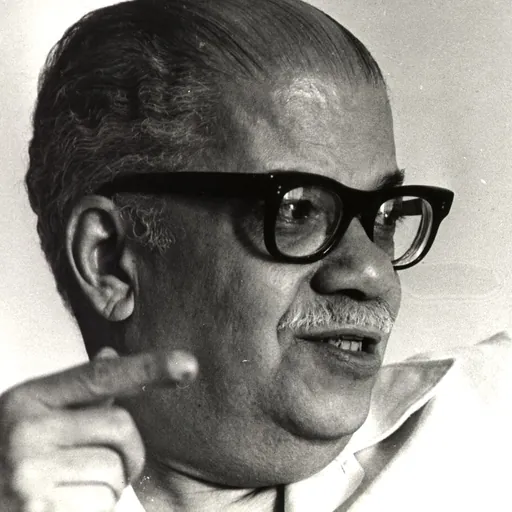
About Edison Carneiro
Lived 1912 – 1972 (aged 60). Edison Carneiro was a Brazilian writer, folklorist, ethnographer and journalist.
Edison de Souza Carneiro (12 August 1912 – 2 December 1972) was a Brazilian writer, historian, folclorist and ethnologist who specialized in Afro-Brazilian culture. He was one of the most well-known Brazilian ethnologists during his time with his studies on Afro-Brazilian culture and history, which had largely been ignored by Brazilian academic literature up to that point. He was also an activist with the Brazilian Communist Party (PCB), starting in the 1930s.
Biography
Carneiro was born on 12 August 1912 in Salvador, Bahia, one of 12 children to Antônio Joaquim de Souza Carneiro, the first to find oil in the Lobato neighborhood of Salvador, and Laura Coelho de Souza Carneiro. His brother was senator and president of the national congress Nelson Carneiro, and through him, his niece is federal deputy and Rio de Janeiro councilwoman Laura Carneiro.
He was a part of a wave of historians in the 1930s that gave greater attention academically to Candomblé, with this wave mostly focusing on the Nagô tradition. The growing literature, both scholarly and popular, helped document Candomblé while contributing to its greater standardization. He would later be invited by Dorothy B. Porter, alongside statesmen such as Kwame Nkrumah and Eric Williams, to give lectures at Howard University.
Carneiro, along with Solano and Margarida Trindade, would co-found the Teatro Popular Brasileiro (TPB), a popular theater group inspired by Brazilian Black and indigenous cultural traditions.
In 1962, the "Carta do samba" ("The samba letter"), a document written by Carneiro, was made public, which expressed the need to preserve traditional features of samba, such as the syncopa, without, however, "denying or taking away spontaneity and prospects for progress". This letter came to meet a series of circumstances that made traditional urban samba not only revalued in different Brazilian cultural circles, but also started to be considered by them as a kind of "counter-hegemonic" and "resistance music" in the Brazilian music scene. In a decade characterized in the Brazilian music industry by the domination of international rock music and its Brazilian variant, Jovem Guarda, the traditional samba would have started to be seen as an expression of the greatest authenticity and purity of the genre, which led to the creation of terms such as "samba autêntico" ("authentic samba"), "samba de morro" ("samba of the hill"), "samba de raiz" ("roots samba"), or "samba de verdade" ("real samba").
Carneiro died on 2 December 1972 in Rio de Janeiro.
Works Religiões Negras, Editora Civilização Brasileira, Rio de Janeiro, 1936, 1963; Negros Bantos, Editora Civilização Brasileira, Rio de Janeiro, 1937; O Quilombo dos Palmares, Editora Brasiliense, São Paulo, 1947, 1958; Castro Alves, 1947, 1958; Candomblés da Bahia, Editora do Museu do Estado da Bahia, Salvador, 1948; Antologia do Negro Brasileiro, Editora Globo, Porto Alegre, 1950; A Cidade do Salvador, 1954; A Conquista da Amazônia, 1956; A Sabedoria Popular, 1957; Insurreição Praiana, 1960; Samba de Umbigada, Ministério da Educação e Cultura, Rio de Janeiro, 1961.
Don’t just read it —
keep it.
Full-length biographies made to live with: read them, listen on the way to work, watch them tonight.
- E-book
- Audio
- Video
Instant download · yours to keep · every purchase keeps this site free
Important facts
People in Edison Carneiro's life
Named in this biography and alive at the same time




Related people
Same field, nearest in time




Contemporaries
People whose lives overlapped Edison Carneiro's




Frequently asked questions
Who was Edison Carneiro?
Brazilian ethnologist and writer
When was Edison Carneiro born?
Edison Carneiro was born on 12 August 1912 in Salvador.
When did Edison Carneiro die?
Edison Carneiro died on 2 December 1972 in Rio de Janeiro.
What was Edison Carneiro's occupation?
Edison Carneiro was a writer, folklorist, ethnographer and journalist.
What nationality was Edison Carneiro?
Edison Carneiro was Brazilian.
Sources & further reading
Cite this page
APA: Biography.guide. (2026). Edison Carneiro. https://biography.guide/edison-carneiro/
MLA: "Edison Carneiro." Biography.guide, https://biography.guide/edison-carneiro/.
Chicago: "Edison Carneiro." Biography.guide. https://biography.guide/edison-carneiro/.
Data last updated: 2026-09-20 · Spot an error? Report a correction.
Page generated 2026-09-27 05:09 UTC