
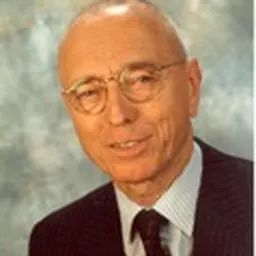
Edgar Claxton
British rail engineer
About Edgar Claxton
Lived 1910 – 2000 (aged 90). Edgar Claxton was an electrical engineer, mechanical engineer and civil engineer.
Edgar Claxton (7 July 1910 – 13 August 2000) was an English rail engineer. He worked for the British Railways Board and was part of the team which electrified parts of the United Kingdom's mainline railway network in the 1960s. He was responsible for "design and procurement of all the equipment, and for the electrification side of the projects". He was made an MBE in 1969 for his work.
Background and private life Edgar Claxton's parents were Edgar "Ted" Claxton, and Nellie Mildred "Helen" Petty. They married on 1 August 1908, in Hammersmith. Ted was a poor law settlement officer, working around the country from the offices of St Marylebone Workhouse. At the same time he was registrar for births and deaths for Marylebone parish, working from an office in his home, as did his father Jesse. Helen was a music teacher, and the honorary piano accompanist for the Northwood Choral Society. A year after Helen's death, Ted Claxton married Mary Browning Eustance in Edmonton on 24 April 1946.
Edgar Claxton was born in Marylebone on 7 July 1910, and died in Oxford on 13 August 2000. He first appeared in the newspapers at the age of two years, having attended a family wedding. He attended Merchant Taylors' School, Northwood, and in 1939 he gained First Class Honours in engineering at University College London. At the inquest of 20 July 1928 it was found that the car had stopped before the impact, the motor cyclist had been driving too fast, and that Edgar Claxton was "exonerated from all blame". The verdict was "accidental death".
Between 1952 and 1975 Claxton was living at 47 Grange Gardens, Pinner. He married Elizabeth "Betty" Welsh. They had several children. He is buried in Shotteswell churchyard.
Career Early career Claxton's first employment was with the engineering firm Kennedy & Donkin. This involved him with projects "mostly for generating and sub-stations, overhead lines and cables", including work in Northern Ireland and "construction of the National Grid in Scotland".
World War II As an essential railway worker he did not do military service in World War II. Instead, he worked for the Admiralty Dockyard Department. Here, he "looked after planning, specifications and contracts for electrical distribution systems for dock works both at home and abroad".
By the end of 1951, Claxton was the assistant electrification engineer for the MSW electrification scheme, based at Dukinfield, "supervising all branches of the MSW electrification project from end to end", including Scotland. He was working with Metropolitan Vickers & Co., "installing electrical equipment into the newly formed fleet of locomotives for the re-started 1936 programme", i.e. the project plans in which he had been involved before the war.
He read a paper at the British Railways Electrification Conference in 1960. He "was part of the team setting up the first overhead wires for electrification of the mainline railway and was involved in the project commemorated" in the British Railways booklet, Change at Crewe (1960). This brochure details "the completion of Stage One, Manchester-Crewe of the Manchester-Liverpool-Euston Electrification Scheme".
By 1969, Claxton was the fixed equipment projects engineer for the British Railways Board. He was "involved in all British Railway electrification projects throughout the country, and [was] responsible for the design and procurement of all the equipment, and for the electrification side of the projects". He was a Fellow of the Institution of Civil Engineers (FICE), and a Fellow of the Institution of Electrical Engineers (FIEE).
Claxton's team's overhead lines in 1960
According to Claxton's Overhead Line Equipment paper of 1960, the lines included in the electrification plan were: Manchester–Crewe; Liverpool–Crewe; Crewe-Euston; Colchester–Clacton–Walton; Liverpool Street–Chelmsford–Southend; Liverpool Street–Enfield–Chingford–Hertford–Bishop's Stortford; London–Tilbury–Southend; Glasgow Suburban Stage I; Chelmsford–Colchester.
In October 1960, Ernest Marples said, "It will be the technical advances that will decide the attraction of rail travel in the future. There is the news of the Manchester-Crewe electrification. There is the news of the Kent electrification, which has brought about a 36 per cent. increase in passengers over the previous steam traction".
Don’t just read it —
keep it.
Full-length biographies made to live with: read them, listen on the way to work, watch them tonight.
- E-book
- Audio
- Video
Instant download · yours to keep · every purchase keeps this site free
Important facts
People in Edgar Claxton's life
Named in this biography and alive at the same time


Related people
Same field, nearest in time




Contemporaries
People whose lives overlapped Edgar Claxton's






Frequently asked questions
Who was Edgar Claxton?
British rail engineer
When was Edgar Claxton born?
Edgar Claxton was born on 7 July 1910 in Marylebone.
When did Edgar Claxton die?
Edgar Claxton died on 13 August 2000 in Oxford.
What was Edgar Claxton's occupation?
Edgar Claxton was an electrical engineer, mechanical engineer and civil engineer.
Sources & further reading
Cite this page
APA: Biography.guide. (2026). Edgar Claxton. https://biography.guide/edgar-claxton/
MLA: "Edgar Claxton." Biography.guide, https://biography.guide/edgar-claxton/.
Chicago: "Edgar Claxton." Biography.guide. https://biography.guide/edgar-claxton/.
Data last updated: 2026-09-20 · Spot an error? Report a correction.
Page generated 2026-09-27 05:30 UTC