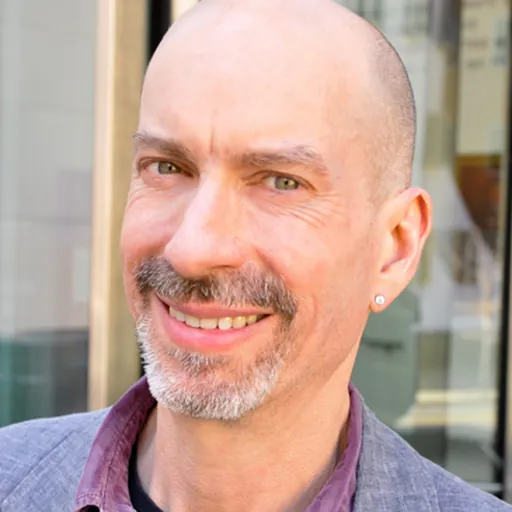
About Earl K. Miller
Born 1962. Earl K. Miller is an American neuroscientist.
Education Miller received a Bachelor of Arts degree (summa cum laude, with honors) in psychology from Kent State University in 1985, Master of Arts degree in psychology and neuroscience from Princeton University in 1987, and a PhD in psychology and neuroscience from Princeton University in 1990. In 2020, Earl Miller was awarded an honorary doctorate (Doctor of Science, honoris causa) from Kent State University.
Career Miller's dissertation on neurophysiological investigations of the inferior temporal cortex in the macaque was supervised by Charles G. Gross at Princeton University. From 1990–1995 he was a postdoctoral research fellow in the laboratory of neuropsychology at the National Institute of Mental Health under supervision of Robert Desimone.
In 1995, Miller joined the faculty of the Department of Brain and Cognitive Sciences at MIT as Assistant Professor of Neuroscience and quickly advanced the academic ranks. He received tenure in 1999 (two years ahead of schedule) and became a full Professor in 2002. He was appointed to the Picower chair at MIT in 2003. He was Associate Director of the Picower Institute for Learning and Memory at MIT from 2001 to 2009, and was Director of Graduate Studies in Brain and Cognitive Sciences at MIT. He has delivered numerous lectures worldwide, serves as editor, and on the editorial boards of, major journals in neuroscience, and on international advisory boards. He has served on the scientific advisory boards of NeuroFocus, Thync, Motimatic, and Neurable. Miller is the co-founder and Chief Scientist of SplitSage
Examples of discoveries from Miller's laboratory include the neural basis of abstract rules like "same vs. different", categories, quantity, and the allocation of attentional resources. They have also shown how the brain can learn and flexibly remap associations. The Miller Lab has shown that cortical neurons can be multifunctional (i.e., show "mixed selectivity"). This is a major advance beyond earlier theories that each neuron has a specific function. This property gives the brain greater computational horsepower and endows flexibility, a hallmark of higher-level cognition.
Miller has innovated techniques for recording from many neurons simultaneously in multiple brain areas, a departure from the classic single-neuron recording approach. It has revealed network dynamics and emergent properties that are not possible by studying individual neurons. Miller's lab has used this approach to understand how network interactions produce thought and action. This includes discoveries that oscillating "brain waves" control the timing of shifts of attention and that different items simultaneously held in working memory line up on different phases of each brain wave. The latter may explain why we can only think about a few things at the same time. They have shown that lower-frequency (alpha/beta) brain waves act as a top-down control signal that regulates sensory processing in cortex. They found that brain waves transfer information between the left and right cerebral cortex. They have shown how the general anesthetic, propofol, induces unconsciousness by shifting cortical brain waves to low frequencies
Miller's paper with Jonathan Cohen, An Integrative Theory of Prefrontal Cortex Function, has been designated a Current Classic as among the most cited papers in Neuroscience and Behavior. It is the 5th most-cited paper in the history of Neuroscience. His paper with Tim Buschman, Top-down versus Bottom-up Control of Attention in the Prefrontal and Posterior Parietal Cortices was The Scientist's Hot Paper for October 2009. Earl K. Miler was named in the top 2% of scientists worldwide He has been cited in over 65,000 publications
Selected Awards and Honors Reference
Excellence in Graduate Mentoring, Department of Brain and Cognitive Sciences, MIT (2025) Doctor of Science (honoris causa), Kent State University (2020). The George A. Miller Prize in Cognitive Neuroscience (2019). Elected to the American Academy of Arts and Sciences (2017) Paul and Lilah Newton Brain Science Award (2017) The Goldman-Rakic Prize for Outstanding Achievement in Cognitive Neuroscience (2016) Kent State University Professional Achievement Award (2016). Elected to the Memory Disorders Research Society, 2016 Amar G. Bose Research Fellowship (2014), MERIT Award, National Institute of Mental Health (2010) The Mathilde Solowey Award in Neurosciences (2007) Elected Fellow of the American Association for the Advancement of Science (2005), Picower Professorship at MIT (endowed chair) (2003) The Society for Neuroscience Young Investigator Award (2000) National Academy of SciencesTroland Research Award (2000) Tenured at MIT two years ahead of schedule (1999) John Merck Scholar Award (1998), McKnight Scholar Award (1996), Pew Scholar Award (1996) Alfred P. Sloan Research Fellow (1996) Phi Beta Kappa (1985)
Business The discovery that different individuals have different perceptual capacities in different parts of their field of view led Earl Miller to found SplitSage. SplitSage uses a patented process to assess these individual differences. It can be used to customize displays, develop individualized training, and organize teams to maximize information throughput and improve situational awareness and performance.
Earl Miller is co-founder of Neuroblox, a platform for modeling neural control circuits and their regulation that aims to provide advanced diagnostics and simulation to enhance brain health care
Media Appearances Miller has made frequent appearances in the popular press. He was profiled in Discover Magazine and The New Yorker. He wrote a guest column in Fortune. Professor Miller has appeared on NBC's Today Show, on CBS Sunday Morning with Jane Pauley, and has been a frequent guest on National Public Radio and other radio talk shows as well as podcasts. He has been quoted and/or his work profiled in the New York Times, The Washington Post, CNN, MSNBC, Time, ABC News, Slate, The Boston Globe, The Times of London, Forbes etc. A list of media appearances is online.
Philanthropy Miller has funded a charitable trust to create scholarships for disadvantaged students at his alma mater Kent State University. The "Earl K. Miller First Generation Scholarship" provides financial support for first generation college students in need of aid.
Don’t just read it —
keep it.
Full-length biographies made to live with: read them, listen on the way to work, watch them tonight.
- E-book
- Audio
- Video
Instant download · yours to keep · every purchase keeps this site free
Important facts
People in Earl K. Miller's life
Named in this biography and alive at the same time




Related people
Same field, nearest in time





Contemporaries
People whose lives overlapped Earl K. Miller's



Frequently asked questions
Who is Earl K. Miller?
American cognitive neuroscientist and memory researcher
When was Earl K. Miller born?
Earl K. Miller was born on 30 November 1962.
What is Earl K. Miller's occupation?
Earl K. Miller is a neuroscientist.
What nationality is Earl K. Miller?
Earl K. Miller is American.
Sources & further reading
Cite this page
APA: Biography.guide. (2026). Earl K. Miller. https://biography.guide/earl-k-miller/
MLA: "Earl K. Miller." Biography.guide, https://biography.guide/earl-k-miller/.
Chicago: "Earl K. Miller." Biography.guide. https://biography.guide/earl-k-miller/.
Data last updated: 2026-09-22 · Spot an error? Report a correction.
Portrait: Wikimedia Commons · author & licence
Page generated 2026-09-27 05:02 UTC