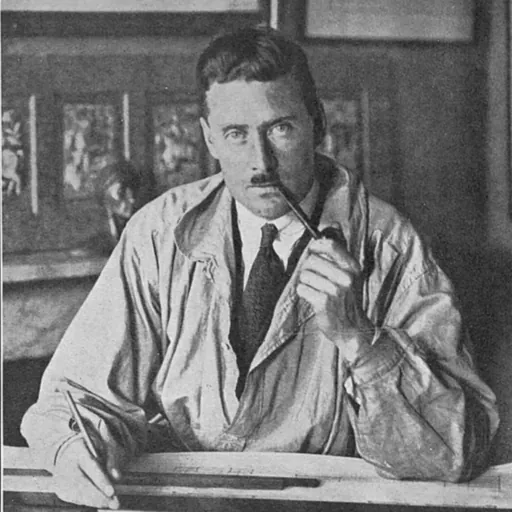
About E. Berry Webber
Lived 1896 – 1963 (aged 67). E. Berry Webber was an architect.
Ernest Berry Webber, (29 April 1896 – 19 December 1963) was an English architect, surveyor and town planner best known for his designs of municipal buildings, including those in Southampton in Hampshire, and Dagenham and Hammersmith, both in London.
Born in London, and after attending the London School of Building, Webber studied under Arthur Beresford Pite and then became articled to the architect Robert Atkinson. During the war years, Webber moved to the office of Vincent Harris, a prolific designer of public buildings. Webber's work for Harris involved entering the practice into architectural competitions by undertaking urban planning drafts and designs of municipal buildings.
In 1925, aged 29, Webber won a competition to design a new art gallery and museum in Manchester, to be constructed on the site now occupied by Piccadilly Gardens. The plans never went ahead, but his designs impressed his peers. His first major municipal design was the Guildhall Civic Centre in Southampton, which was built over a ten-year period, starting in 1929. Other civic centres followed, including the Civic Centres at Dagenham (1936–37), and Hammersmith (1939–40). Together with his municipal structures, his designs total at around 50 buildings, including schools, offices, museums and libraries.
Webber retired to Brighton in the 1950s where he died in 1963 aged 67.
Early life and education Webber was born at 47 St. Paul's Road, Walworth, Surrey. He was the youngest of three children, and the second son to Henry Webber, a shopkeeper,
Ernest attended the London School of Building and studied under Arthur Beresford Pite. After leaving, he became articled to Robert Atkinson, and in 1914 he moved to the office of Vincent Harris, a prolific designer of public buildings. The war intervened and Webber served his four-year service in France. After the war, he resumed his apprenticeship with Harris where his work focused on preparing designs for competitions; he continued under Harris for 11 years. A reporter for the Lancashire Daily Post listed the win as Webber's "first great success" and the moment when he jumps from "comparative obscurity to a position of high distinction in his profession." which required his relocation to the city as the construction period was to last for 10 years, which he was to oversee. It was built to a cost of £620,000 and completed in 1939. Alongside this, he completed the new King Edward VI School, also in the city. The building was designed in the English Baroque style. A reporter for the Architect and Building News described the design as being from someone who was "at the top of his form". The building was completed and opened in 1933.
Webber designed the Dagenham Civic Centre, built from 1936 to 1937. The Civic Centre's foundation stone was laid by Harry Snell, 1st Baron Snell on 11 July 1936. Pevsner describes the centre as "Dagenham's best building by far". It is constructed in the Modernist style, which Webber also used for the adjacent fire and ambulance station. The Civic Centre was opened on 16 October 1937 by Sir Kingsley Wood. An extension was added to the civic centre in 1964 by Webber's firm after the architect's death.
Also in 1936, Webber won a competition to build the parliamentary buildings in Southern Rhodesia. The following year, he undertook the designs for Hammersmith Town Hall in King Street, Hammersmith, London, which were completed in 1939. Pevsner calls the town hall "an unfortunate building", regretting both the loss of the "picturesque character" of the area which occurred as a result of its construction, and the "ill-judged" extensions of the 1970s. It became a Grade II listed building, together with the Civic Centre in Dagenham, in 1981.
In 1955 Webber undertook a £1.5million rebuild of the Portsmouth Guildhall, which had received substantial bomb damage during the war. It was reopened by Elizabeth II on 10 June 1959.
Personal life Webber married Gladys Bellis Roberts (1896–1984) on 22 November 1922 at St Mary and Holy Trinity Church in Stratford. They had a son named Geoffrey. On 25 June 1929 Webber was given the Freedom of the City of London. and in 1960 he was made a companion of the entertainment charity, the Grand Order of Water Rats.
Webber retired to Brighton in the 1950s. He was taken ill at his house, 2 Arundel Terrace, and died shortly after at the Royal Sussex County Hospital on 19 December 1963. His probate was set at £18,611 (£ in adjusted for inflation).
Footnotes
Don’t just read it —
keep it.
Full-length biographies made to live with: read them, listen on the way to work, watch them tonight.
- E-book
- Audio
- Video
Instant download · yours to keep · every purchase keeps this site free
Important facts
People in E. Berry Webber's life
Named in this biography and alive at the same time



Related people
Same field, nearest in time

Contemporaries
People whose lives overlapped E. Berry Webber's



Frequently asked questions
Who was E. Berry Webber?
British architect
When was E. Berry Webber born?
E. Berry Webber was born on 29 April 1896 in Walworth.
When did E. Berry Webber die?
E. Berry Webber died on 19 December 1963 in Brighton, Sussex.
What was E. Berry Webber's occupation?
E. Berry Webber was an architect.
Sources & further reading
· DBpedia: Ernest Berry Webber
Cite this page
APA: Biography.guide. (2026). E. Berry Webber. https://biography.guide/e-berry-webber/
MLA: "E. Berry Webber." Biography.guide, https://biography.guide/e-berry-webber/.
Chicago: "E. Berry Webber." Biography.guide. https://biography.guide/e-berry-webber/.
Data last updated: 2026-09-22 · Spot an error? Report a correction.
Portrait: Wikimedia Commons · author & licence
Page generated 2026-09-27 05:02 UTC