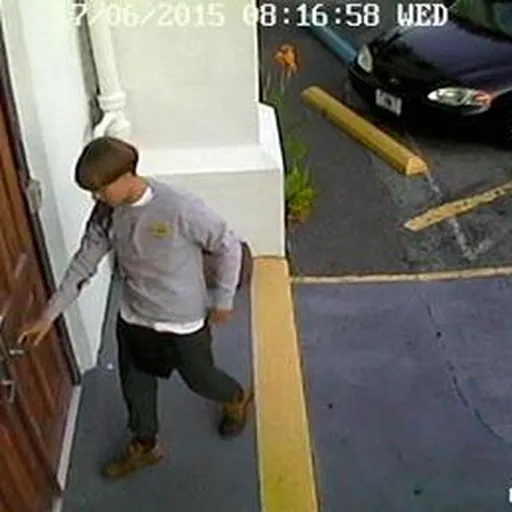
Dylann Roof
American white supremacist and neo nazi (born April 3nd 1994)
About Dylann Roof
Born 1994. Dylann Roof is an American mass murderer and landscape contractor.
Dylann Storm Roof (born April 3, 1994) is an American mass murderer, white supremacist, and neo-Nazi who perpetrated the Charleston church shooting. During a Bible study on June 17, 2015, at Emanuel African Methodist Episcopal Church in Charleston, South Carolina, Roof murdered nine people and injured a tenth; the victims were African Americans, and included Clementa C. Pinckney, who was the church's senior pastor and a state senator. After several people identified Roof as the main suspect, he became the center of a manhunt that ended the morning after the shooting with his arrest in Shelby, North Carolina. He later confessed that he committed the shooting in hopes of igniting a race war. Roof's actions in Charleston have been widely described as domestic terrorism.
Three days after the shooting, a website titled The Last Rhodesian was discovered and later confirmed by officials to be owned by Roof. The website contained photos of Roof posing with symbols of white supremacy and neo-Nazism, along with a picture of him wearing a jacket containing the flags of Apartheid-era South Africa and Rhodesia, and a manifesto in which he outlined his views toward Black people, among other groups. On March 31, 2017, Roof agreed to plead guilty in South Carolina state court to all state charges pending against him—nine counts of murder, three counts of attempted murder, and possession of a firearm during the commission of a felony—to avoid a second death sentence. In return, he accepted a sentence of life in prison without parole. On April 10, 2017, Roof was sentenced to nine consecutive sentences of life without parole after formally pleading guilty to state murder charges. He is currently awaiting execution for the federal convictions on death row at USP Terre Haute.
Early life Roof was born in Columbia, South Carolina, to Franklin Bennett Roof (nicknamed Benn), a carpenter and a construction contractor, and Amelia "Amy" Cowles, a bartender. His parents had divorced but were temporarily reconciled at the time of his birth. In November 1999, when Roof was five, The family mostly lived in South Carolina, though from about 2005 to 2008, they temporarily moved to the Florida Keys. There is no information about Roof attending local schools there.
According to a 2009 affidavit filed for Mann's divorce, Roof exhibited "obsessive compulsive behavior" as he grew up, obsessing over germs and insisting on having his hair cut in a certain style. He stopped attending classes in 2010 and, according to his family, dropped out of school and spent his time alternating between playing video games and taking drugs. He claimed in his interrogation to have received his GED after dropping out of online schooling.
Prior to the attack, Roof was living alternately in Bennett's and Cowles' homes in downtown Columbia and Hopkins, respectively, He allegedly spent his time using drugs and getting drunk. Cowles said he tried to mentor Roof, but Roof rejected his attempts to help and they drifted apart.
Earlier contacts with police Roof had a prior police record consisting of two arrests, both made in the months preceding the attack. He was investigated on one occasion during this period but without arrest or charge.
On February 28, 2015, mall security at the Columbiana Centre in Columbia called police after Roof, wearing all-black clothing, asked employees unsettling questions. During police questioning, Roof consented to be searched, and was found to be in possession of several strips of buprenorphine/naloxone, a prescription medication for opioid use disorder which is sometimes sold illegally, but usually for therapeutic rather than recreational use. As Roof did not have a valid prescription, he was arrested for a misdemeanor charge of drug possession, and was subsequently banned from the Columbiana Centre for a year.
On March 13, 2015, Roof was investigated for loitering in his parked car near a park in downtown Columbia. He had been recognized by an off-duty police officer who investigated his March 2 questioning; the officer then called a colleague to investigate. A police officer conducted a search of his vehicle and found a forearm grip for an AR-15 semiautomatic rifle and six unloaded magazines, all capable of holding 40 rounds. When asked about it, Roof informed the officer that he wanted to purchase an AR-15, but did not have enough money to do so. He was not charged, as it was not illegal in South Carolina to possess a forearm grip.
On April 26, 2015, Roof was arrested again for trespassing on the Columbiana Centre mall's grounds in violation of the ban. The ban was then extended for three additional years.
Charleston church shooting
On the evening of June 17, 2015, a mass shooting took place at Emanuel African Methodist Episcopal Church in downtown Charleston, South Carolina. During a routine Bible study at the church, a white man about 21 years old, later identified as Roof, opened fire with a handgun, firing more than 50 rounds, and ultimately killing nine people. Roof was unemployed and living in largely African-American Eastover at the time of the attack.
Motivation According to a childhood friend, Roof went on a rant about the killing of Trayvon Martin and the 2015 Baltimore protests that were sparked by the death of Freddie Gray while Gray was in police custody. He also often claimed that "Blacks were taking over the world". Roof reportedly told friends and neighbors of his plans to kill people, including a plot to attack the College of Charleston, but his claims were not taken seriously. Another online photo showed Roof sitting on the hood of his car with an ornamental license plate with a Confederate flag on it. According to his roommate, Roof expressed his support for racial segregation in the United States and had wanted to start a civil war.
One of the friends who briefly hid Roof's gun away from him said, "I don't think the church was his primary target because he told us he was going for the school. But I think he couldn't get into the school because of the security ... so I think he just settled for the church." An African-American friend of his said that he never witnessed Roof expressing any racial prejudice, but also said that a week before the shooting, Roof had confided in him that he would commit a shooting at the college.
On the day he was captured (June 18, 2015), Roof confessed to committing the Charleston attack with the intention of starting a race war, and reportedly told investigators he almost did not go through with the shooting because members of the church study group had been so nice to him.
Federal prosecutors said in August 2016 that Roof was "self-radicalized" online, instead of adopting his white supremacist ideology "through his personal associations or experiences with white supremacist groups or individuals or others".
Website and handwritten documents On June 20, 2015, a website that had been registered to a Dylann Roof on February 9, 2015, lastrhodesian.com, was discovered. Roof is believed to have taken self-portraits using a timer, and staff members working at the sites did not remember his visits. in which he outlined his opinions, all methodically broken into the following sections: "Blacks", "Jews", "Hispanics", "East Asians", "Patriotism", and "An Explanation":
The manifesto states that its author was "truly awakened" by coverage of the killing of Trayvon Martin:
The manifesto also mentioned the Northwest Front, a Seattle-based white supremacist organization.
According to web server logs, Roof's website was last modified at 4:44 p.m. on June17, 2015, when Roof noted, "t the time of [this] writing I am in a great hurry."
Weapon purchase and FBI lapse Roof purchased the gun used in the shooting from a retail gun store in West Columbia, using money given to him on his birthday. On August 30, 2019, the Fourth Circuit Court of Appeals ruled that the survivors and families of the deceased could sue the federal government, after a lower court had previously claimed the federal government had immunity. On October 28, 2021, Charleston attorney Carl Pierce, whose firm represented Rev. Daniel Simmons, confirmed that the federal government would pay $88 million. Also on that day, individual settlements were being filed in the U.S. District Court in Columbia. The U.S. Justice Department approved the settlement but did not admit guilt.
One week prior to the shooting, two of his friends tried to hide the gun after Roof claimed he was going to kill people. They returned it to him after the girlfriend of one of the friends, in whose trailer they hid the gun, pointed out that her boyfriend was on probation and needed to have the gun out of his possession.
Prior to the shooting FBI analysis of Roof's seized cellphone and computer found that he was in online communication with other white supremacists, according to unnamed officials. Although Roof's contacts did not appear to have encouraged the massacre, the investigation was said to have widened to also include other persons of interest.
Reaction by white supremacists Although the Council of Conservative Citizens took down its website on June 20 in the immediate wake of negative publicity, Harold Covington, the founder of the Northwest Front, also condemned Roof's actions, but called the attack "a preview of coming attractions". Its editor, Andrew Anglin, "repudiated Roof's crime and publicly disavowed violence, while endorsing many of Roof's views." He said that while he would have sympathy with a white man shooting criminals, killing innocents including elderly women was "a completely insane act".
A neo-Nazi group named itself the "Bowl Patrol" after Roof's "bowl-cut" hairstyle. The group remained active as of a July 2020 exposé in the Huffington Post, five years after the Charleston church shooting.
Brenton Tarrant, who committed the Christchurch mosque shootings in New Zealand, highlighted Roof as an influence in his manifesto. Three years later, the perpetrator of the 2022 Buffalo shooting, Payton Gendron, also referred to Roof in his manifesto as an inspiration and wrote Roof's name on one of his guns.
Manhunt and capture The attack was treated as a hate crime by police, and officials from the Federal Bureau of Investigation (FBI) were called in to assist in the investigation and manhunt.
At 10:44 a.m., on the morning after the attack, Roof was captured in a traffic stop in Shelby, North Carolina, approximately from the shooting scene. A .45-caliber pistol was found in the car during the arrest, though it was not immediately apparent if it was the same one used in the attack.
Police received a tip-off from a driver, Debbie Dills, from Gastonia, North Carolina. She recognized Roof driving his car, a black Hyundai Elantra with South Carolina license plates and a three-flag "Confederate States of America" bumper decoration, on U.S. Route 74, recalling security camera images taken at the church and distributed to the media. She later recalled: "I got closer and saw that haircut. I was nervous. I had the worst feeling. Is that him or not him?" She called her employer, who contacted local police, and then tailed the suspect's car for until she was certain authorities were moving in for an arrest. His older half-sister also reported him to the police after seeing his photo on the news.
Roof was arrested and was interrogated by agents of the FBI. He stated that he was planning to travel to Nashville, Tennessee when he was arrested in Shelby. Roof initially did not believe his interrogators when they informed him that the death toll of his attack was nine people, believing that the number of casualties was lower, saying he felt "bad" after learning the true number. When asked if he believed that his actions would start a revolution, implying that it would start a race war, he dismissed the idea as delusional. An unidentified source said interrogations with Roof after his arrest determined he had been planning the attack for around six months, researched Emanuel AME Church, and targeted it because of its role in African American history.
Roof is the first person in U.S. history to have faced the death penalty on both state and federal charges at the same time. In September 2015, it was announced that prosecutors would seek the death penalty in Roof's state prosecution, and in May 2016, the U.S. Department of Justice announced that prosecutors would seek the death penalty in his federal prosecution as well.
State prosecution On June 19, 2015, Roof was charged with nine counts of murder and one count of possession of a firearm during the commission of a violent crime. He first appeared in Charleston County court by video conference at a bond hearing later that day. At the hearing, shooting survivors and relatives of five of the victims spoke to Roof directly, saying that they were "praying for his soul" and forgave him. Governor Nikki Haley called for prosecutors to seek the death penalty for Roof.
The judge, Charleston County chief magistrate James "Skip" Gosnell Jr., caused controversy at the bond hearing with his statement that, alongside the dead victims and their families, "there are victims on this young man's side of the family ... Nobody would have ever thrown them into the whirlwind of events that they are being thrown into." Gosnell then set a $1 million bond for the weapons possession charge and no bail on the nine counts of murder.
On July 7, 2015, Roof was indicted on three new charges of attempted murder, one for each person who survived the shooting. A temporary gag order was issued by a judge on July 14 following the appearance of a letter purportedly written by Roof on an online auction site. Seven groups, including news media outlets, families of the slain victims, and church officials, called for easing some restrictions placed by the gag order, particularly 9-1-1 calls. Portions of the gag order were lifted on October 14, allowing for the release of 9-1-1 call transcripts and other documents, but the order remained in place for graphic crime scene photos and videos, as well as audio for the 9-1-1 calls.
On July 16, 2015, Roof's trial in state court was scheduled by Circuit Court Judge J. C. Nicholson to start on July 11, 2016. On July 20, Roof was ordered to provide handwriting samples to investigators. The order explained that following his arrest in Shelby, notes and lists were found written on his hand and at other locations; that the handwriting samples were needed to determine if the handwriting matched.
On September 3, Ninth Circuit solicitor (district attorney) Scarlett Wilson said that she intended to seek the death penalty for Roof because more than two people were killed in the shooting and others' lives were put at risk. On September 16, Roof said through his attorney that he was willing to plead guilty to the state charges to avoid being sentenced to death. Roof reappeared in state court on October 23, 2015,
The jury selection process for the state trial was initially expected to start in June 2016; jury selection was postponed in November 2016. In April 2016, the state trial was delayed to January 17, 2017. It was delayed again in January 2017. On April 10, 2017, Roof pleaded guilty to nine state counts of murder and was sentenced to nine consecutive sentences of life without parole.
Federal prosecution Indictment Five days after the shooting, Attorney General Loretta Lynch announced a grand jury had indicted Roof on 33 federal charges: nine counts of using a firearm to commit murder and 24 civil rights violations (12 hate crime charges under the Matthew Shepard and James Byrd Jr. Hate Crimes Prevention Act and 12 counts under a second hate-crime statute that prohibits using force or threatening the use of force to obstruct a person's free exercise of religious beliefs), with 18 of the charges carrying the federal death penalty.
On July 31, 2015, Roof pleaded not guilty to the federal charges against him at the behest of his lawyer David Bruck. Roof wanted to plead guilty, but Bruck stated he was not willing to advise a guilty plea until the government indicated whether it wanted to seek the death penalty, as 18 of the 33 charges could carry the death penalty.
On May 24, 2016, the Justice Department announced they would seek the death penalty for Roof. As he was already facing the death penalty in South Carolina, Roof became the first person in U.S. history to face the death penalty on both federal and state charges at the same time.
Trial preparations On June 9, 2016, Roof, through his lawyers, announced that he did not want to be tried by a jury. Instead, Roof wanted the judge presiding over his case to hear the case entirely by himself, determining guilt or innocence and, if Roof was convicted, whether to sentence him to death. The judge denied that motion after the prosecution (whose consent is required for a bench trial under the rules that apply to federal criminal proceedings) opposed Roof's request.
On August 2, 2016, Roof's lawyers filed a motion arguing that the federal capital punishment laws were unconstitutional. Federal prosecutors filed a response on August 22, asking the judge to reject the motion.
On September 6, 2016, federal prosecutors filed a motion seeking to bar Roof's attorneys from asking the jurors for mercy during sentencing should he be found guilty of the charges against him. They argue that the defense will already have the opportunity to present evidence that could sway the jury's opinion for sentencing. The next day, prosecutors asked for the use of summary charts as evidence for the trial. One of the charts was expected to be a timeline of the case as drafted by the agent responsible for investigating the shooting. The initial pool of three thousand candidates was narrowed down to the final jury of twelve, plus alternates. The federal trial itself was expected to start late November or early December and last for about two months.
On November 8, 2016, District Court judge Richard M. Gergel ordered a competency evaluation for Roof, which Gergel scheduled for November 16, 2016. Gergel also postponed the jury selection to November 21, 2016.
On November 14, 2016, Gergel delayed the competency hearing to November 17, 2016. On November 16, 2016, Gergel delayed the competency hearing to November 21, 2016. Gergel also delayed the jury selection to November 28, 2016. The competency hearing ended November 22, 2016.
On November 25, 2016, Roof was declared competent to stand trial. Three days later, a federal judge granted Roof's motion for pro se representation.
On December 4, 2016, Roof, in a handwritten request, asked Gergel to give him back his defense team for the guilt phase of his federal death penalty trial. On December 5, 2016, Gergel allowed Roof to hire back his lawyers for the guilt phase of his trial. On December 6, 2016, a federal judge denied a motion by Roof's defense team to delay Roof's trial.
Trial and sentencing
On December 7, 2016, Roof's federal trial began. The jury consisted of "two black women, eight white women, one white man and one black man". Two days into the trial, Roof's confession was played in court, admitting that he had killed the people at the church before chuckling. On December 15, 2016, after about two hours of deliberation, the jury found Roof guilty on all 33 counts.
At a court hearing on December 28, 2016, Roof reiterated that he would proceed with the sentencing phase without attorneys, although Judge Gergel repeatedly warned him that it was not in his interests to do so. At the hearing Roof said that he did not plan to call any witnesses or present any evidence at the sentencing phase in order to avoid the death penalty.
On January 3, 2017, following a lengthy closed-door competency hearing, Judge Gergel denied a motion, submitted under seal by Roof's court-appointed counsel, that sought to have Roof declared incompetent. Gergel wrote: "After fully considering all of the evidence presented, the court ruled from the bench that Defendant remains competent to stand trial and to self-represent." and on January 11, 2017, Judge Gergel formally sentenced Roof to death.
Until April 19, 2017, Roof was located at the Charleston County Jail; on that day federal authorities took custody of him and took him to FTC Oklahoma City. On April 22, 2017, Roof arrived at USP Terre Haute, the location of the federal death row for men and the federal execution chamber.
Post-trial proceedings and release of documents On May 10, 2017, Judge Gergel denied Roof's motion for a new trial. On the same day, Gergel unsealed psychiatric reports from two court-ordered exams of Roof performed by James Ballenger, a forensic psychiatrist, as well as the transcripts of two competency hearings, all of which found Roof competent to stand trial. The court first ordered a psychiatric exam after Roof wrote a letter to prosecutors which referred to his defense attorneys as "the sneakiest group of people I have ever met" and adamantly rejected their strategy to portray him as mentally ill.
The psychiatric report showed that Roof stated of the relatives of his victims that he "did not identify with them, he didn't care." told Ballenger that he "would rather die" than rely on autism defense, stating "it would ruin me" and "everybody would think I am a weirdo." According to a 321-page brief filed by Roof's lawyers in the U.S. Court of Appeals for the 4th Circuit, Roof's representing himself during the penalty phase of his trial deprived the jury of extenuating information about his mental illness. The brief cites the Supreme Court's ruling in Indiana v. Edwards that judges can force a lawyer on defendants who lack mental capacity.
On May 25, 2021, his lawyers began an appeal process before the United States Court of Appeals for the Fourth Circuit claiming that Roof was "too disconnected from reality" to represent himself at the federal trial. In the 321-page motion, his attorneys argue that he had disorders ranging from schizophrenia spectrum to autism, anxiety and depression, and that he did not care about his sentence, in the belief that white nationalists would rescue him from prison after an impending race war. Roof reportedly had decided he wanted to appeal his death sentence once he realized that the war was not going to happen and he was not going to be rescued. According to his defense team, Roof reportedly masked his mental illness during the trial because he felt it might interfere with his rescue from prison.
On August 25, 2021, a panel of the Fourth Circuit unanimously rejected Roof's appeal. Upholding the death sentence, the judges wrote in their 149-page opinion that "no cold record or careful parsing of statutes and precedents can capture the full horror of what Roof did. His crimes qualify him for the harshest penalty that a just society can impose." On September 10, 2021, his attorneys appealed the judges' ruling.
On September 24, 2021, a federal court declined to take the appeal case against the panel's decision, arguing in a one-page file that the appeals should go before the full appeals court. A day prior, attorneys for the federal government opposed appeals saying that Roof was properly convicted and sentenced saying that there is "no need to revisit" the facts for which Roof was found guilty.
On March 2, 2022, attorneys for Roof announced that they had asked the Supreme Court to resolve the dispute between them and their client over the mental illness defense. Roof had fired his attorneys to prevent them from portraying him as having a mental illness. The attorneys argued that they should have been allowed to remain on the case. On October 11, 2022, it was announced that the Supreme Court had denied the appeal without comment.
Imprisonment On August 4, 2016, Roof was beaten by a fellow inmate while detained at the Charleston County Detention Center. Roof suffered bruising to the face and body, but was not seriously injured, and was allowed to return to his cell after being examined by medical personnel. The assailant was identified as 25-year-old Dwayne Marion Stafford, who was awaiting trial on charges of first-degree assault and strong-arm robbery. Stafford was able to exit his unlocked cell, pass through a steel cell door with a narrow vertical window, and go down the stairs into the jail's protective custody unit to reach Roof. At the time of the attack, Roof was alone after two detention officers assigned to be with him left, one being on break and the other called away to do another task.
Roof and his attorney stated that they did not plan to press charges. The night after the attack, 18 months after his initial arrest, Stafford was released on over $100,000 bond.
In December 2024, when President Joe Biden announced commutations for the death sentences of 37 out of 40 federal death row inmates to life imprisonment without the possibility of parole, he excluded Roof, along with Dzhokhar Tsarnaev who committed the 2013 Boston Marathon bombing and Robert Gregory Bowers who committed the 2018 Pittsburgh synagogue shooting because of their convictions for either terrorism or hate-motivated mass murder related crimes.
Don’t just read it —
keep it.
Full-length biographies made to live with: read them, listen on the way to work, watch them tonight.
- E-book
- Audio
- Video
Instant download · yours to keep · every purchase keeps this site free
Important facts
People in Dylann Roof's life
Named in this biography and alive at the same time






Related people
Same field, nearest in time



Contemporaries
People whose lives overlapped Dylann Roof's


Frequently asked questions
Who is Dylann Roof?
American white supremacist and neo nazi (born April 3nd 1994)
When was Dylann Roof born?
Dylann Roof was born on 3 April 1994 in Columbia.
What is Dylann Roof's occupation?
Dylann Roof is a mass murderer and landscape contractor.
What nationality is Dylann Roof?
Dylann Roof is American.
Sources & further reading
Cite this page
APA: Biography.guide. (2026). Dylann Roof. https://biography.guide/dylann-roof/
MLA: "Dylann Roof." Biography.guide, https://biography.guide/dylann-roof/.
Chicago: "Dylann Roof." Biography.guide. https://biography.guide/dylann-roof/.
Data last updated: 2026-09-20 · Spot an error? Report a correction.
Page generated 2026-09-27 05:10 UTC