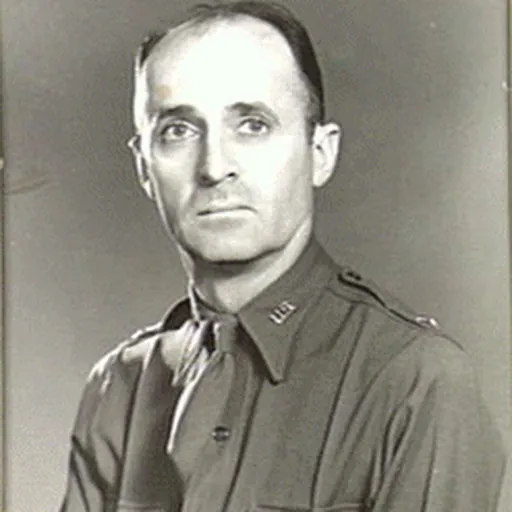
About Dwight Johns
Lived 1894 – 1977 (aged 83). Dwight Johns was an American engineer.
Brigadier General Dwight Frederick Johns (16 May 1894 – 8 November 1977) was an American soldier and general in the first half of the 20th century. He is best known for his service in the South West Pacific Area during World War II, where he headed the Advance Base and the Combined Operations Service Command during the Kokoda Track campaign and the Battle of Buna-Gona. He later commanded the Advance Base at Lae and Finschhafen, and the Engineer School at Fort Belvoir. After the war he headed the Pacific Engineer Division, where he was responsible for a number of important flood control and irrigation projects.
Education and early life
Dwight Frederick Johns was born in Rockford, Illinois on 16 May 1894. He entered the United States Military Academy at West Point, New York as an appointee from Illinois in 1912 and graduated sixth of 125 in the class of 1916. He was commissioned as a second lieutenant in the United States Army Corps of Engineers in June 1916. Returning to the United States Military Academy in August 1918, he became an instructor in drawing from August to December 1918, and in Tactics from November to December 1918. From December 1918 to mid-1919 he was an instructor in mathematics.
Between the wars Like most officers in the aftermath of World War I, Johns was reduced in rank to his substantive rank of captain in August 1919, From 1931 to 1933 he was a student at the Command and General Staff College at Fort Leavenworth. After graduating, he became District Engineer at St Paul, Minnesota. On 1 July 1937, he was promoted to lieutenant colonel. He attended the U.S. Army War College from 1937 to 1938, then became at instructor at the Command and General Staff College.
World War II In 1940 Johns became commanding officer of the 21st Engineers. The 21st Engineers were assigned the task of investigating techniques for the rapid construction of air bases. As such, Johns was involved in the development of a number of new construction techniques, most notably the use of Marston Mat.
Brigadier General Dwight F. Johns (left) decorates Private 1st Class Julius Franklin, who dived into a river and swam through burning petrol and exploding ammunition to rescue a fighter pilot whose plane had crashed into a river in New Guinea. alt=Tall man wearing garrison hat and a pistol in a holster pins a medal on short man wearing steel helmet. His expertise in airbase construction led to Johns being sent to the South West Pacific as Chief Engineer, American Forces in Java. Departing Washington, D.C. by air on 14 January 1942, Johns arrived in Surabaya nine days later. His first mission was to provide airfield facilities on Java for 2,000 aircraft. Tapping into the vast resources of labour available in one of the world's most densely populated regions, Johns set about readying the required airfields. However, Java was captured by the Japanese before the aircraft arrived.
Johns reached Australia on 28 February 1942 and became Chief Engineer, United States Army Forces in Australia (USAFIA), with the rank of brigadier general. With the arrival in Australia of General Douglas MacArthur, Brigadier General Hugh John Casey, who had accompanied MacArthur from the Philippines, became Chief Engineer at General Headquarters (GHQ), South West Pacific Area (SWPA). Johns, who was in an earlier class at West Point than Casey, remained Chief of Engineers, USAFIA until 25 May 1942, when he became Chief of Staff of US Army Services of Supply (USASOS).
When the Kokoda Track campaign became mired in logistical difficulties, MacArthur and General Sir Thomas Blamey agreed to establish a Combined Operations Service Command (COSC) under New Guinea Force to co-ordinate logistical activities in Papua-New Guinea. Johns was designated commander of both COSC and the Advance Base, New Guinea on 8 October 1942. He was given an Australian deputy, Brigadier Victor Secombe, a Royal Australian Engineers officer. All Australian and American logistical units were placed under COSC but Johns chose to exercise command of the Australian units through Secombe. They built an organization that "was a radical departure from that which the Australian Army considered normal administrative procedure, but was adequately to meet the novel demands of a campaign in a country lacking roads and railways, in which all transport had to be by sea or air, and in which often the administrative or base areas coincided with the operational areas." Johns later wrote that:
The Tatana Island Causeway, looking towards Tatana Island. Brigadier General Dwight F. Johns is third from the left. alt=Six men in floppy hats shovel dirt. Two men wearing steel helmets and carrying pistols in holsters watch. Johns impressed Australian officers with his sensitive handling of inter-Allied issues, his co-operative nature, and his ability to get the job done. Lieutenant General Edmund Herring, who came to regard Johns as a close friend, later described Johns and Secombe as "born co-operators." One of Johns' most important decisions involved the construction of a new deep-water berth for Liberty ships at Tatana Island. This involved building a causeway out to the island. The project would double the capacity of the port of Port Moresby, but to build it Johns had to divert the African-American 96th Engineers from work on the airfields around Port Moresby, raising fears from airmen like Brigadier General Ennis Whitehead that the airfields would not be ready for all-weather operations by the time that the rainy season arrived. Rains in late October did indeed close three airfields but the causeway opened on 30 October and the wharf accepted its first ship on 3 November.
Johns relinquished his roles in Papua and resumed his former post at USASOS in March 1943, being replaced by Brigadier General Hanford MacNider. In turn, he replaced MacNider as GHQ Coordinator, Milne Bay in October 1943. As such, he was responsible for all logistical activities at what was now the major US base in Papua-New Guinea. On 15 December 1943, he became Coordinator, Finschhafen. Finschhafen was destined to become the new hub of US activity in Papua-New Guinea; but an enormous amount of work was required to get the base ready for action. For his service in New Guinea, Johns was awarded the Distinguished Service Medal.
In 1944, Johns became commandant of the Engineer School at Fort Belvoir. For his work at Fort Belvoir, Johns was awarded the Legion of Merit. In retirement, Johns was awarded the Gold Medal from the Society of American Military Engineers in 1950, and served as its president in 1953. Johns maintained the wartime friendships he had made, and with his wife Laura he entertained Australian general Sir Edmund Herring in their home in Piedmont, California in 1967. Johns died on 8 November 1977.
Don’t just read it —
keep it.
Full-length biographies made to live with: read them, listen on the way to work, watch them tonight.
- E-book
- Audio
- Video
Instant download · yours to keep · every purchase keeps this site free
Important facts
People in Dwight Johns's life
Named in this biography and alive at the same time





Related people
Same field, nearest in time

Contemporaries
People whose lives overlapped Dwight Johns's


Frequently asked questions
Who was Dwight Johns?
United States Army general (1894-1977)
When was Dwight Johns born?
Dwight Johns was born on 16 May 1894 in Rockford.
When did Dwight Johns die?
Dwight Johns died on 8 November 1977.
What was Dwight Johns's occupation?
Dwight Johns was an engineer.
What nationality was Dwight Johns?
Dwight Johns was American.
Sources & further reading
Cite this page
APA: Biography.guide. (2026). Dwight Johns. https://biography.guide/dwight-johns/
MLA: "Dwight Johns." Biography.guide, https://biography.guide/dwight-johns/.
Chicago: "Dwight Johns." Biography.guide. https://biography.guide/dwight-johns/.
Data last updated: 2026-09-22 · Spot an error? Report a correction.
Portrait: Wikimedia Commons · author & licence
Page generated 2026-09-27 05:03 UTC