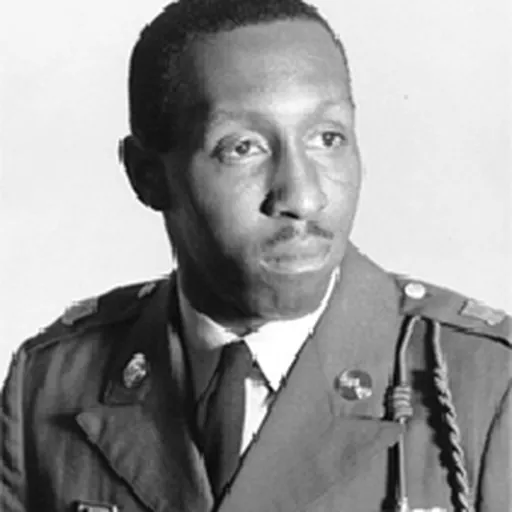
About Dwight H. Johnson
Lived 1947 – 1971 (aged 23). Dwight H. Johnson was an American military personnel.
Dwight Hal Johnson (May 7, 1947 – April 30, 1971) was a United States Army soldier who received the Medal of Honor for his actions on January 15, 1968, near Dak To during the Vietnam War. A tank driver with the 4th Infantry Division, Johnson distinguished himself during a fierce engagement by repeatedly exposing himself to enemy fire to rescue wounded crew members and engage opposing forces at close range.
After returning to the United States, Johnson struggled to adjust to civilian life, experiencing severe psychological distress related to his combat experiences. Despite national recognition following the Medal of Honor ceremony in 1968, he faced financial instability, difficulty maintaining employment, and ongoing mental health challenges consistent with what is now recognized as post-traumatic stress disorder.
Johnson was fatally shot in Detroit on April 30, 1971, following an attempted robbery of a convenience store. His life has been cited as an example of the difficulties faced by many Vietnam War veterans in reintegrating into civilian society, particularly in relation to psychological trauma and social conditions in urban America.
Early life Johnson was born on May 7, 1947, in Detroit, Michigan, and grew up in the E. J. Jeffries Homes, a public housing complex. He was raised by his mother, who supported Johnson and his younger brother largely on her own, and he never knew his father.
Growing up in a high-poverty environment, Johnson experienced instability during his youth and had early encounters with the criminal justice system prior to his military service.
During late 1967 and early 1968, U.S. forces in the Central Highlands were engaged in heavy fighting around Dak To in Kontum Province, part of a broader series of engagements with North Vietnamese Army units along the border with Laos and Cambodia. The fighting was characterized by frequent ambushes, and high casualties on both sides.
On January 15, 1968, near Dak To, his unit was ambushed by a large North Vietnamese force. During the battle, Johnson left his disabled tank and engaged enemy soldiers at close range, rescued wounded crew members, and continued fighting under intense fire.
Medal of Honor citation Johnson receives the Medal of Honor from President Lyndon B. Johnson on November 19, 1968 For conspicuous gallantry and intrepidity at the risk of his life above and beyond the call of duty. Specialist 5 Johnson, a tank driver with Company B, was a member of a reaction force moving to aid other elements of his platoon, which was in heavy contact with a battalion size North Vietnamese force. Specialist Johnson's tank, upon reaching the point of contact, threw a track and became immobilized. Realizing that he could do no more as a driver, he climbed out of the vehicle, armed only with a .45 caliber pistol. Despite intense hostile fire, Specialist Johnson killed several enemy soldiers before he had expended his ammunition. Returning to his tank through a heavy volume of antitank rocket, small arms and automatic weapons fire, he obtained a sub-machine gun with which to continue his fight against the advancing enemy. Armed with this weapon, Specialist Johnson again braved deadly enemy fire to return to the center of the ambush site where he courageously eliminated more of the determined foe. Engaged in extremely close combat when the last of his ammunition was expended, he killed an enemy soldier with the stock end of his submachine gun. Now weaponless, Specialist Johnson ignored the enemy fire around him, climbed into his platoon sergeant's tank, extricated a wounded crewmember and carried him to an armored personnel carrier. He then returned to the same tank and assisted in firing the main gun until it jammed. In a magnificent display of courage, Specialist Johnson exited the tank and again armed only with a .45 caliber pistol, he engaged several North Vietnamese troops in close proximity to the vehicle. Fighting his way through devastating fire and remounting his own immobilized tank, he remained fully exposed to the enemy as he bravely and skillfully engaged them with the tank's externally-mounted .50 caliber machine gun; where he remained until the situation was brought under control. Specialist Johnson's profound concern for his fellow soldiers, at the risk of his life above and beyond the call of duty are in keeping with the highest traditions of the military service and reflect great credit upon himself and the United States Army.
Post-war adjustment After returning from Vietnam, Johnson struggled to reintegrate into civilian life. Prior to receiving the Medal of Honor, he had difficulty finding stable employment and accumulated significant debt.
He was diagnosed with severe depression associated with post-Vietnam adjustment problems, now recognized as post-traumatic stress disorder (PTSD).
Despite national recognition as a Medal of Honor recipient, Johnson continued to face financial instability and personal difficulties. His experiences reflected broader challenges faced by many Vietnam veterans adjusting to civilian life. The store owner was in the back office, responding to Johnson's demand for the money, when shots were fired. The owner was hit in the left bicep and returned fire with a .38 Special revolver. Seven shots were fired. Johnson sustained four bullet wounds, three to the chest and one to the face, and died on the operating table at 4 a.m. on April 30. He was buried at Arlington National Cemetery on May 6, 1971, in Section 31 Lot 471. Johnson's mother said: "Sometimes I wonder if Skip was tired of this life and needed someone else to pull the trigger".
Media Two plays have been written about Johnson's tragic life, the second of which was also produced and shown on PBS:
One song has been written about Johnson's tragic life (with some "poetic license"): Bummer by Harry Chapin, on Portrait Gallery, Elektra Entertainment, 1975.
Don’t just read it —
keep it.
Full-length biographies made to live with: read them, listen on the way to work, watch them tonight.
- E-book
- Audio
- Video
Instant download · yours to keep · every purchase keeps this site free
Important facts
People in Dwight H. Johnson's life
Named in this biography and alive at the same time

Related people
Same field, nearest in time




Contemporaries
People whose lives overlapped Dwight H. Johnson's


Frequently asked questions
Who was Dwight H. Johnson?
United States Army Medal of Honor recipient (1947–1971)
When was Dwight H. Johnson born?
Dwight H. Johnson was born on 7 May 1947 in Detroit.
When did Dwight H. Johnson die?
Dwight H. Johnson died on 30 April 1971 in Detroit.
What was Dwight H. Johnson's occupation?
Dwight H. Johnson was a military personnel.
What nationality was Dwight H. Johnson?
Dwight H. Johnson was American.
Sources & further reading
· Wikipedia: Dwight H. Johnson
Cite this page
APA: Biography.guide. (2026). Dwight H. Johnson. https://biography.guide/dwight-h-johnson/
MLA: "Dwight H. Johnson." Biography.guide, https://biography.guide/dwight-h-johnson/.
Chicago: "Dwight H. Johnson." Biography.guide. https://biography.guide/dwight-h-johnson/.
Data last updated: 2026-09-21 · Spot an error? Report a correction.
Portrait: Wikimedia Commons · author & licence
Page generated 2026-09-27 05:00 UTC